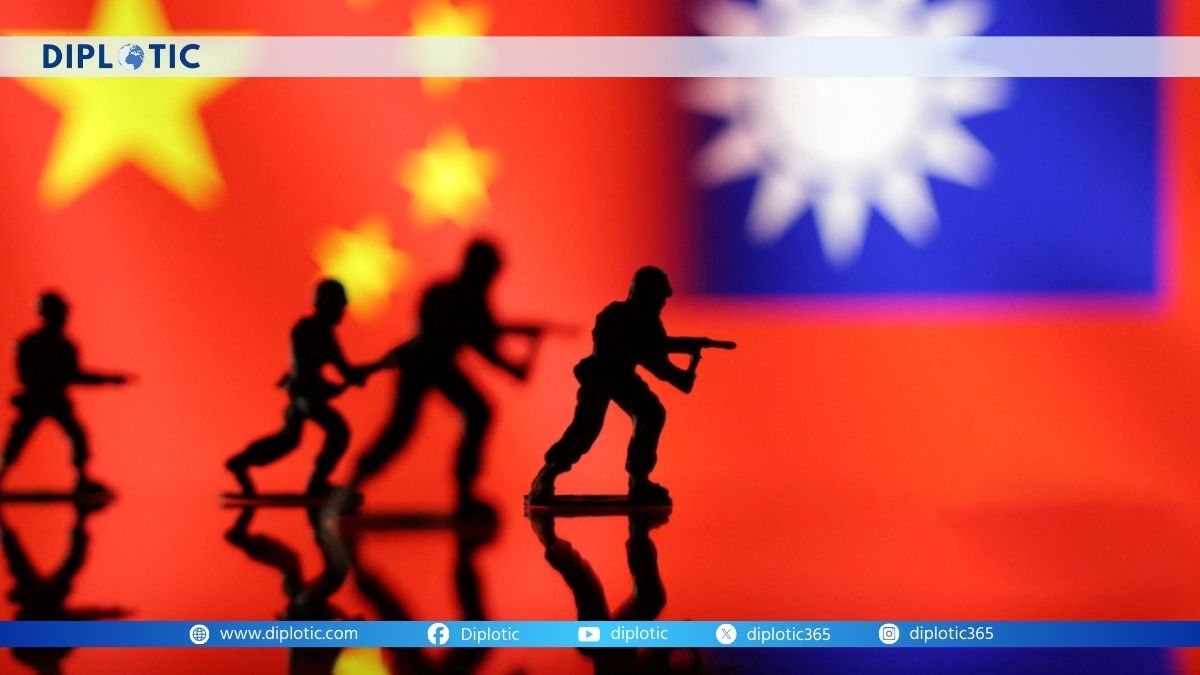
In late December 2025, China carried out a large military operation around Taiwan that immediately raised concern across the region. Officially, Beijing described it as another military drill. But many details did not fit that label. Chinese warships and aircraft moved closer to Taiwan than ever before. For the first time, live-fire activities reportedly took place inside Taiwan’s twelve-nautical-mile territorial waters. Civilian flights were rerouted, shipping routes were adjusted, and insurance risks were raised. These were not symbolic gestures. They caused real disruption to daily life and commerce.
This operation, called “Justice Mission 2025,” did not happen in isolation. It followed years of rising pressure on Taiwan and came amid growing tension between China, the United States, and Japan. What made this moment different was not only how close the Chinese military came, but how unclear its intentions were. The line between exercise and attack appeared deliberately blurred. That ambiguity may now be Beijing’s most effective tool in the Taiwan Strait.
What Made This Operation Different From Earlier Chinese Drills?
China has conducted many military exercises around Taiwan since 2022. Most followed a familiar pattern. Beijing announced them in advance. Specific air and sea zones were marked. Notices were issued to ships and airlines days ahead of time. Even when the drills were large, they were structured to signal strength without creating confusion about whether war was imminent.
“Justice Mission 2025” broke from that pattern. The operation began with little warning. Its timing, scale, and proximity surprised observers. Chinese naval and air forces reportedly moved within five nautical miles of Taiwan’s main island. Live-fire drills were included. This crossed thresholds that earlier exercises had avoided.
The impact was immediate. Taiwan’s aviation authorities issued emergency advisories, forcing civilian planes to reroute. Shipping companies adjusted schedules to avoid the area. Insurance firms flagged higher risks for vessels operating nearby. These are steps usually taken during real security crises, not routine drills.
Beijing said the operation was a response to foreign actions. These included a large U.S. arms package approved for Taiwan and statements by Japanese leaders linking Taiwan’s security to Japan’s own defense. Chinese officials framed the drills as a warning against “Taiwan independence forces” and “foreign interference.”
Yet the scale and intensity of the operation suggest something more deliberate. The Chinese military appeared less interested in sending a short political message and more focused on testing how far it could go without triggering a firm response. By moving suddenly, operating very close to Taiwan, and using live fire, Beijing created uncertainty for Taipei, Washington, and Tokyo. No one could be fully sure whether this was the peak of the action or only the beginning.
How Strategic Ambiguity Becomes a Military Tool
For decades, strategic ambiguity has been central to the Taiwan issue. The United States has avoided clearly stating whether it would defend Taiwan militarily. This policy aimed to deter China from attacking while also discouraging Taiwan from declaring formal independence. It relied on uncertainty to keep peace.
China now appears to be using ambiguity in a different way. Beijing’s actions suggest a strategy designed to make uncertainty itself a form of pressure. By operating at the edge of war without crossing into open conflict, China forces others to guess its intentions. Each move raises the question: is this still a drill, or is it the start of something more serious?
This approach works on several levels. Militarily, it allows the Chinese armed forces to operate closer to Taiwan while gathering intelligence and improving readiness. Politically, it tests how Taiwan’s government responds when red lines are crossed in practice, if not clearly in words. Internationally, it puts pressure on the United States and its allies to decide when and how to react.
The danger lies in normalization. If Chinese forces repeatedly enter Taiwan’s surrounding waters and airspace under the label of exercises, such actions may begin to feel routine. What once would have triggered strong responses may later be met with statements and monitoring alone. Over time, the baseline shifts.
This strategy also draws lessons from recent global conflicts. Before invading Ukraine, Russia described its actions as a “special military operation,” not a war. The language reduced clarity and delayed international reactions. China’s use of similar phrasing signals awareness of how ambiguity can slow decision-making by opponents.
By blurring preparation and execution, Beijing keeps others off balance. Taiwan must remain on constant alert, unsure whether the next move will stop or escalate. That constant pressure is itself a form of coercion.
Why Psychological Pressure Matters as Much as Military Force
Military movements are only part of the picture. Alongside the drills, China has intensified psychological pressure on Taiwan. State media and official military channels released videos showing drones over Taipei landmarks, simulated strikes on advanced weapons systems, and animated sequences of coordinated attacks. These images were not defensive. They emphasized speed, reach, and control.
The message was clear. China wanted to show it could strike Taiwan quickly and without warning. Some videos even simulated attacks on U.S.-supplied systems, suggesting that foreign military support would not guarantee safety. This messaging was aimed not just at military planners, but at the public.
Psychological pressure seeks to weaken confidence. If citizens begin to believe resistance is futile, political resolve can erode without a single shot being fired. This approach echoes classic military thinking. Winning without fighting is considered the highest form of victory.
Yet Beijing also understands that fear alone may not be enough. Taiwan has a strong sense of identity and has faced pressure for decades. Strategic ambiguity supports psychological pressure by keeping the threat credible. If drills could turn into real attacks at any moment, uncertainty becomes exhausting.
This creates a difficult dilemma for Taiwan’s leaders. Strong reactions risk escalation. Weak responses risk normalizing intrusion. Every decision is watched closely by Beijing, which adjusts its next move accordingly.
The psychological element also affects regional actors. Japan must consider whether Chinese actions near Taiwan count as a direct threat to its own security. The United States must judge whether these moves are aggressive acts or still within the gray zone. Ambiguity slows consensus and complicates coordination.
Are Red Lines Losing Their Meaning in the Taiwan Strait?
Taiwan’s defense officials have long stated that entry by foreign military forces into its territorial waters or airspace gives it the right to act in self-defense under international law. “Justice Mission 2025” appears to have tested that principle directly. Chinese forces reportedly crossed into those spaces and conducted live-fire activities.
Yet no immediate military response followed. This raises hard questions. If such actions do not trigger consequences, do red lines still exist? Or are they being quietly redefined through repeated challenges?
Beijing’s calculations seem clear. Major powers want to avoid war with China. That reluctance creates room for gradual escalation. Today it is two days of drills and live fire. Tomorrow it could be longer, closer, and larger. Each step measures tolerance.
This pattern creates crisis fatigue. Governments must repeatedly mobilize attention and resources for each incident. Over time, urgency fades. Constant alerts can dull reactions, making it harder to recognize the moment when a true crisis begins.
For Washington, this directly tests its own policy of strategic ambiguity. That policy depends on credibility. If ambiguity is tested again and again without clear responses, it risks becoming paralysis. Deterrence weakens not because of one dramatic failure, but through slow erosion.
The risk is not an announced invasion. It is a gradual shift in reality, where Taiwan becomes more isolated and pressured, and where China’s presence near the island becomes an accepted fact. Such a change would alter the balance in the region without a formal declaration of war.
What Comes Next for the United States, Taiwan, and the Region?
Responding to Beijing’s new approach will require careful balance. Abandoning strategic ambiguity entirely could provoke escalation. Doing nothing could invite further pressure. The challenge lies in redefining thresholds and making clear which actions carry consequences.
This does not mean responding militarily to every provocation. It means restoring clarity where ambiguity has become dangerous. Allies need shared understandings of what constitutes unacceptable behavior. Communication channels must remain open, but signals must also be firm.
The events of late 2025 suggest that the Taiwan Strait has entered a new phase. Military drills are no longer just demonstrations. They are tools designed to shape perceptions, test limits, and slowly change facts on the ground.
History shows that major shifts often happen quietly before they become obvious. The past and present are now closely linked in the Taiwan issue. How regional powers respond to this new use of strategic ambiguity will help determine whether stability holds or slowly slips away.