
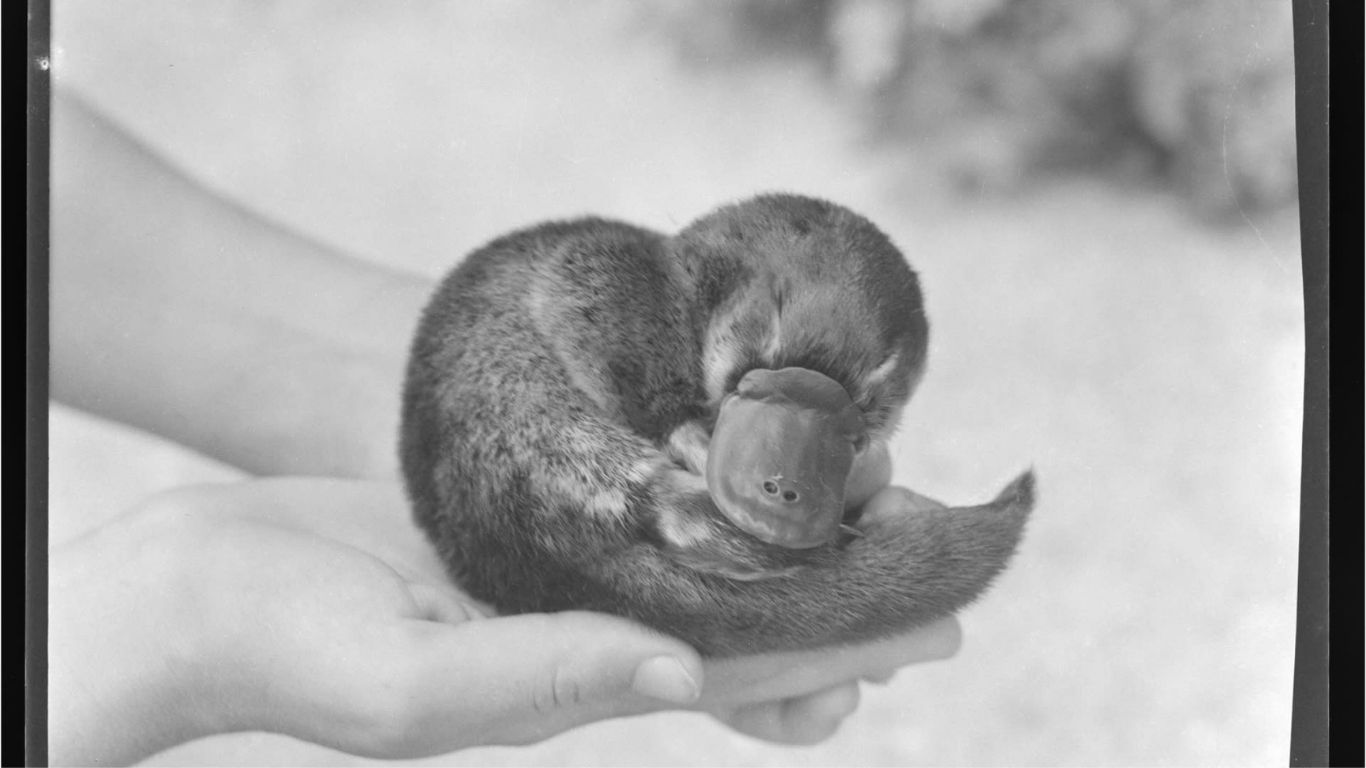
The astonishing true story behind Winston Churchill’s secret platypus gift from Australia during WWII. New research reveals how heat, not German submarines, led to the tragic demise of this diplomatic mission gone awry.
In the shadowy corridors of wartime diplomacy, few stories are as bizarre and captivating as that of Winston Churchill’s dead platypus. For decades, the tragic demise of this rare Australian monotreme was veiled in mystery, wrapped in wartime propaganda, and whispered through generations as a casualty of German U-boat attacks. But new research finally uncovers the truth: it wasn’t the bombs that killed him it was the heat.
A Platypus for Churchill’s Favor
In 1943, amidst the relentless grip of World War II, Australia found itself desperately seeking assurance from the “motherland”. With Japanese forces pressing ever closer, Australian leaders concocted an extraordinary gift a live platypus to curry favor with British Prime Minister Winston Churchill, a well-known collector of exotic animals.
Despite Australia’s stringent ban on exporting the elusive monotreme, Churchill’s expressed desire for not one, but six platypuses set an ambitious plan in motion. Conservationist David Fleay, renowned for his platypus expertise, managed to negotiate down the number to one, setting the stage for a high-stakes journey that would captivate historians for decades.
A Floating Platypusary Amidst Wartime Peril
An elaborate habitat dubbed the “platypusary” was constructed aboard a camouflaged vessel tasked with the 45-day voyage from Melbourne to London. Outfitted with fresh creek water, hay-lined burrows, and a diet of 50,000 worms topped with duck egg custard, young “Winston” the platypus embarked on a treacherous crossing through U-boat-infested waters.
Yet, as the ship neared the Atlantic, tragedy struck. A grieving Churchill informed Australian Foreign Minister H.V. ‘Doc’ Evatt that the prized platypus had died, citing supposed German submarine attacks as the culprit. For years, the official narrative remained young Winston had perished from shellshock amid enemy bombardments.
The Platypus Was “Cooked Alive”
But doubts lingered. In a groundbreaking investigation, Monash University PhD student Harrison Croft, along with archival teams at the Australian Museum, meticulously pieced together a new account that challenges this long-held myth.
Diving into crew logs, personal interviews, and David Fleay’s own collection, Croft found no evidence of explosions impacting the ship during Winston’s voyage. Instead, temperature logs revealed a more insidious enemy: heat.
Recorded water and air temperatures, even during the cooler hours of 8 am and 6 pm, soared well beyond 27°C (80.6°F) as the ship crossed the equator a threshold now known to be fatal for platypus health. Despite the ship’s best efforts to maintain conditions, Winston was subjected to prolonged exposure to temperatures that were essentially cooking him alive in his confined habitat.
The Real Causes of Winston’s Death
Further analysis of the attendant’s logbook painted a grim picture of dwindling worm supplies, as his rations were reduced due to spoilage. Combined with the unrelenting tropical heat, these conditions proved catastrophic for Winston, a creature evolutionarily designed for the cool, shaded streams of southeastern Australia.
“It’s much easier to shift blame onto the Germans than to admit logistical failures in animal care,” says Ewan Cowan, a historian involved in the research. The discovery reframes Winston’s death not as an act of wartime aggression, but as a tragic oversight in biological understanding and environmental control.
Platypus Diplomacy Dies with Winston and Penelope’s Scandal
Despite the failed mission, Australia’s flirtation with “platypus diplomacy” wasn’t over. In 1947, fresh off a monumental success breeding platypuses in captivity, David Fleay orchestrated another diplomatic gift: three platypuses for the Bronx Zoo in New York.
This time, the fanfare was immense. Betty, Penelope, and Cecil arrived at a media frenzy. However, the endeavor soon spiraled into a scandal. Betty died shortly after arrival, and Penelope’s highly publicized “pregnancy” turned out to be a ruse, a ploy, tabloids claimed, to secure more worms and avoid Cecil’s advances. The saga of Penelope’s “fake pregnancy” and her subsequent disappearance from the zoo captured headlines worldwide, while Cecil’s death was dramatically attributed to a “broken heart.”
By 1958, with several failed attempts and more platypus fatalities, Australia tightened its export laws. Platypus diplomacy, once an audacious tool of soft power, was quietly abandoned.
Winston’s Legacy: A Cautionary Tale of Wildlife Diplomacy
Today, Winston’s ill-fated journey serves as a stark reminder of the complexities of wildlife transport and the perils of using animals as diplomatic pawns. His stuffed body, rumored to have been displayed in Churchill’s office, became a silent testament to an era when ambition outpaced scientific understanding.
While the myth of Nazi-induced shell-shock made for a convenient cover story, it was human error, environmental ignorance, and the unforgiving heat of the tropics that truly sealed Winston’s fate.
Eighty years later, the mystery is solved not with wartime heroics, but with careful science, meticulous research, and a dedication to unveiling the quiet tragedies history often buries.