

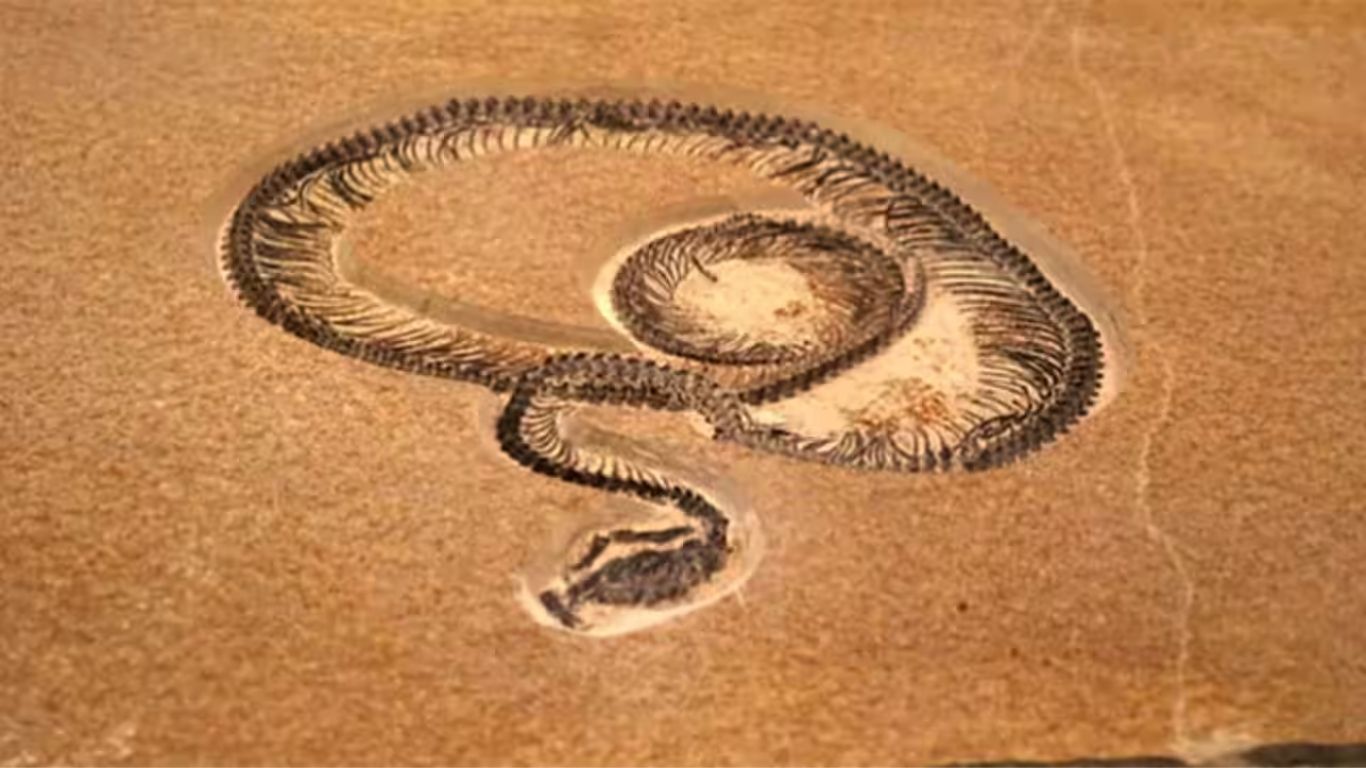
Discover the jaw-dropping fossil discovery of Vasuki indicus, a colossal 50-foot-long snake unearthed in western India. Learn how this ancient predator reshapes our understanding of snake evolution and prehistoric biodiversity.
In a groundbreaking discovery that stuns both paleontologists and reptile enthusiasts, scientists in India have uncovered fossil remains of a gargantuan snake species Vasuk indicus that once slithered across the lush forests of the Middle Eocene, around 47 million years ago. Estimated to measure an astonishing 50 feet (15 meters) in length and weigh over 2,200 pounds (1,000 kg), this extinct serpent rivals the legendary Titanoboa as one of the largest snakes to have ever lived.
The remarkable fossil was found in the Panandhro Lignite Mine, nestled in Gujarat’s Kutch region, revealing crucial insights into prehistoric life and Earth’s evolutionary history.
A Myth-Inspired Name with Colossal Roots
The name Vasuki indicus pays homage to Vāsuki, the revered serpent from Hindu mythology that coils around the neck of Lord Shiva. This cultural symbolism enriches the scientific narrative by connecting India’s paleontological legacy with its mythological traditions.
Anatomical Marvel: Thick-Bodied and Built for Ambush
The fossilized vertebrae 27 in total are among the most complete ever discovered for snakes in the Madtsoiidae family. Vasuki indicus had a wide, cylindrical body and robust vertebral structure, suggesting it was a slow but formidable ambush predator.
Rather than pursuing prey, it likely relied on stealth, patience, and powerful constriction much like today’s pythons and anacondas. Its immense size would have made it nearly immobile for long chases but devastatingly effective in sudden attacks.
Fossil Find Reveals Rich Prehistoric Ecosystem
The shale beds that cradled Vasuki‘s remains date back to the Middle Eocene epoch, a time of warm global temperatures and tropical ecosystems. These conditions enabled the evolution of massive reptiles and high biodiversity.
Researchers believe Vasuki lived in a dense, tropical forest teeming with prey. This find supports the theory that warm climates can contribute to gigantism in reptiles, especially snakes.
A Major Leap for Snake Evolution Research
Led by Professor Sunil Bajpai and postdoctoral researcher Debajit Datta from the Indian Institute of Technology Roorkee, the study emphasizes the importance of India’s fossil-rich terrains in understanding snake evolution. The vertebrae belong to the extinct Madtsoiidae family, a group of land-dwelling snakes that roamed ancient supercontinent Gondwana.
This discovery not only adds to the diversity of the Madtsoiidae lineage but also enhances knowledge about intercontinental dispersal patterns during prehistoric times.
Madtsoiidae: The Forgotten Giants of the Snake Family Tree
Madtsoiid snakes, including Vasuki indicus, are known for their large size and primitive features. Once widespread across South America, Africa, India, Australia, and even Antarctica, they thrived in warm, tropical regions. Their fossils date from the Late Cretaceous to the Late Pleistocene, but their exact place in snake evolution remains debated.
While some studies suggest they fall within the modern Serpentes group, others position them just outside, complicating the evolutionary puzzle. However, discoveries like Vasuki offer vital data that may clarify these questions in the future.
Giant Serpents of Today vs. Prehistoric Titans
To understand Vasuki’s enormity, consider today’s largest snakes:
- Reticulated Python: Up to 30 feet (9 meters)
- Green Anaconda: Up to 29 feet (8.8 meters), heaviest modern snake
- Burmese Python: Up to 23 feet (7 meters), invasive in the U.S.
- King Cobra: The world’s longest venomous snake, up to 18 feet (5.5 meters)
Even these modern giants pale in comparison to Vasuki indicus, which was significantly longer and likely more powerful.
India’s Paleontological Treasure Trove
The Kutch fossil site once again confirms India’s critical role in decoding Earth’s evolutionary story. Fossils like Vasuki indicus challenge assumptions that giant snakes only existed in South America or Africa. This find shows that ancient India supported massive, complex ecosystems and diverse reptilian life.
As more excavations unfold, the region could become a global hotspot for Mesozoic and Cenozoic-era discoveries.
Final Thoughts: A Serpent of Legend, Preserved in Stone
Vasuki indicus is more than a fossil; it’s a living legacy of Earth’s vibrant past. Its colossal size, cultural symbolism, and scientific significance make it a true icon of prehistoric discovery. This giant snake not only expands our understanding of ancient reptiles but also underscores the untapped paleontological potential of the Indian subcontinent.
With every unearthed fossil, scientists move closer to unraveling the evolutionary mysteries of our planet. And Vasuki indicus stands tall or rather, long as one of the most extraordinary pieces of that puzzle.




