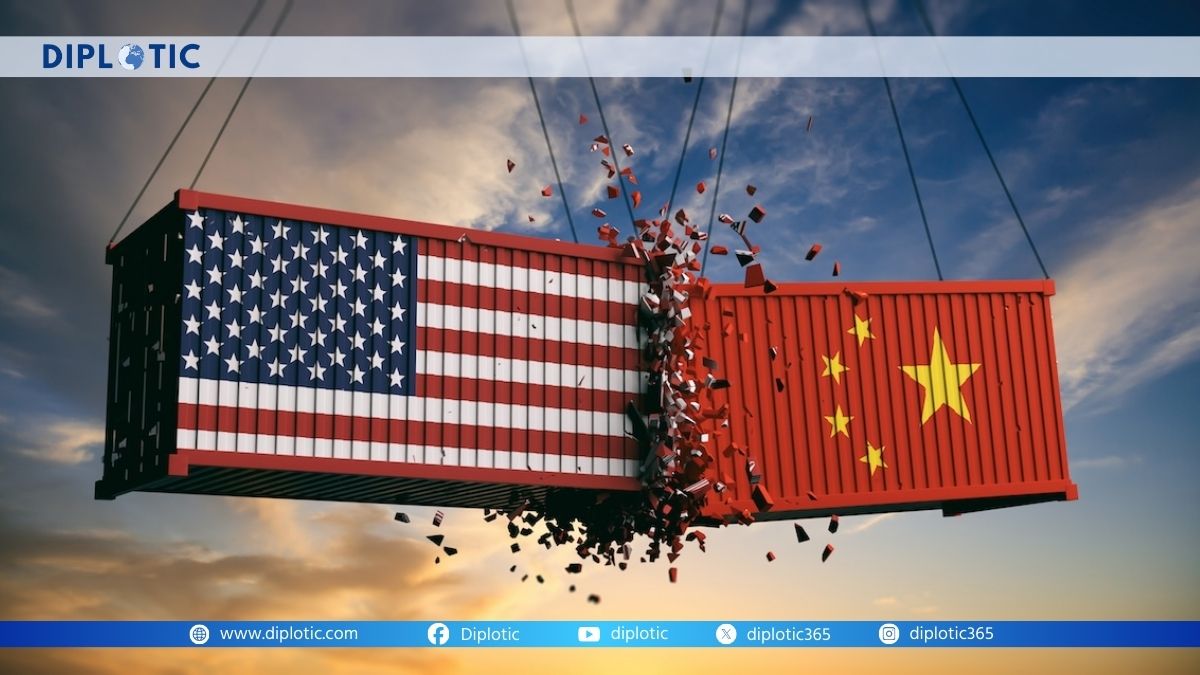
The trade relationship between the United States and China is often described in sharp, simple terms: rivalry, conflict, and separation. Headlines speak of tariffs, technology bans, and economic divorce. Yet beneath this loud political language lies a far more complex reality. In 2025, despite years of trade war rhetoric and policy actions, the two largest economies in the world remain deeply tied to each other. Goods, capital, technology, and risks continue to move between them in ways that no tariff wall has fully stopped. This raises a central question that policymakers, businesses, and ordinary citizens are still struggling to answer: is real economic decoupling between the United States and China even possible?
To understand this question, it is not enough to focus on one year or one administration. The current tensions are the product of decades of integration, policy choices, and unmet expectations. What is unfolding now is not a sudden break, but a slow and uneven attempt to reshape a relationship that has become too large, too profitable, and too costly to undo easily. The story of U.S.–China trade in 2025 is therefore not just about conflict. It is about limits, trade-offs, and the hard reality of interdependence in a divided world.
How Deep Is the Economic Bond Between Washington and Beijing?
The scale of economic ties between the United States and China explains why decoupling remains more theory than practice. Together, the two economies account for more than forty percent of global output and nearly half of global manufacturing. No other bilateral economic relationship comes close in size or impact. For the United States, China remains one of its largest export markets, buying hundreds of billions of dollars in American goods and services each year. For China, the U.S. market remains critical for high-value exports, advanced components, and financial stability.
This relationship expanded rapidly after China joined the World Trade Organization in 2001. American consumers benefited from lower prices on everyday goods, from electronics to clothing. U.S. corporations gained access to a vast labor force and a growing consumer market. At the same time, China used export-led growth to lift hundreds of millions of people out of poverty and to build industrial strength at a historic pace. For many years, both sides accepted the trade-offs, believing the benefits outweighed the costs.
But those costs accumulated. In the United States, manufacturing job losses hit certain regions hard, especially in the Midwest and parts of the South. Research showed that communities exposed to Chinese import competition experienced long-term job losses, wage pressure, and social strain. These economic shocks fed political anger and helped shape a more confrontational view of China across party lines. In China, frustration grew over continued U.S. pressure, export controls, and what Beijing saw as attempts to block its rise.
Despite these tensions, trade flows have not collapsed. Even after tariffs were imposed starting in 2018, U.S. companies continued to rely on Chinese supply chains. In many cases, production shifted on paper rather than in reality, with Chinese firms routing exports through third countries such as Vietnam or Mexico. This meant that while the trade deficit with China narrowed, overall dependence on Chinese-made inputs remained. The bond weakened in some areas, but it did not break.
Is the Trade War Redefining Power or Repeating Old Mistakes?
The trade war that began during President Donald Trump’s first term marked a turning point in U.S.–China relations. Tariffs were presented as a tool to force change: reduce the trade deficit, bring manufacturing back to the United States, and pressure China to reform practices such as subsidies, forced technology transfer, and intellectual property theft. By 2025, it is clear that these goals were only partly achieved, if at all.
Tariffs raised costs for American firms and consumers, with studies showing that U.S. companies absorbed much of the burden. While some supply chains shifted, overall manufacturing employment did not return at the scale promised. China, for its part, adjusted by finding new markets, increasing state support for key industries, and accelerating domestic innovation. The result was pain on both sides, but no decisive victory.
What changed more deeply was the political mindset. Trade policy became openly tied to national security. Advanced technologies such as semiconductors, artificial intelligence, and data infrastructure moved to the center of the conflict. Export controls, investment restrictions, and blacklists expanded under both the Trump and Biden administrations. By Trump’s second term, these tools were no longer temporary measures but core elements of U.S. strategy.
China responded with its own controls, most notably on rare earth minerals that are essential for electric vehicles, renewable energy, and military systems. Because China dominates global processing of these materials, its actions sent shockwaves through global supply chains. Temporary truces, such as the October 2025 agreement to pause some tariffs and export restrictions, showed that both sides recognized the risks of escalation. Yet these truces did not resolve the underlying struggle over power, technology, and rules.
The trade war, then, has not ended globalization. Instead, it has reshaped it into a more fragmented and cautious system. Countries and companies now plan for political risk alongside cost and efficiency. This shift marks a real change from the optimism of the early 2000s, but it still falls short of true separation.
Can Technology and Security Concerns Be Separated From Trade?
One of the hardest questions in the U.S.–China relationship is whether economic exchange can be separated from security fears. For Washington, the answer has increasingly been no. Policymakers argue that access to advanced U.S. technology helps strengthen China’s military and surveillance systems. This belief has driven strict limits on chip exports, restrictions on U.S. investment, and pressure on allies to follow similar rules.
China sees these moves as an attempt to contain its development rather than protect security. In response, Beijing has invested heavily in self-reliance, pouring resources into domestic chipmaking, artificial intelligence, and strategic industries. The launch of advanced Chinese AI models in 2025 showed that these efforts are producing results, even if gaps remain. This technological race adds a new layer of tension to trade, making compromise harder.
At the same time, the two economies remain linked through finance and consumption. China continues to hold a large amount of U.S. government debt, making it a key creditor. American firms still earn significant revenue from sales in China, revenue that supports jobs and investment back home. Cutting these ties would impose serious costs on both sides and could destabilize global markets.
The TikTok case illustrates this tension clearly. U.S. concerns about data security led to a forced sale framework rather than a full ban, reflecting the difficulty of balancing security goals with economic and legal realities. Similar patterns appear across the trade relationship: strong political pressure for separation, followed by partial and negotiated outcomes that stop short of a clean break.
What Does the Future Hold for a World That Cannot Fully Split?
Looking ahead, the most likely path is not decoupling but selective distancing. The United States and China will continue to reduce exposure in sensitive sectors while remaining deeply connected in others. This approach reflects limits on power as much as strategy. Neither side can fully replace the other without severe economic damage, and both know it.
For the global economy, this means higher costs, more uncertainty, and slower growth. Supply chains will be less efficient but more diversified. Smaller countries will face pressure to choose sides or navigate carefully between them. International institutions such as the World Trade Organization will struggle to enforce rules that major powers increasingly bypass.
The deeper risk lies in miscalculation. Trade tools used for political goals can spiral into broader conflict if red lines are crossed. Temporary truces, like those seen in late 2025, show that dialogue is still possible, but trust remains thin. Managing this relationship will require constant adjustment rather than grand solutions.
The U.S.–China trade relationship in 2025 is therefore best understood not as a story of separation, but of uneasy coexistence. Decoupling remains a powerful political slogan, but economic reality keeps pulling both sides back from the edge. The real challenge ahead is not how to break ties completely, but how to live with rivalry without letting it tear the global system apart.