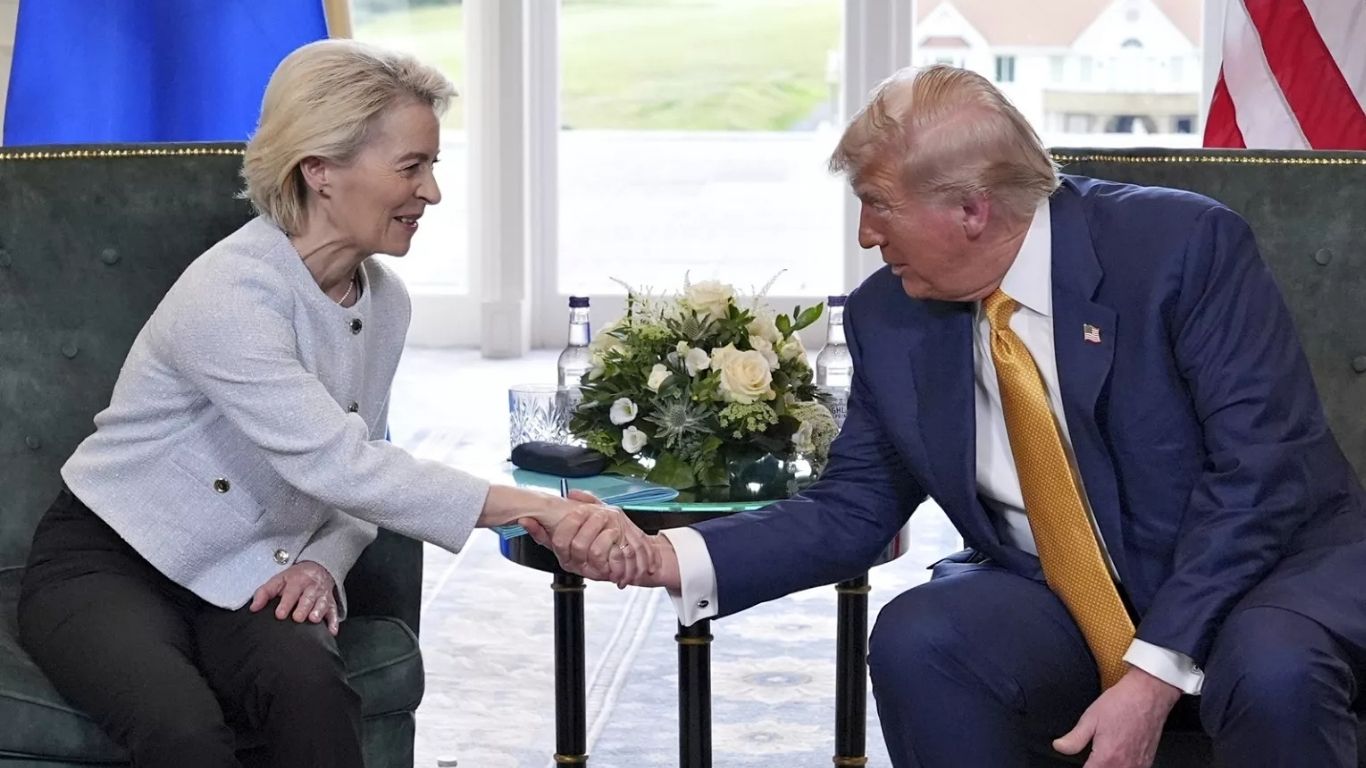
President Trump and EU chief Ursula von der Leyen announce a historic $1.35 trillion US-EU trade framework, including zero tariffs and massive energy, military, and pharmaceutical commitments. Here’s what it means for global markets.
In a dramatic development with far-reaching global implications, President Donald Trump on Sunday declared the United States and the European Union had reached what he called the “biggest trade deal ever made.” The agreement, forged after months of tense back-and-forth and escalating tariff threats, was unveiled during a press conference at Trump’s Turnberry golf resort in Scotland, alongside European Commission President Ursula von der Leyen.
The historic $1.35 trillion framework promises to avert a trade war between the two economic giants a prospect that had alarmed economists, global investors, and political leaders alike.
Zero Tariffs, Massive Commitments Define the Agreement
The deal centers on a multi-pronged strategy that includes:
- A 15% flat tariff on most EU imports, including automobiles, pharmaceuticals, and semiconductors.
- A $750 billion EU energy purchase commitment from the U.S.
- A pledge to invest $600 billion into American infrastructure, technology, and energy sectors.
- A sweeping zero-tariff clause for U.S. access to EU markets.
- Major military equipment procurement agreements with American defense contractors.
“These are huge numbers. All of the countries will be opened up to trade with the United States at zero tariffs,” Trump declared. “It’s the largest and most powerful trade deal ever signed by our country.”
Trump’s Tariff Ultimatum Pushes EU to the Table
The agreement follows Trump’s months-long pressure campaign in Brussels, marked by tariff threats ranging from 20% to 50%. A July 9 deadline passed with no resolution, prompting Trump to issue a formal letter notifying the EU of a hike to 30% tariffs set for August 1.
Earlier this year, a temporary 20% reciprocal tariff was placed on EU goods, only to be paused in April. By May, Trump threatened a staggering 50% levy, citing stalled talks.
Von der Leyen, reflecting on the negotiation process, admitted, “I knew it at the beginning, and it was indeed very tough. But we came to a good conclusion for both sides.”
EU Leaders React: Mixed Signals from European Capitals
Reaction across Europe has been cautiously optimistic, though not without dissent.
German Chancellor Friedrich Merz praised the deal for “averting a trade conflict that would have severely impacted the export-oriented German economy.”
Italy’s Prime Minister Giorgia Meloni welcomed the agreement as “positive” but emphasized the need to scrutinize the finer details.
Irish Prime Minister Micheál Martin called it “good for businesses, consumers and investors,” though he acknowledged that the 15% tariff rate would still “challenge bilateral trade.”
French Prime Minister Francois Bayrou, however, expressed concern, calling it “a dark day” and suggesting Europe had made painful concessions.
The vfa, Germany’s leading pharmaceutical association, issued a stark warning about the implications of a 15% tariff on drug exports. “It will result in significant additional costs for manufacturers and jeopardize international patient care,” the group stated in a Monday release.
Pharmaceuticals and Semiconductors in the Crosshairs
Among the most controversial elements of the deal is the inclusion of pharmaceuticals the United States’ largest import category from the EU, valued at $155 billion annually.
Trump had previously floated a 200% tariff on drugs produced outside the U.S., signaling a hardline stance on domestic pharmaceutical manufacturing. Ireland, the top foreign supplier of drugs to the U.S., stands to be significantly impacted.
“Pharmaceuticals are very special,” Trump reiterated. “We can’t be in a position where we’re relying on other countries.”
In addition, Commerce Secretary Howard Lutnick confirmed that tariffs on semiconductors would be finalized in two weeks, further signaling the administration’s aggressive push to reclaim dominance in critical tech sectors.
Global Market Response: Relief and Rebound
Markets responded with enthusiasm to the breakthrough, signaling renewed investor confidence.
- The Stoxx Europe 600 index surged to a four-month high, up 0.68% Monday morning.
- Germany’s DAX index rose 0.47%, while France’s CAC 40 gained 0.82%.
With the looming August 1 deadline, Trump reaffirmed that steel and aluminum tariffs will remain at 50%, and warned other nations, including South Korea and Brazil, that time is running out to avoid similar levies.
“August 1, the tariffs are set. They’ll go into place,” Lutnick stressed on Fox News Sunday. “There will be no further grace periods.”
What’s Next: Eyes on China as Global Trade Realigns
As the US and EU pivot toward a new trade era, attention now turns to China, with a crucial August 12 deadline approaching. Trump indicated that negotiations with Beijing are “very close” to resolution, while Treasury Secretary Scott Bessent is set to resume talks in Stockholm this week.
The broader picture is clear: the Trump administration is aggressively rewriting global trade norms. Sunday’s announcement marks the seventh trade agreement since April and sets a precedent for tough yet high-reward diplomacy.
Final Thoughts
This landmark US-EU trade framework represents a seismic shift in transatlantic economic relations. While many specifics remain under wraps, the immediate impact is unmistakable: a global trade war has been narrowly averted, and the balance of power in international commerce is rapidly evolving.
With monumental energy deals, unprecedented investments, and a commitment to tariff-free cooperation, the “biggest deal ever” may indeed reshape the global economic order one tariff at a time.