
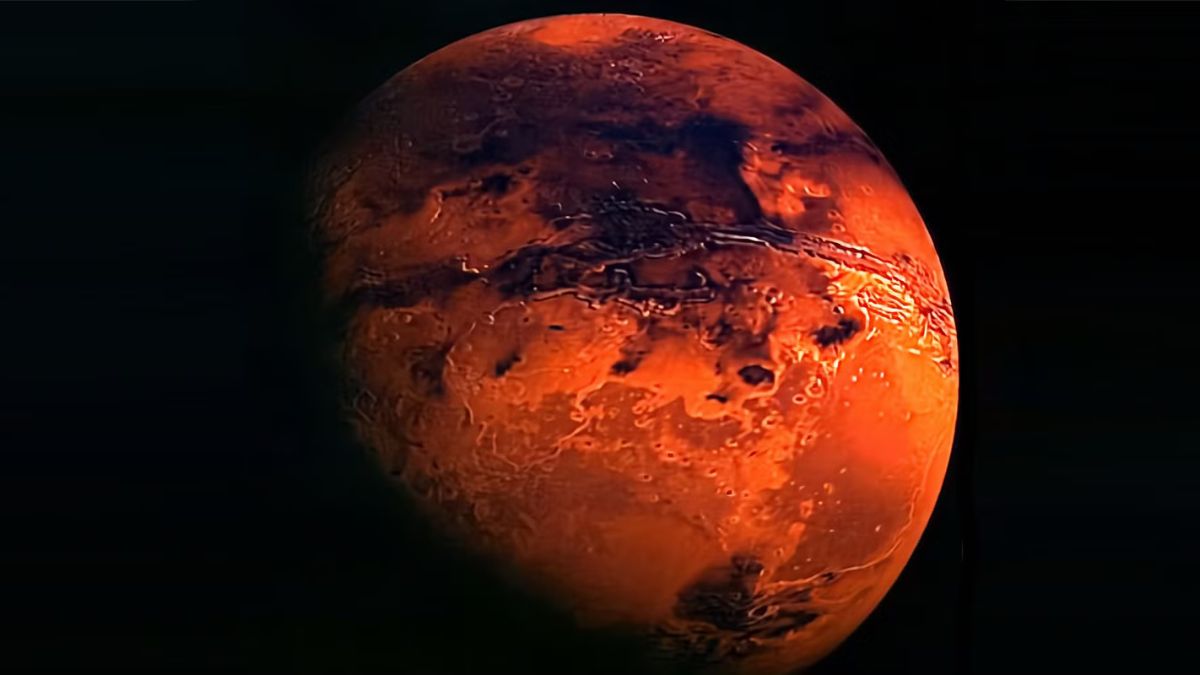
The red coloration of Mars has been attributed to iron reacting with water and atmospheric oxygen throughout the years according to scientific beliefs. Scientists have recently introduced a groundbreaking theory that Mars began to display its rusted appearance much earlier than previous research had indicated. The discovery alters planetary geologic history knowledge and produces fresh inquiries regarding the potential existence of life conditions on Mars.
The Role of Iron Oxides in Mars’ Appearance
The reddish color of Mars originates from iron oxide substances that produce rust-appearing compounds on Earth. The process of iron found in Martian rocks reacting with liquid water or atmospheric oxygen through billions of years resulted in the formation of fine dust according to scientific theories. Intense winds transported Martian dust throughout the planet, which strengthened the planet’s well-known red coloring. Scientists have not been able to locate the source of necessary oxygen during the oxidation process on Mars. According to certain scientists, Mars used to possess enormous bodies of water which contributed extensively to the oxidation process. NASA’s discovery of hematite in 2004 strengthened the theory about Martian surface oxidation through the presence of the mineral iron oxide. Remote observations have not successfully substantiated the connection between Mars’ reddish dust and liquid water on its surface.
A New Explanation: Ferrihydrite and an Earlier Watery Mars
A recent publication in Nature Communications contradicts established ideas regarding the Martian red hue formation process. Dr. Adomas Valantinas from Brown University together with his research team discovered that Martian dust matches ferrihydrite better than previously known dust component hematite. Ferrihydrite stands out as a specific type of iron oxide that contains water molecules. Valentina and his team established their scientific model through laboratory examinations where they converted iron oxides and volcanic rock (basalt) into ultra-fine powder. Laboratory researchers used identical equipment to space-based Martian spacecraft for analyzing the samples they prepared. The scientific experiments showed that a ferrihydrite mixture closely copied the authentic Martian dust samples observed across the Martian surface. Our knowledge about Mars’ historical evolution receives important new information due to this discovery. The formation requirement of ferrihydrite with water implies that Mars’s surface suffered oxidation before it became dry and thus widens the timeline for water presence on Mars. The transformation of Mars from a wet planet to its present dry state occurred during an earlier period of its history.
The Role of Space Missions in the Discovery
Scientists gathered information from international space missions that included the ExoMars Trace Gas Orbiter (TGO) of the European Space Agency (ESA) together with Mars Express. The mineral composition analysis of Martian dust came through the work of Mars Express. Minerals with high water content were detected even in deeply dust-covered terrain areas through the research, thus substantiating the theory of water-mediated oxidation processes. Scientific observations concerning the same planetary regions occurred with different lighting conditions by TGO because of its specific orbital configuration. Two essential laboratory necessities for constructing accurate Martian dust simulations were possible due to this technique, which assessed dust characteristics. The scientific research used information collected by NASA’s Mars Reconnaissance Orbiter (MRO) together with measurements from three Mars rovers labeled Curiosity, Pathfinder, and Opportunity and ESA’s planetary science missions. The different space missions delivered essential findings that verified the existence of ferrihydrite material on Mars.
What’s Next? Future Missions and Sample Analysis
The upcoming space missions will provide scientists with the opportunity to examine Martian dust samples on Earth. Earth-based analysis of Mars surface composition will be possible through the upcoming European Space Agency ‘Rosalind Franklin’ rover and NASA-ESA ‘Mars Sample Return’ mission. NASA’s Perseverance rover has already collected a portion of such samples while it explores the Jezero Crater region of Mars, which was previously home to a lake. The exact ferrihydrite quantity in dust particles will be measured in Earth-based laboratories after scientists receive these samples. Lab analysis of collected Mars samples will generate final evidence concerning how long Mars remained oxidized and whether water influenced its geological formation.
These investigations are fundamental for establishing that Mars was capable of supporting life because they unravel its geologic mysteries. Mars could have hosted microbial life during its early period, billions of years ago, because it once had extensive liquid water.
Conclusion: A Step Closer to Understanding Mars’ Past
Scientists have revealed in a recent study that Mars turned red earlier than researchers previously projected. Found ferrihydrite material in Martian dust serves to bolster the evidence for Mars being an ancient planet with abundant water since it suggests suitable conditions for life.
Through continuous research of present and future mission data scientists bring us closer to determining whether life ever existed on the Red Planet. Space exploration of Mars will reveal additional secrets about past life conditions on the planet as well as its capacity to support life.