
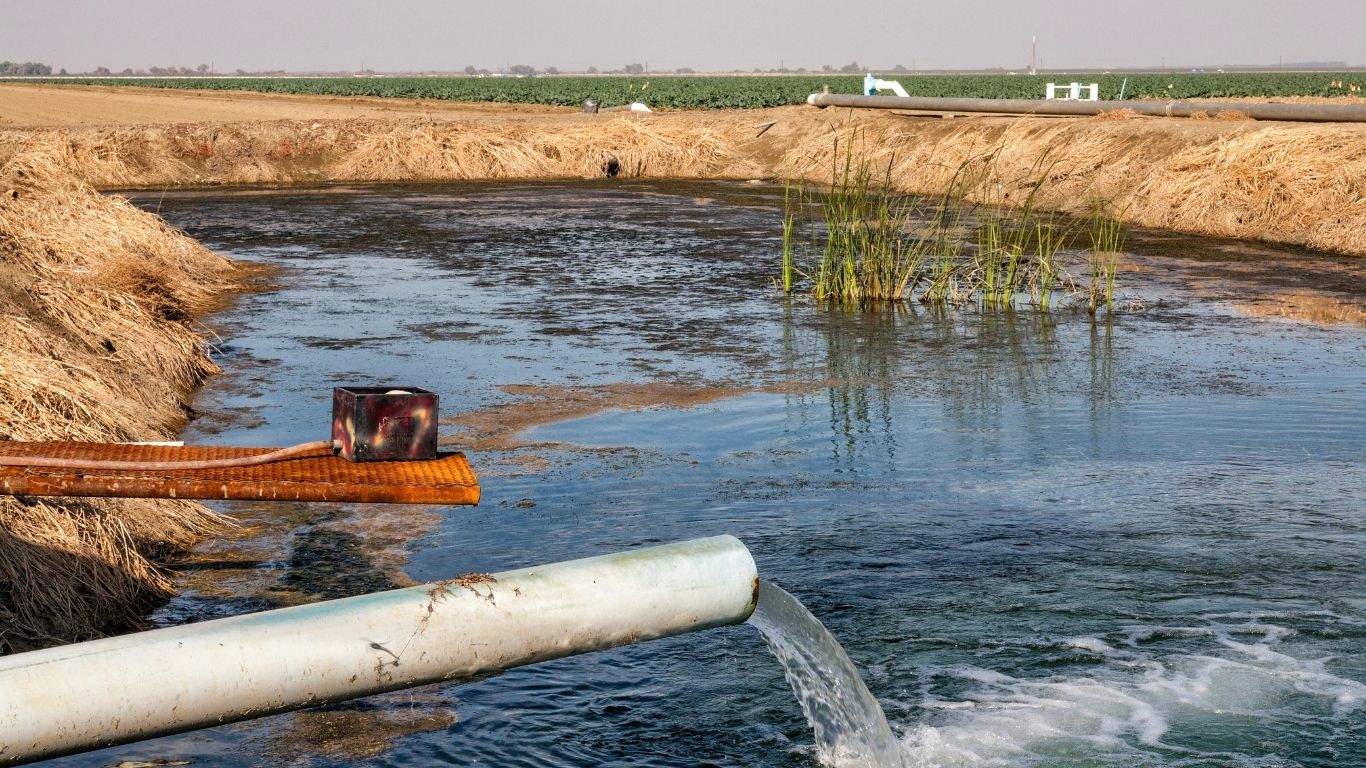
Human groundwater pumping has tilted Earth’s axis by 31.5 inches, causing unexpected planetary drift and sea level rise. Discover the science behind this dramatic shift and what it means for our future.
In a startling revelation that underscores the growing impact of human activity on our planet, a new study has confirmed that excessive groundwater pumping has caused Earth’s axis to tilt by 31.5 inches (80 centimeters) in just under two decades. This planetary drift once thought to be influenced mainly by natural factors is now being directly linked to water redistribution driven by agriculture and urban development.
Published in the Geophysical Research Letters journal, this research pinpoints groundwater depletion as the largest contributor to Earth’s polar motion among climate-related causes, surpassing even glacial melt and ice sheet loss.
What Exactly Happened?
Between 1993 and 2010, an estimated 2,150 gigatons of groundwater were pumped from underground aquifers for irrigation and human use. This vast quantity of water, no longer stored in the Earth’s crust, ended up in the oceans causing a .24-inch global sea level rise and a measurable shift in Earth’s rotational pole.
Lead researcher Ki-Weon Seo, a geophysicist at Seoul National University, stated:
“Our study shows that among climate-related causes, the redistribution of groundwater actually has the largest impact on the drift of the rotational pole.”
This phenomenon is akin to adding weight to a spinning top, slightly altering its balance. When mass is redistributed especially from solid ground to the oceans—it shifts the balance of the entire planet, affecting how it spins and tilts.
The Science Behind Earth’s Polar Drift
Earth doesn’t rotate on a perfectly fixed axis. Instead, its rotational pole naturally wobbles due to shifting masses across the globe. These include ice caps, ocean currents, and, as now confirmed, underground water reserves.
NASA scientists had previously identified water redistribution as a contributing factor in Earth’s rotational behavior, but the 2023 study provides quantitative evidence. Using observational data and advanced modeling, researchers simulated several scenarios of water movement. Only the model incorporating massive groundwater extraction aligned with the observed 31.5-inch drift in Earth’s pole.
Why Location Matters: The Role of North America and India
One of the study’s most fascinating insights is how geography amplifies the effect. Water removed from midlatitude regions especially western North America and northwestern India has the most significant impact on Earth’s tilt.
These areas are major agricultural hubs where groundwater extraction is rampant. Once pumped, the water eventually reaches the oceans via rivers, evaporation, and precipitation cycles. As the oceans swell and the continents lighten, Earth’s balance subtly, but measurably, shifts.
What Are the Implications of a Tilted Earth?
While a 31.5-inch shift in Earth’s axis may sound negligible, it has profound long-term implications for climate and geophysical systems:
- Sea Level Rise: As more groundwater enters oceans, global sea levels continue to climb, threatening coastal communities.
- Climate Patterns: A changing tilt could potentially alter weather and precipitation patterns over centuries.
- Satellite Calibration: Earth observation and navigation satellites rely on stable polar motion data for accuracy.
- Water Management Policy: Governments may now need to consider planetary balance when forming groundwater regulation policies.
This discovery marks a critical intersection between human activity and planetary mechanics, adding another layer to the already complex climate change narrative.
Can We Fix Earth’s Tilt?
In short: not directly. Once groundwater has entered the ocean, it cannot be easily retrieved and re-injected into its original location. Restoring Earth’s axis to its former orientation isn’t feasible at least not with current technology.
However, mitigation is possible. By:
- Reducing groundwater extraction,
- Enhancing aquifer recharge methods (e.g., rainwater harvesting),
- And shifting toward sustainable irrigation practices,
we may at least slow future shifts in Earth’s tilt and reduce other cascading climate impacts.
A Wake-Up Call for Planetary Stewardship
Ki-Weon Seo, speaking not only as a scientist but also as a concerned father, remarked:
“I’m concerned and surprised to see that pumping groundwater is another source of sea-level rise.”
His statement reflects a growing awareness in the scientific community that our most mundane activities have planetary consequences. What once seemed like a local or regional issue—irrigating farmland, drawing municipal water is now revealed to be a global force capable of shifting the planet itself.
Looking Ahead: Science and Sustainability
The study opens the door for new climate models that better incorporate groundwater dynamics into predictions. It also signals the need for deeper historical data analysis, which could reveal whether similar axis shifts occurred in the pre-industrial era or if this is a uniquely modern phenomenon.
In tandem, conservationists, policymakers, and scientists are now called upon to develop water use frameworks that consider not just local availability but global consequences.
Conclusion: A Tipping Point Beneath Our Feet
The Earth’s subtle 31.5-inch tilt is more than a geological oddity it’s a powerful signal. It tells us that our underground actions can ripple across the planet in unforeseen ways. From sea level rise to satellite trajectories, the consequences are real, measurable, and urgent.
In our quest to manage climate change and resource sustainability, this new evidence adds yet another layer of complexity but also clarity. The planet is shifting beneath our feet literally and it’s time we changed course.