Bangladesh faces a turbulent transition ahead of its 2026 national election as the Awami League remains banned, raising fears of exclusion, voter disenfranchisement, and deepening political polarization.
A Nation at a Crossroads After an Uprising
Bangladesh is once again standing on the edge of a political transformation, one that many hoped would restore democratic accountability after years of contested elections and declining public trust. The 2024 mass uprising, the most significant in the country’s history, toppled the 16-year rule of Sheikh Hasina and triggered a national reckoning with the very foundations of its electoral system.
But two years ahead of the 2026 election, Bangladesh’s road to democracy appears deeply uncertain. With the Awami League banned under the Anti-Terrorism Act and major allies potentially excluded as well, the country faces a critical question: Can an election be truly democratic if one of the largest political blocs and millions of its supporters are pushed out of the electoral process?
The Shadow of Disputed Elections
Democracy in Bangladesh has long been shaped by political turbulence. Out of the 12 parliamentary elections held since independence, only a handful (1991, 1996, 2001, and 2008) are widely regarded as free and fair.
The subsequent elections of 2014, 2018, and 2024 were seen not as democratic contests but as tightly controlled exercises. Many Bangladeshis sarcastically labeled them “selections, not elections,” as they paved the way for Sheikh Hasina to remain in office without broad electoral legitimacy.
The 2024 uprising that toppled her government raised hopes for renewal. Yet, the sweeping legal changes that followed have introduced new uncertainties, leaving many wondering whether the 2026 election will truly break with the past or create new forms of exclusion.
A Drastic Shift: Awami League Banned from Politics
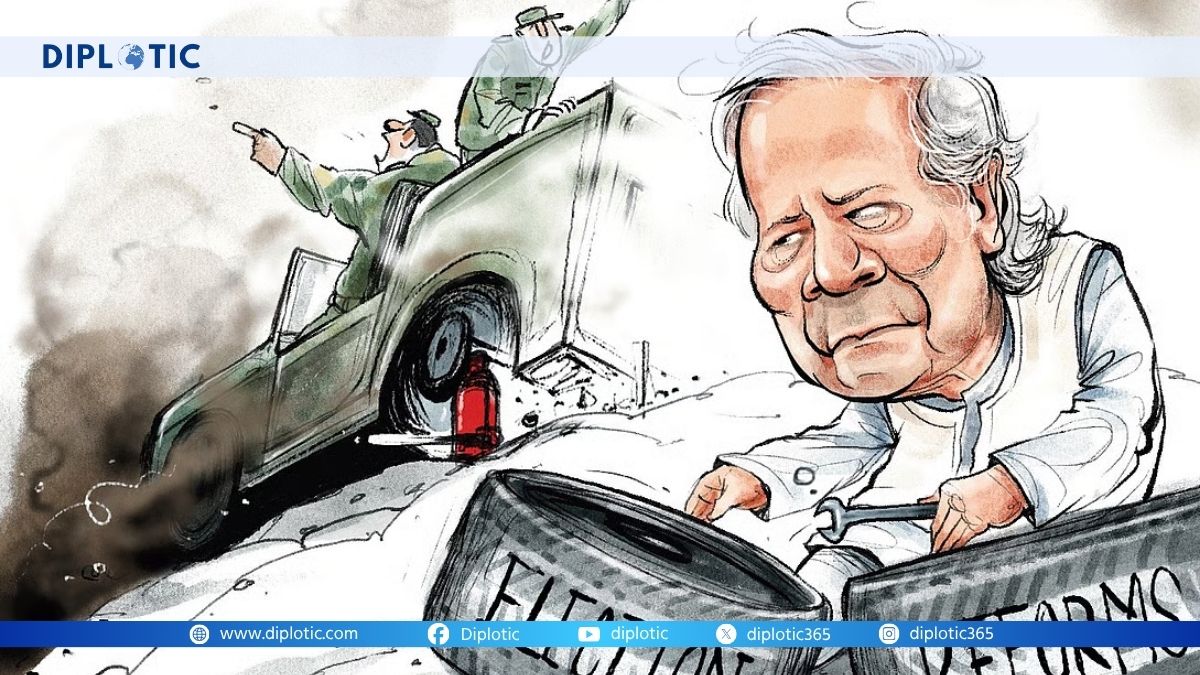
The interim government led by Nobel Laureate Muhammad Yunus has implemented unprecedented electoral reforms. Under the new rules:
- Anyone formally accused of crimes against humanity is barred from running for office.
- Charges filed by the International Crimes Tribunal automatically disqualify candidates.
- The Awami League, as well as Sheikh Hasina, is banned from participating.
- The Election Commission has frozen the party’s registration.
These measures have radically reshaped the political landscape.
For the first time in Bangladesh’s modern history, the nation’s largest political party and a central ideological force has been formally removed from the playing field.
This abrupt recalibration of political power has set off alarms among analysts, activists, and international observers who fear that excluding a major political constituency will undermine the legitimacy of the upcoming polls.
A Polarized Political Field Without its Largest Contender
With the Awami League absent, its former rivals, the Bangladesh Nationalist Party (BNP) and Jamaat-e-Islami, now find themselves repositioning for dominance.
Smaller parties, traditionally aligned with one of the two major camps, are fragmenting in unpredictable ways. Some groups are pushing for the Jatiya Party, long viewed as a government-friendly ally of the Awami League, to also be barred until ongoing investigations conclude.
If these demands are met, the 2026 election will effectively devolve into an exclusive contest among anti–Awami League forces raising concerns that the new system may merely replace one form of electoral imbalance with another.
Democracy at Risk: International Concern Mounts
Six international human rights organizations recently issued a joint letter urging the interim government to:
- Reconsider the ban on the Awami League
- Reduce the sweeping powers of the Anti-Terrorism Act
- End arbitrary detentions
- Ensure freedom of assembly and political participation
- Restore conditions for genuine multiparty democracy
Their warnings reflect a broader fear: that democracy cannot flourish if millions of voters have no political home at the ballot box.
The interim government has attempted to restore credibility by announcing that officials involved in the controversial 2014, 2018, and 2024 elections will be barred from managing the next polls. While intended to rebuild trust, this measure has sparked debate within the bureaucracy and raised further questions about how the system will function.
What About the Voters?
The heart of the crisis is not only the exclusion of political leaders it is the disenfranchisement of their supporters.
The Awami League, despite its authoritarian drift under Hasina, still commands a massive voter base. If millions of citizens find themselves effectively barred from voting for their preferred political ideology, Bangladesh risks:
- Creating a democratic vacuum
- Fueling resentment and instability
- Provoking new cycles of polarization
- Reinforcing the perception that elections are once again engineered, not earned
Democracy is not just about holding elections it is about guaranteeing the right to choose, even when that choice is politically inconvenient.
A Fragile Path Ahead
As Bangladesh prepares for the 2026 election, the stakes are higher than at any point in its post-independence history. The country has a rare chance to rebuild its democratic institutions after years of manipulation and erosion.
But the path chosen—one that excludes a major political ideology—threatens to exchange one form of authoritarianism for another.
Bangladesh now faces a profound dilemma:
Can it restore democracy by restricting who gets to participate in it?
Unless inclusivity returns to the center of the electoral process, the nation risks stepping into another cycle of contested legitimacy—one that could undo the fragile progress earned after the 2024 uprising.