

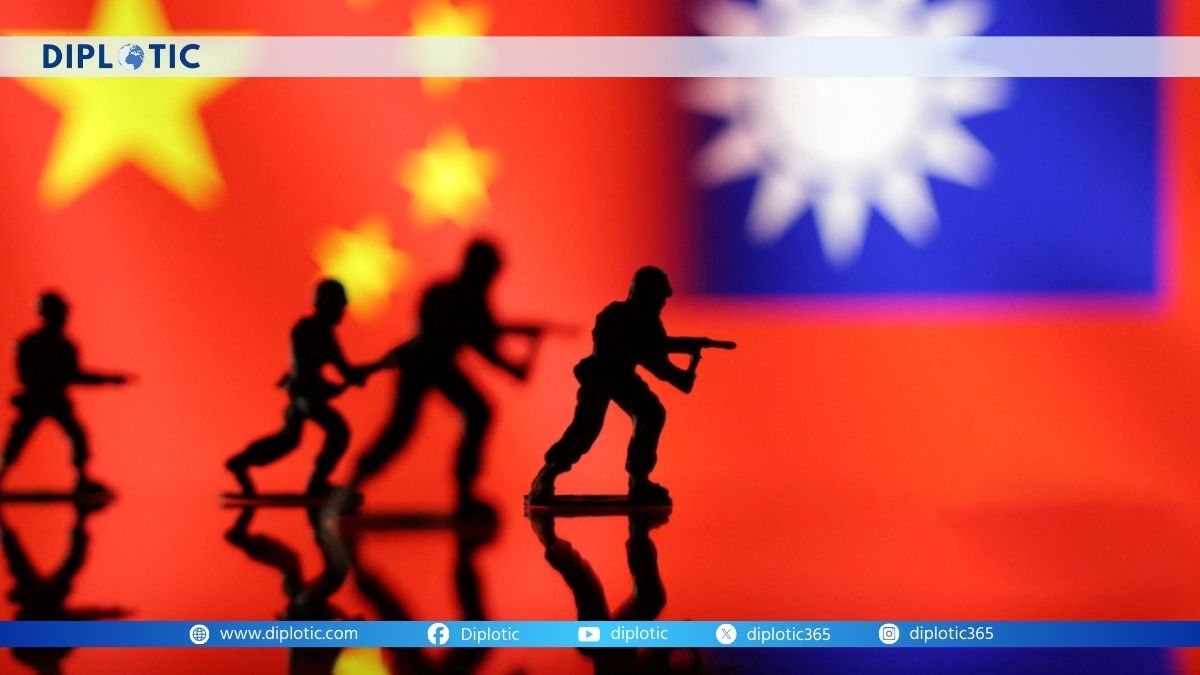
China’s largest and closest-ever military drills around Taiwan at the end of 2025 were not just another show of force. They were a message—aimed simultaneously at Taipei, Washington, and the wider international community. Taiwan’s response, articulated by President Lai Ching-te in his New Year address, framed 2026 as a make-or-break year for the island’s sovereignty. The question now is not whether tensions will continue, but how close the region is drifting toward a real confrontation.
A Drill Designed to Intimidate, Not Just Train
Beijing’s “Justice Mission 2025” exercises marked a significant escalation in both scale and intent. Dozens of rockets were fired toward Taiwan, warships and aircraft encircled the island, and the drills came closer to Taiwanese territory than any previous exercise. For the first time, China explicitly stated that the maneuvers were meant to deter “outside intervention”—a thinly veiled warning to the United States and its allies.
The impact was immediate. Taiwan canceled dozens of domestic flights and scrambled jets and naval vessels to monitor the situation. European and British officials expressed concern, signaling that what happens in the Taiwan Strait is no longer viewed as a purely regional issue. Beijing’s message was clear: reunification is not a distant ambition, but an active strategic objective backed by growing military confidence.
Lai Ching-te’s Message: Resolve Over Reassurance
President Lai’s response avoided dramatic rhetoric, but its substance was unmistakable. He emphasized that Taiwan’s sovereignty is non-negotiable and that the island must prepare for the worst while hoping for peace. His framing of 2026 as “a crucial year” was not accidental. It echoes growing assessments in Washington that China aims to be militarily capable of seizing Taiwan by 2027.
Lai also used the moment to press a stalled domestic agenda: a proposed $40bn increase in defense spending. The proposal has been blocked in Taiwan’s opposition-controlled parliament, creating a political bottleneck at a time of rising external pressure. By pointing out that China’s drills treated Taiwan’s newly acquired combat capabilities as a “hypothetical adversary,” Lai underscored a stark reality: deterrence only works if it is credible.
At the same time, Lai extended a conditional olive branch, reiterating willingness to engage with Beijing on an equal and dignified basis—so long as China acknowledges the Republic of China’s existence and respects Taiwan’s democratic way of life. From Beijing’s perspective, that condition alone is unacceptable.
Beijing’s Response: Zero Tolerance for Dissent
China’s reaction to Lai’s speech was swift and hostile. State media accused him of deception, hostility, and malice, reflecting Beijing’s broader refusal to recognize any Taiwanese leader who does not endorse unification. President Xi Jinping’s own New Year address reinforced this stance, repeating that reunification “cannot be stopped.”
The timing matters. The drills followed just 11 days after the United States announced a record $11.1bn arms package for Taiwan. From Beijing’s view, this confirmed its long-held belief that Taiwan is not acting alone, but as part of a broader containment strategy led by Washington. The drills, therefore, were as much a signal to the US as to Taipei.
Why 2026 Matters More Than the Headlines Suggest
What makes this moment especially volatile is the convergence of military preparation, political signaling, and global uncertainty. China’s drills are growing more realistic, more aggressive, and more openly political. Taiwan, meanwhile, faces internal divisions over defense spending even as the external threat intensifies. The United States is increasing arms support, but remains strategically ambiguous about direct intervention.
This combination raises the risk of miscalculation. Large-scale drills increase the chances of accidents. Political rhetoric hardens positions. Each side tests red lines, unsure of how far the other is willing to go.
For Taiwan, 2026 is not just about military readiness—it is about political unity, economic resilience, and international diplomacy. For China, it is about proving that its rise includes the power to reshape regional order. And for the rest of the world, the Taiwan Strait is becoming one of the most dangerous fault lines of the decade.
The drills may be over, but the message lingers: the status quo is under sustained pressure. Whether it holds through 2026 will depend less on speeches and more on decisions made quietly—in parliaments, defense ministries, and command rooms on both sides of the strait.




