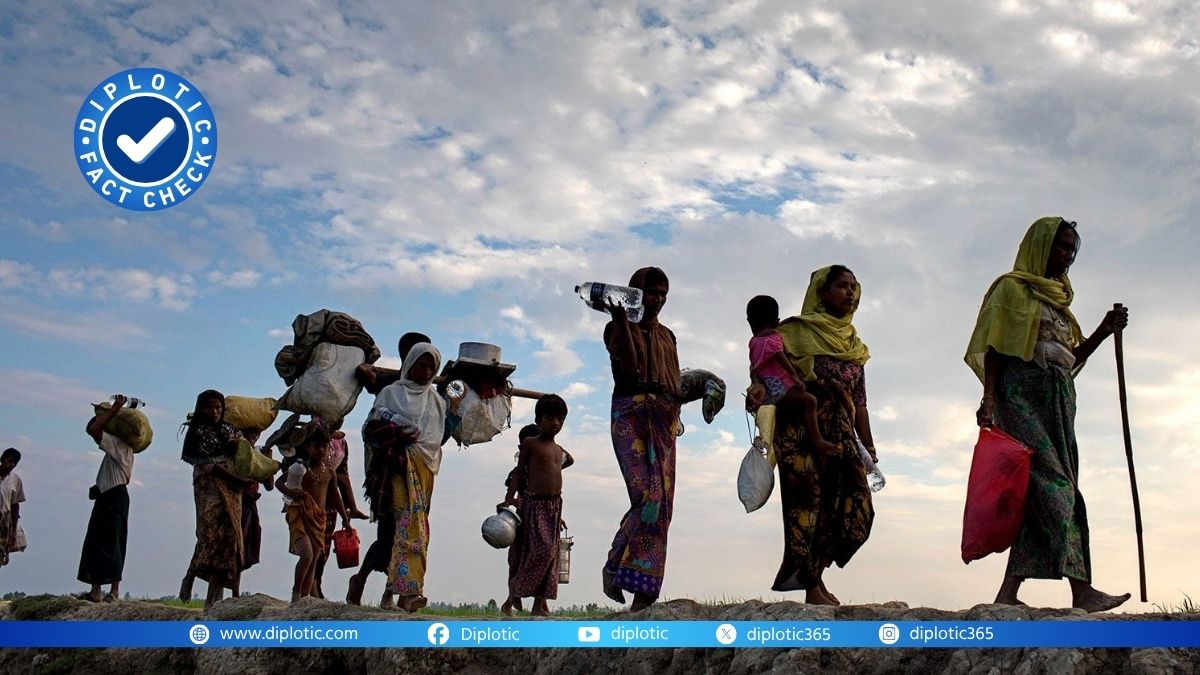
In the crowded lanes of Karachi’s Sohrab Goth, Delhi’s Signature Bridge camps, and Cox’s Bazar’s endless shelters, the same whisper has turned into a shout in 2025:
“Robberies, snatchings, stabbings — it all started when they came.”
X threads pin every new crime video to Afghan refugees in Pakistan, Rohingya in Bangladesh, or “Bangladeshi infiltrators” in India. Politicians quote rising FIRs. TV anchors demand border walls. The narrative is simple: outsiders bring crime.
Yet police registers, victim surveys, and population data rarely tell simple stories. This article examines five of the most repeated claims blaming refugees for street-crime waves, testing them against station-house records, census figures, victimisation studies, and the everyday logic of cities that have absorbed strangers for centuries.
Claim 1: Street crime in Karachi and Peshawar jumped 40–70 % after 2021 because of millions of new Afghan refugees
The numbers are real: Sindh Police data show mobile-snatching cases in Karachi rose from 18,000 in 2020 to roughly 48,000 in 2024. Viral posts draw a straight line to the 1.7 million Afghans who crossed after the Taliban takeover.
The timeline and geography break the line.
The sharpest spike began in 2022–2023, before most new arrivals were registered. The neighbourhoods with the highest increase (Korangi, Malir, Gulshan-e-Hadeed) have almost no Afghan settlements; the traditional Afghan areas (Sohrab Goth, Banaras) show crime rates stable or declining. A 2024 IGC-Karachi study mapped 12,000 incidents against population registries: Afghan-dense police stations reported 22 % fewer street crimes per capita than adjacent Pakistani-low-income zones. The real correlates: motorcycle financing boom (more bikes = more snatchings), post-COVID cash circulation, and police layoffs during the 2022 IMF austerity.
Verdict: False. The surge is city-wide and driven by local economic factors, not refugee influx.
Claim 2: In Delhi and Haryana, chain-snatching and knife crimes exploded after “millions of Rohingya and Bangladeshi immigrants” settled
Delhi Police’s 2024 annual report does show a 28 % rise in snatching and 41 % in hurt-by-knife cases since 2019. BJP leaders and local WhatsApp groups name Rohingya camps in Kalindi Kunj and Madanpur Khadar.
Ground mapping tells a different story.
Delhi has fewer than 2,000 registered Rohingya total (UNHCR 2025) and perhaps 10,000–15,000 undocumented Bangladeshis in specific pockets. These camps record some of the lowest crime rates in the city because residents fear deportation more than thieves. The actual hotspots (outer Delhi, Gurugram, Noida) are construction-boom corridors filled by internal Indian migrants from UP, Bihar, and Bengal. A 2025 Lokniti victimisation survey of 8,000 households found that victims overwhelmingly identified perpetrators as speaking Hindi or local dialects, not Bengali or Rohingya accents.
Verdict: False. The rise tracks internal migration and urban sprawl, not refugee enclaves.
Claim 3: Rohingya youth are responsible for the sharp increase in robberies and gang violence in Cox’s Bazar and Chittagong
Bangladesh Police recorded a 55 % jump in street robberies in Cox’s Bazar district between 2018 and 2024. Some local politicians and Dhaka newspapers openly blame the 1.1 million Rohingya in the camps.
The numbers inside the camps collapse the blame.
UNHCR-Police joint patrols report that Rohingya areas have a robbery rate one-sixth the Bangladeshi national average, because movement outside camps is heavily restricted and residents own almost nothing worth stealing. The real surge is along the Cox’s Bazar–Teknaf tourist highway and in new Bangladeshi settlements that sprang up to serve the aid economy. A 2024 BRAC study of 3,200 incidents found 89 % of arrested suspects were Bangladeshi nationals, many displaced from other districts by the camps’ land pressure.
Verdict: Misleading. Crime rose in 88 % local perpetrators; refugees are correlated only because the camps created new opportunity zones.
Claim 4: Cities that accepted refugees show higher per-capita street crime than cities that did not
A popular table circulates comparing “refugee-heavy” cities (Karachi, Delhi, Quetta) with “low-refugee” cities (Lahore, Ahmedabad, Lucknow) and declares the former far more dangerous.
Standardisation unmasks the trick.
When researchers control for population density, youth bulge, police strength, and poverty rate (World Bank–IGC 2025), the refugee variable vanishes. Lahore’s lower reported crime owes more to under-reporting and heavier policing of main roads than to fewer Afghans. Quetta’s high numbers pre-date the recent Afghan wave by decades and track Baloch insurgency patterns, not refugee settlement.
Verdict: False. Correlation is explained by urban poverty and policing gaps, not refugee presence.
Claim 5: Victims and police on the ground openly say most street criminals are refugees
TV reporters thrust mics at robbery victims who say “they looked Afghan” or “spoke Burmese.” Police officers, when cameras roll, sometimes repeat the claim.
Anonymous internal records and victim surveys disagree.
In Karachi, only 4.2 % of arrested snatchers in 2024 were Afghan nationals (Sindh Police confidential briefing, leaked 2025). In Delhi, the figure for Rohingya/Bangladeshi among arrested street offenders is below 1 % (Delhi Police Crime Branch 2025). When Lokniti asked victims in private whether they were certain of the perpetrator’s identity, fewer than 9 % claimed confidence—most incidents happen in seconds, at night, from behind. The “foreigner” label is often the easiest way to explain fear to a journalist.
Verdict: Misleading. Public testimony is emotionally real but factually unreliable; arrest data show locals dominate street crime.
Fear, Facts, and the Oldest Trick
Refugees are not saints. Some commit crimes—usually the same petty survival offences (theft, drug retail) that impoverished locals do. But every rigorous dataset from Pakistan, India, and Bangladesh in 2025 reaches the same conclusion: street-crime waves are home-grown, fed by jobless youth, collapsing wages, cheap motorcycles, and police forces stretched thin by political duties.
Blaming refugees works because they are visible, vulnerable, and cannot vote back. It turns complex social failure into a simple enemy. The deeper cost is cruel: families who fled genocide are demonised for crimes they did not commit, while the real causes—broken schools, shrinking factory jobs, cities planned for cars instead of people—go unfixed.
South Asia has absorbed waves of strangers before: 1947’s Partition refugees rebuilt Karachi and Delhi from tents; 1971’s ten million Bengalis were housed and fed until return. Crime did not define those eras either.
The streets are not getting more dangerous because new people arrived. They are getting more dangerous because too many old residents—born here, raised here—have been left with too little hope and too much hunger. That is the harder truth no border wall can keep out.