

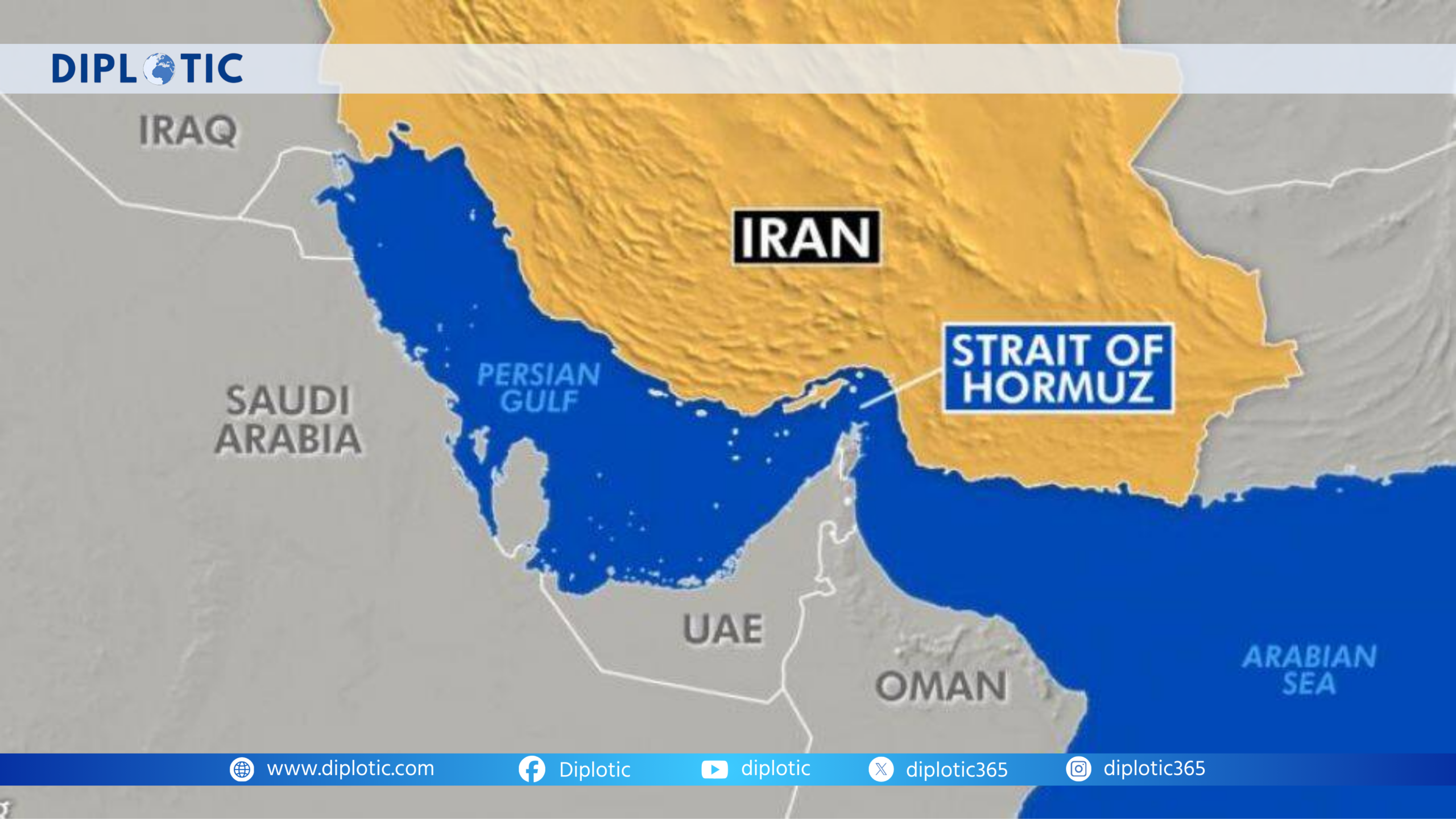
In the tense waters of the Middle East, a narrow passageway has become the focal point of global economic anxiety. The Strait of Hormuz, a 33-kilometer-wide channel bounded by Iran to the north and Oman and the United Arab Emirates to the south, is the world’s most important oil transit chokepoint . Every day, about 20 million barrels of crude oil—roughly 20 percent of global consumption—pass through its waters, carried by tankers heading to energy-hungry economies across Asia and beyond . Now, with Iran threatening to “set fire” to any ships attempting to transit and vowing that “not a single drop of oil” will leave the region, the strait has become the epicenter of a crisis with profound implications for South Asia . This explainer breaks down what the Strait of Hormuz is, why it matters so much to the global economy, what would happen if it were closed, and how South Asian nations would be affected.
Where Is the Strait of Hormuz and Why Is It So Important?
The Strait of Hormuz connects the Persian Gulf with the Gulf of Oman and the Arabian Sea beyond. At its narrowest point, the shipping lane is just 33 kilometers wide, with the entire channel lying within the territorial waters of Iran and Oman . Despite its narrowness, the strait is deep enough to accommodate the world’s largest crude oil tankers, making it the essential maritime artery for the major oil and gas producers of the Middle East .
The volume of energy flowing through this passage is staggering. In 2025, approximately 20 million barrels of oil passed through the strait daily, representing nearly $600 billion worth of energy trade annually . This oil comes not only from Iran but also from Iraq, Kuwait, Qatar, Saudi Arabia, and the United Arab Emirates—virtually all of the Gulf’s major producers depend on the strait to reach global markets . About 3,000 ships sail through each month, carrying not just crude oil but also liquefied natural gas, refined products, and other goods .
For context, the strait’s importance exceeds that of any other oil transit chokepoint. The Suez Canal and SUMED Pipeline in Egypt handle about 9 percent of global oil trade. The Bab el-Mandeb Strait at the southern entrance to the Red Sea handles about 12 percent. The Strait of Hormuz, at 20 percent, is in a league of its own . Disrupting this flow would send shockwaves through energy markets unmatched by any other single chokepoint.
Where Does the Oil Going Through Hormuz Actually Go?
The overwhelming majority of oil passing through the strait heads east. According to US Energy Information Administration estimates, around 82 percent of crude oil and condensates leaving the Strait of Hormuz in 2022 were bound for Asian markets . This concentration reflects the fundamental reality of global energy flows: the world’s largest oil producers are in the Gulf, and the world’s fastest-growing oil consumers are in Asia.
The top destinations paint a clear picture. China is the single largest importer, taking an estimated 90 percent of Iran’s exports alone, plus substantial volumes from Saudi Arabia, Iraq, and other Gulf states . India follows as the second-largest destination, importing about 3.5 million barrels per day from Gulf countries, mostly through the strait . Japan, South Korea, and Singapore are also major customers, together accounting for millions of barrels daily .
For South Asia specifically, the dependence is acute. India imports approximately 85 percent of its crude oil requirements, and the majority of that comes through the Strait of Hormuz . Pakistan, Bangladesh, and Sri Lanka are similarly dependent on Gulf oil flowing through this passage. Any sustained disruption would force these nations to seek alternative supplies from more distant sources, at higher cost, and with greater logistical complexity.
What Is Happening Now and How Is Iran Threatening the Strait?
In the wake of US and Israeli strikes on Iran, Tehran has escalated its rhetoric and actions targeting the strait. Iran’s General Sardar Jabbari declared that the country will “not let a single drop of oil leave the region” and threatened to “set fire” to any ships attempting to transit . These are not empty threats. Iran has a range of military capabilities that could disrupt shipping, including fast attack boats armed with anti-ship missiles, naval mines that can be laid by small craft or submarines, and a variety of surface vessels and semi-submersibles .
The impact is already being felt. At least three ships were attacked near the strait over the weekend, and about 150 tankers are reportedly stranded, unwilling to risk transit . The cost of hiring a supertanker to ship oil from the Middle East to China has nearly doubled from last week’s price, reaching a record high of more than $400,000 . Insurance premiums for vessels entering the region have skyrocketed, and many shipping companies are simply waiting to see if the security situation improves .
As Arne Lohmann Rasmussen, chief analyst at Global Risk Management, explained: “It is de facto closed in that no one dares to go through. You can be attacked, and you can’t get insurance or it is extremely expensive, so you have to wait until the security situation is better” . This is not a physical blockade in the traditional sense, but the effect is the same: oil is not moving.
What Would Happen If the Strait Were Fully Closed?
A full closure of the Strait of Hormuz would be one of the most disruptive events in modern economic history. The immediate effect would be a spike in oil prices as markets priced in the loss of 20 percent of global supply. The global benchmark Brent crude briefly hit $82 a barrel on Monday, but analysts warn that this is just the beginning. In escalation scenarios, prices could reach $140 or even $200 per barrel, depending on the duration of disruption and the extent of damage to infrastructure .
Beyond the price spike, the closure would create physical shortages. Refineries in Asia that depend on Gulf crude would have to cut runs or seek alternative supplies from the Atlantic Basin, the Americas, or West Africa. But those supplies are finite, and competition for them would drive prices even higher. The logistics of rerouting would add weeks to transit times and strain the capacity of alternative routes.
The impact would ripple through every sector of the global economy. Higher oil prices mean higher transportation costs, which mean higher food prices, higher manufacturing costs, and higher inflation everywhere. Central banks would face the nightmare scenario of stagflation—rising prices combined with slowing growth—with limited tools to address either problem .
The strait’s closure would also hurt the Gulf countries themselves. Saudi Arabia, Iraq, Kuwait, and the UAE depend on oil exports for the vast majority of government revenue. With their primary export route blocked, they would face economic crisis even as the global economy suffered . Iran, by comparison, exports about 1.7 million barrels per day and earned $67 billion in oil revenue in the year ending March 2025—its highest in a decade . A blockade would cut off this vital income stream, potentially destabilizing the regime further .
How Could Iran Actually Close the Strait?
International law allows countries to exercise control of territorial seas up to 12 nautical miles from their coastline. At its narrowest point, the Strait of Hormuz and its shipping lanes lie entirely within Iranian and Omani territorial waters, giving Tehran some legal basis for asserting control . But physically closing the strait is a different matter.
According to experts, the most effective way for Iran to shut the strait would be to lay naval mines using fast attack boats and submarines . Mines are cheap, difficult to detect, and can remain dangerous for long periods. Even the threat of mines can halt shipping, as commercial vessels are unwilling to risk striking one. Iran’s regular navy and the IRGC navy could also launch direct attacks on foreign warships and commercial vessels using anti-ship missiles and swarming tactics with fast boats .
However, any Iranian attempt to close the strait would invite a powerful military response. Large Iranian naval vessels would become easy targets for US air strikes, and President Trump has stated that one of his aims is to destroy Iran’s navy . The US has previous experience with this mission. During the 1980s Iran-Iraq war, strikes on oil facilities escalated into a “tanker war” that saw both countries attacking neutral ships. Eventually, American warships began escorting Kuwaiti tankers through the Gulf in what became one of the largest naval surface warfare operations since World War Two .
Are There Alternative Routes That Could Offset a Closure?
The persistent threat of a Hormuz closure has prompted Gulf countries to develop alternative export routes, though none can fully replace the strait’s capacity. Saudi Arabia operates a 1,200-kilometer pipeline capable of transporting up to 5 million barrels of crude oil per day to Red Sea ports . In the past, it has also temporarily repurposed natural gas pipelines to carry crude. The UAE has connected its inland oilfields to the port of Fujairah on the Gulf of Oman via a pipeline with a daily capacity of at least 1.5 million barrels .
These alternatives provide some cushion, but they are insufficient to replace the 20 million barrels that normally flow through the strait. Oil could be diverted along this infrastructure to bypass Hormuz, but Reuters reports that would still lead to a drop in supply of between 8 and 10 million barrels per day . That is equivalent to losing the entire output of several major producers. Moreover, the Red Sea route faces its own security challenges, with Houthi rebels in Yemen having attacked vessels in recent years.
For South Asian importers, these alternatives offer limited comfort. The Saudi and UAE pipelines feed Red Sea ports, from which oil would still need to transit the Bab el-Mandeb Strait and then travel the length of the Red Sea to the Suez Canal or around Africa. Both routes are longer, more expensive, and face their own security risks. The cost and time involved would significantly increase delivered prices even if physical supply could be maintained.
What Does This Mean for South Asian Economies?
For South Asia, the stakes could hardly be higher. India, Pakistan, Bangladesh, and Sri Lanka are all heavily dependent on imported oil, and the majority of that oil comes through the Strait of Hormuz. Any sustained disruption would hit these economies through multiple channels simultaneously.
The first and most direct impact would be on the balance of payments. Higher oil prices mean larger import bills, wider current account deficits, and greater pressure on foreign exchange reserves. For India, which imports about 85 percent of its crude requirements, every $10 increase in oil prices widens the current account deficit by about 0.4 percent of GDP and pushes inflation higher by about 0.3 percentage points . For Pakistan and Sri Lanka, both of which have faced recent balance of payments crises, the pressure could become acute.
The second impact would be on inflation. Higher oil prices feed directly into transportation costs, which feed into food prices, manufacturing costs, and ultimately consumer prices. Central banks would face the difficult choice of raising interest rates to contain inflation, potentially slowing growth, or allowing inflation to erode purchasing power and destabilize expectations. With growth already moderating in much of the region, there are no good options.
The third impact would be on government budgets. Many South Asian countries subsidize fuel prices to shield consumers from global volatility. When oil prices spike, these subsidies balloon, diverting resources from development spending and widening fiscal deficits. Alternatively, governments can pass higher costs to consumers, but that risks social unrest and political backlash, as history has shown.
The fourth impact would be on remittances. Millions of South Asians work in the Gulf countries, sending billions of dollars home each year. If the Gulf economies suffer from blocked oil exports, many of these workers could lose their jobs or see their incomes reduced. The resulting drop in remittances would further pressure balance of payments and household incomes across the region.
How Should South Asian Policymakers Respond?
In the face of such uncertainty, South Asian policymakers need a multi-pronged strategy. Diplomatic engagement with all parties is essential to protect national interests and, if possible, facilitate de-escalation. India, in particular, has relationships with both the US and Iran that could be leveraged to promote dialogue. The evacuation of citizens from conflict zones, already underway with India’s Operation Sindhu evacuating over 2,000 nationals from Iran, must continue and expand if necessary .
On the economic front, governments should review strategic petroleum reserve levels and ensure release mechanisms are ready if needed. Currency intervention capacity should be preserved for moments of acute stress. Central banks may need to communicate clearly about their willingness to raise rates if inflation pressures intensify, while also preparing to support growth if recession risks materialize.
Diversification of energy sources and supply routes should accelerate. India has been investing in renewable energy, nuclear power, and domestic production, but these are long-term solutions that cannot address an immediate crisis. In the short term, building strategic reserves and maintaining relationships with multiple suppliers is the best defense.
For businesses and households, the message is one of prudent preparation. Fuel-efficient choices, inventory buffers, and contingency planning for supply chain disruptions can all help navigate uncertain times. While no one can predict exactly how the conflict will evolve, understanding the stakes and preparing for multiple scenarios is the wisest course.
Conclusion
The Strait of Hormuz is a narrow passage with outsized importance for the global economy and particularly for South Asia. At 20 percent of global oil flows, it is the world’s most critical energy chokepoint, and its vulnerability to disruption has been starkly exposed by the current crisis. Iran’s threats to block the strait, combined with actual attacks on vessels and the withdrawal of shipping, have already begun to disrupt trade and drive up prices.
If the strait were fully closed, the consequences would be catastrophic. Oil prices could double or triple, inflation would surge globally, and economies across Asia would face severe pressure. The Gulf states themselves would suffer, and the geopolitical fallout would be unpredictable. Alternative export routes exist but cannot fully compensate for the loss of the strait’s capacity.
For South Asia, the immediate priority is to prepare for the worst while hoping for the best. That means diplomatic engagement, strategic reserve management, currency defense, and contingency planning across government, business, and households. The coming days and weeks will test whether the region’s economies have the resilience to withstand a shock of this magnitude. The only certainty is that the narrow waters of the Strait of Hormuz will remain the focus of global attention for the foreseeable future.




