

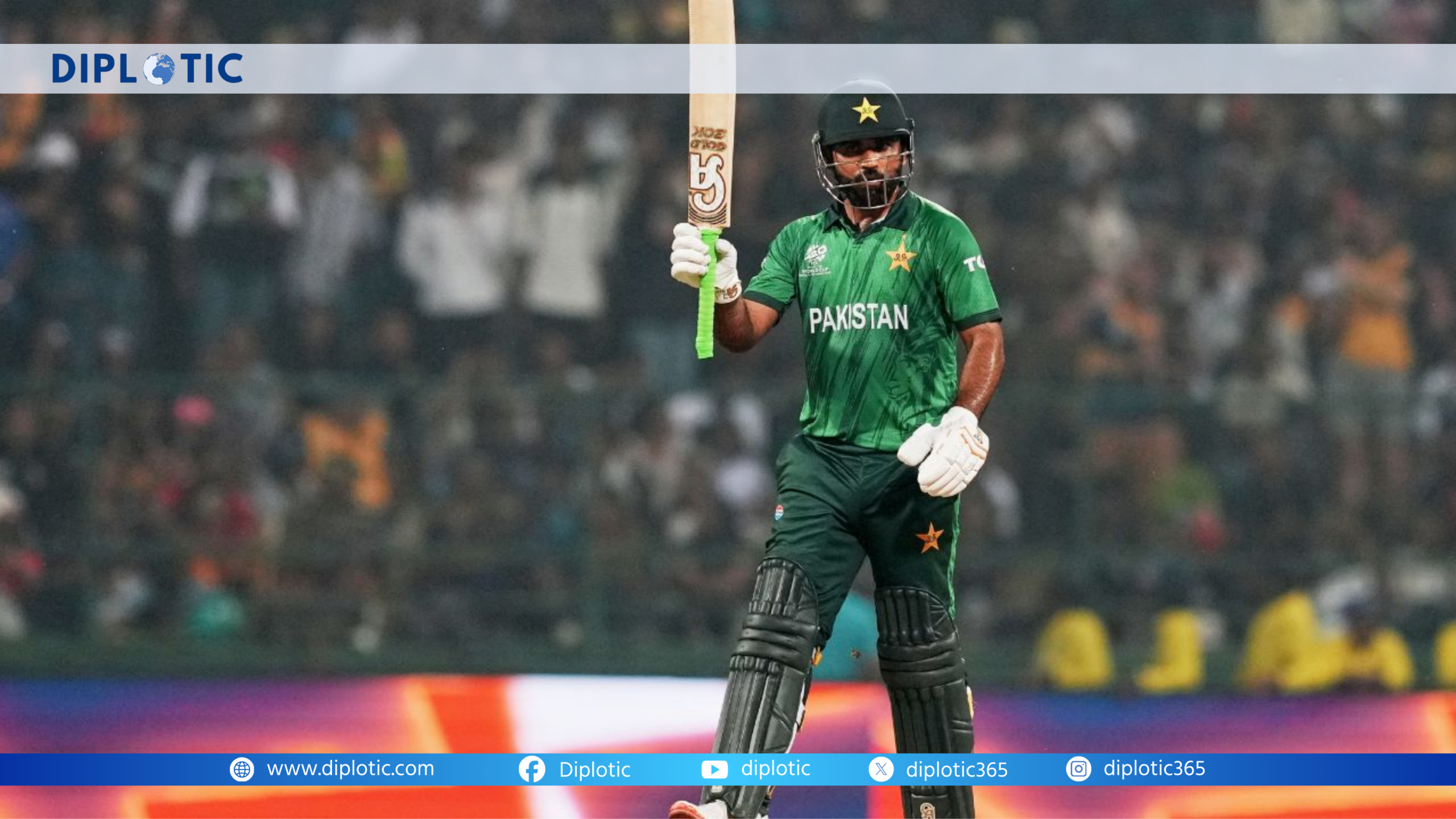
In the annals of cricket history, certain performances transcend team results and etch themselves into the collective memory of fans. Sahibzada Farhan’s campaign at the 2026 ICC Men’s T20 World Cup is one such achievement. The Pakistan opener concluded his tournament on Saturday with a brilliant century against Sri Lanka in Pallekele, finishing with a staggering 383 runs at an average of 76.60 . In doing so, he surpassed Virat Kohli’s long-standing record of 319 runs from the 2014 edition to claim the title of most runs in a single T20 World Cup . He also matched Chris Gayle’s feat of scoring two centuries in T20 World Cup history, but with a remarkable distinction: Farhan is the first batter to achieve both tons in the same tournament . This is the story of a record-breaking performance that announced a new superstar to the world, even as his team’s campaign fell short of expectations.
How Did Farhan’s Record-Breaking Campaign Unfold?
From the moment Farhan walked to the crease in Pakistan’s opening match, there was something different about his approach. The right-hander combined classical strokeplay with calculated aggression, anchoring innings when needed and accelerating when the situation demanded. His two centuries were the centerpieces of a campaign characterized by remarkable consistency. In an era where T20 batting often prioritizes explosive cameos over sustained excellence, Farhan delivered both: the ability to build an innings and the power to dominate attacks.
The final group stage match against Sri Lanka encapsulated his tournament perfectly. His unbeaten 100 off just 60 balls was a masterclass in pacing a T20 innings, blending solid defense with exquisite shot-making . It was his second hundred of the World Cup, following an earlier century that had already announced his arrival on the global stage. By the time he walked off the field in Pallekele, he had accumulated 383 runs—64 more than Kohli’s previous record, and a tally that places him alongside the all-time greats of the format .
Where Does Farhan’s Achievement Rank in T20 World Cup History?
The numbers tell a compelling story. Farhan’s 383 runs place him comfortably atop the list of highest run-scorers in a single T20 World Cup edition . He surpassed Kohli’s 319 from 2014, Tillakaratne Dilshan’s 317 from 2009, Babar Azam’s 303 from 2021, and Mahela Jayawardene’s 302 from 2010 . Each of those players delivered iconic performances in their respective tournaments, but Farhan’s tally stands apart.
Even more remarkable is his achievement of scoring two centuries in the same World Cup. Chris Gayle, the only other player with two T20 World Cup tons, scored his across different editions—one in 2007 and another in 2016 . Farhan is the first batter to achieve the rare feat of twin centuries in a single tournament, a testament to his consistency and ability to perform under pressure across multiple high-stakes matches . His average of 76.60 further underscores his dominance; in a format where a strike rate of 140 is often valued over a high average, Farhan delivered both .
Why Did Pakistan Fail to Reach the Knockouts Despite Farhan’s Heroics?
Cricket, however, is a team sport, and individual brilliance cannot always compensate for collective shortcomings. For the second consecutive T20 World Cup, Pakistan failed to progress beyond the group stages . The last time they reached the semi-finals was in 2022, when they finished as runners-up to England . This year, despite Farhan’s record-breaking run, the team could not string together enough wins to advance.
Captain Salman Ali Agha offered a candid assessment of the team’s shortcomings. “The reason is that we have to increase our game playing under pressure,” he said after the victory over Sri Lanka . “And when the pressure increases, how to improve our decision making. I think that matters more right now. Because whenever there is pressure, I think our decision making is not as good as it should be” . His analysis points to a fundamental issue that has plagued Pakistan cricket across formats: the ability to hold nerve and make sound choices in crunch moments. “When you come to the World Cup or ICC events, there is always pressure. If your decision making is not good under that pressure, then the result will be like this” .
This disconnect between individual brilliance and team performance is a familiar story in Pakistan cricket. Farhan’s runs kept Pakistan competitive, but they could not mask weaknesses in other departments—inconsistent bowling, fielding lapses, and the very decision-making under pressure that Ali Agha identified. The result is a bittersweet campaign: the emergence of a new superstar, but another early exit for the team.
What Does This Mean for Pakistan’s T20 Future?
For Sahibzada Farhan personally, this World Cup represents a coming-of-age moment. Before the tournament, he was a promising talent with potential. Now, he has announced himself as a genuine match-winner on the biggest stage. His ability to score consistently against varied attacks, in different conditions, and under the spotlight of a World Cup suggests a batsman ready to anchor Pakistan’s top order for years to come. The challenge for the team management will be to build a lineup around such talent, ensuring that his contributions are not isolated achievements but part of a cohesive unit’s success.
For Pakistan cricket more broadly, the tournament raises uncomfortable questions. How can a team with a player producing record-breaking performances fail to advance? The answer lies in the gaps Ali Agha identified: composure under pressure, decision-making, and the ability to execute plans when stakes are highest. These are not problems that can be solved by individual brilliance alone. They require cultural change, mental conditioning, and perhaps a reassessment of how the team prepares for high-pressure tournaments.
The 2026 World Cup may ultimately be remembered for Farhan’s extraordinary individual achievement—a record that could stand for years, perhaps even decades. But for Pakistani fans, it will also be remembered as a tournament of what might have been. The hope now is that Farhan’s emergence signals not just a personal milestone but the beginning of a new era for Pakistan cricket, one where individual brilliance and team success finally align.




