

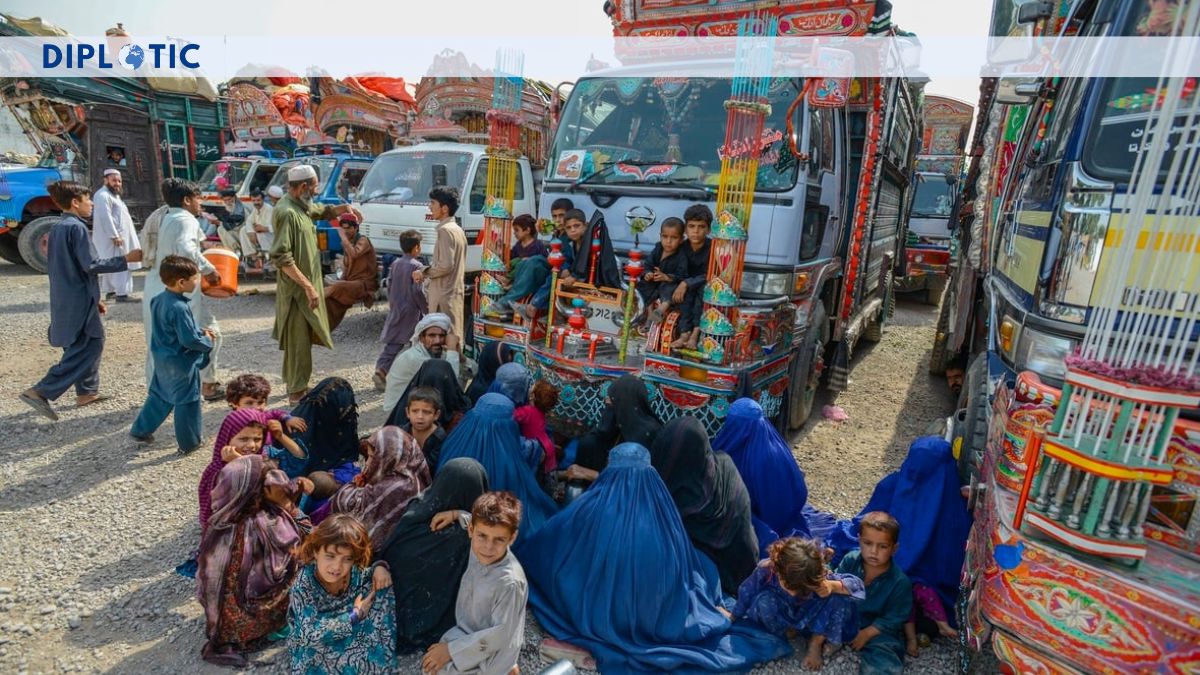
Pakistan has hosted millions of Afghan refugees since 1979, shouldering a burden few nations have faced. As repatriation begins, the debate demands a balanced view of humanitarian responsibility, legal reality, and shared global accountability.
A Humanitarian Burden Few Nations Have Carried
Since 1979, Pakistan has shouldered one of the largest and longest humanitarian responsibilities in modern history by hosting millions of Afghan refugees fleeing war, foreign military occupation, and the collapse of state authority in Afghanistan. For more than four decades, Pakistan kept its borders largely open despite facing its own existential challenges, including terrorism, economic instability, internal displacement, and repeated natural disasters.
According to data from the United Nations High Commissioner for Refugees (UNHCR), Pakistan remains one of the world’s largest refugee-hosting countries. This reality places Pakistan in a unique global position one defined not by formal treaty obligations, but by sustained humanitarian action that far exceeds what most nations have undertaken.
Yet, despite the magnitude of this burden, international relief efforts have rarely matched the scale of Pakistan’s contribution. The refugee crisis became a long-term responsibility for Pakistan, even as global attention shifted elsewhere.
Hospitality Without Legal Obligation
Pakistan’s refugee policy has always been grounded more in humanitarian goodwill than in binding international law. Notably, Pakistan is not a signatory to the 1951 Refugee Convention or its 1967 Protocol. Still, it provided shelter, access to basic services, and economic opportunities to Afghan refugees for generations.
Administrative mechanisms such as Proof of Registration (PoR) cards and Afghan Citizen Cards (ACC) were introduced as temporary arrangements to manage refugee presence. These documents were never intended to provide permanent residency; rather, they functioned as interim tools, repeatedly extended through government notifications based on evolving circumstances.
Over time, however, temporary solutions hardened into a prolonged status quo one that strained public infrastructure, labor markets, housing, schools, and healthcare systems. Entire communities bore the cost of a humanitarian commitment that lasted far longer than initially anticipated.
Human Rights Concerns and Global Scrutiny
In recent years, Pakistan’s evolving refugee policy has drawn criticism from international human rights organizations. Amnesty International, among others, has raised concerns about unlawful detention, harassment, and deportation of Afghan refugees, urging the government to halt forced removals and ensure protection for vulnerable populations.
These concerns deserve serious consideration. Women, children, and marginalized groups face genuine risks upon return to Afghanistan, where political uncertainty and economic hardship persist. Civil society groups have rightly emphasized that refugee protection must align with international humanitarian standards.
At the same time, the discussion cannot occur in isolation from legal realities and state sovereignty.
Expired Documents and the Question of Legality
A core issue facing Afghan nationals in Pakistan today is the expiration of PoR and ACC documents. Pakistan does not offer a permanent legal framework for indefinite refugee settlement. As a result, millions now reside in legal uncertainty.
The government argues that its current actions follow due process, rooted in earlier notifications and extensions that clearly outlined timelines and expectations. Authorities have also detailed arrangements for transportation, food assistance, and medical facilities for returnees ahead of enforced deadlines.
From the state’s perspective, immigration enforcement is not synonymous with humanitarian abandonment. Rather, it reflects a transition from emergency hospitality to regulated migration management.
Repatriation Versus Deportation: A Crucial Distinction
Much of the debate hinges on the difference between deportation and repatriation. Deportation implies forcible removal from a place of lawful and permanent protection. Repatriation, by contrast, refers to the return of individuals to their country of origin once temporary refuge has reached its natural conclusion.
Pakistan maintains that it is facilitating phased, structured repatriation not arbitrary expulsion. Return procedures have been outlined in stages, allowing time for preparation and support. Under international norms, no country is expected to host millions of undocumented migrants indefinitely once the primary cause of displacement has changed.
Where Responsibility Truly Lies
An uncomfortable but necessary question must be asked: who bears ultimate responsibility for Afghan refugees?
Afghanistan’s de facto authorities, the Taliban, claim the right to govern, yet have failed to fully assume responsibility for reintegrating their own citizens. Economic collapse, institutional weakness, and social instability remain unaddressed at the source.
Shifting Afghan state responsibilities onto neighboring countries that have already paid a disproportionate price for decades is neither fair nor sustainable. Durable solutions must originate inside Afghanistan, supported by international development assistance rather than perpetual displacement.
The Role of International Organizations
International humanitarian organizations such as UNHCR and the International Organization for Migration (IOM) play a critical role in monitoring return movements and protection needs. However, their focus must increasingly shift toward in-country support within Afghanistan.
Long-term development, livelihood creation, and institutional rebuilding offer far more sustainable outcomes than prolonged refugee hosting. Shared global responsibility means investing where returnees live not outsourcing humanitarian obligations to host states indefinitely.
Balancing Compassion, Sovereignty, and Stability
Pakistan’s identity as a humanitarian nation is not diminished by enforcing immigration laws. Compassion and sovereignty are not mutually exclusive. Dignity, regional stability, and lawful migration management can coexist when policies are grounded in fairness and realism.
Hospitality cannot substitute for permanent legal protection, and generosity cannot be transformed into an endless obligation. Pakistan’s record demonstrates extraordinary compassion far exceeding global averages, but sustainability demands balance.
A Path Forward Based on Shared Responsibility
The way forward lies not in blame, but in cooperation. Refugees must be supported in returning home with dignity. Afghanistan must assume responsibility for reintegration. International actors must redirect resources toward rebuilding Afghan society. And host countries like Pakistan must be allowed to recalibrate policies based on present realities, not frozen expectations from decades past.
The Afghan refugee crisis will only find resolution through shared responsibility, honest assessment, and collective commitment to restoring Afghanistan itself. Anything less merely postpones a problem the world can no longer afford to ignore.




