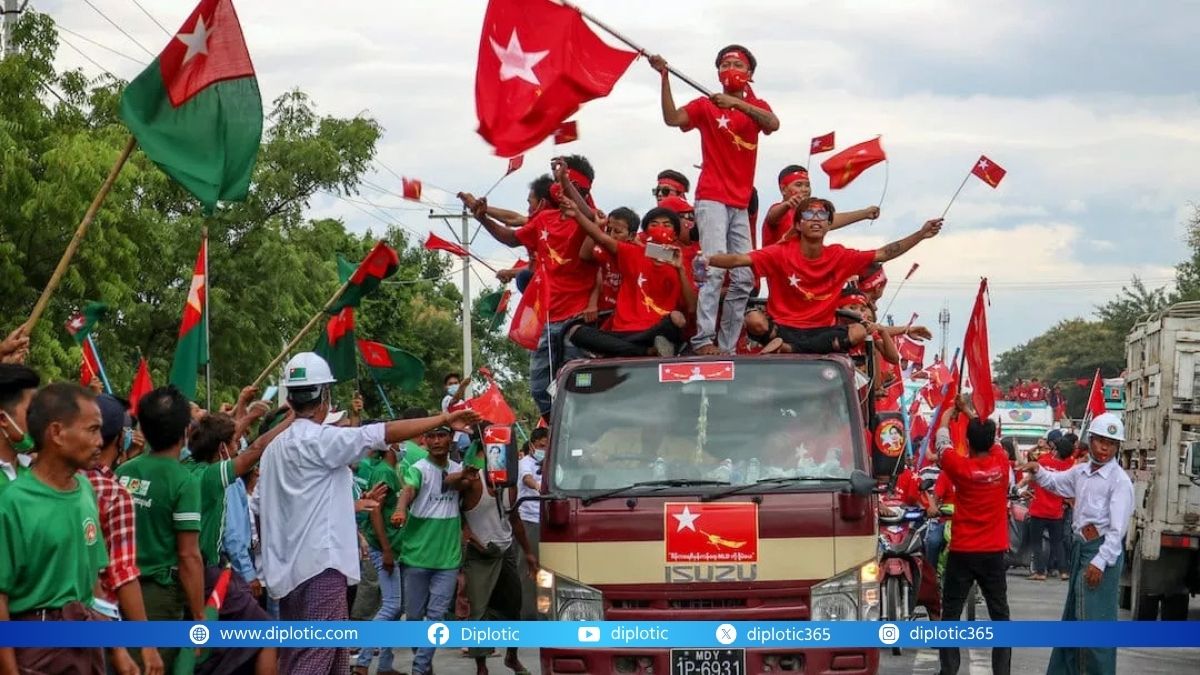
Myanmar’s military-backed Union Solidarity and Development Party (USDP) has officially launched its campaign for the December 28 elections, marking a critical juncture in the nation’s ongoing political crisis. This election set against a backdrop of civil war, international condemnation, and widespread skepticism, is widely regarded by rights groups, foreign governments, and diplomatic circles as a strategic maneuver to legitimize the military’s 2021 coup. The campaign’s initiation in Naypyitaw and Yangon signifies the military regime’s attempt to project democratic norms, despite mounting evidence challenging the election’s credibility.
Clash of Legitimacies: Military Coup vs. Democratic Aspirations
The military’s power grab in February 2021, which ousted the National League for Democracy (NLD) led by Aung San Suu Kyi, plunged Myanmar into political turmoil and widespread civil conflict. The NLD, having secured overwhelming victories in prior nationwide elections, is notably absent from this electoral process due to enforced disbandment by the military-appointed Union Election Commission. This systemic exclusion of credible opposition parties highlights the military’s intent to control electoral outcomes and consolidate power under the guise of democratic procedure.
International human rights organizations like Human Rights Watch have explicitly condemned the elections as a “sham,” emphasizing the absence of fair competition and inclusive political participation. In a further rebuke, the European Commission declined to dispatch election observers, decrying the process as neither free nor fair, thereby undermining any prospects for global validation.
Regional Diplomatic Stance and ASEAN’s Reluctance
Diplomatic channels observing the developments have noted a cautious yet critical posture from regional actors. The Association of Southeast Asian Nations (ASEAN), traditionally committed to non-interference, has reportedly decided against sending observers, reflecting growing frustration with the Myanmar military’s persistence and escalating violence. This absence of ASEAN monitoring further isolates the military government, curtailing its efforts to gain international legitimacy through regional endorsement.
UN Secretary-General Antonio Guterres recently issued a stark warning about the potential exacerbation of instability, pinpointing the elections as a possible catalyst for intensified conflict. His caution underscores global concerns that the military’s electoral strategy might deepen entrenched divisions and provoke further violence in Myanmar’s already fragile socio-political landscape.
Voting Disruptions Amid Armed Conflict and Civil Unrest
The election is slated to proceed under severely constrained conditions, with voting excluded in approximately one-seventh of national parliamentary constituencies, many located within active conflict zones. These restrictions not only disenfranchise significant segments of the population but also reflect the volatile security environment where armed resistance groups and ethnic militias challenge the military’s authority.
Several armed opposition factions have pledged to disrupt the electoral process, advocating boycotts and calling the polls illegitimate. Such resistance reflects entrenched public disillusionment toward the military government and signals the complexity of achieving national reconciliation under current circumstances.
Public Sentiment: Disinterest and Deep Skepticism
Observations from Myanmar’s diverse communities reveal widespread apathy and mistrust regarding the elections. In the Rakhine state capital of Sittwe, citizens expressed outright dismissal of the electoral process, viewing it as devoid of genuine democratic choice. Displaced persons in Mandalay echoed similar sentiments, prioritizing security and stability over participation in an election perceived as a formality benefiting the military establishment.
This pervasive disenchantment poses a significant challenge to the legitimacy and long-term efficacy of the election in fostering national unity or political reconciliation.
USDP’s Expected Dominance in a Narrow Political Field
With major opposition parties outlawed and absent, the USDP stands virtually unchallenged and is anticipated to secure the majority of parliamentary seats. This dominated political landscape will likely entrench military influence and marginalize any meaningful legislative dissent, effectively sidelining civilian governance frameworks.
The electoral victory for the USDP, while projected, does little to assuage criticism from international watchdogs, political analysts, and Myanmar’s own populace, who view the outcome as preordained and contrived.
Myanmar’s Electoral Future and Diplomatic Challenges Ahead
The forthcoming 2025 elections in Myanmar represent a controversial and highly contested attempt by the military to reassert authority and secure internal and external recognition. However, glaring deficiencies in fairness, credible opposition engagement, and security cast doubt on the election’s prospects to catalyze genuine political stabilization.
For the international community and regional partners, balancing diplomatic pressure, humanitarian concerns, and strategic engagement will remain crucial as Myanmar navigates its fraught electoral path. Without transparent processes, inclusivity, and conflict de-escalation, the elections risk perpetuating cycles of instability, undermining prospects for democratic restoration and sustainable peace.