

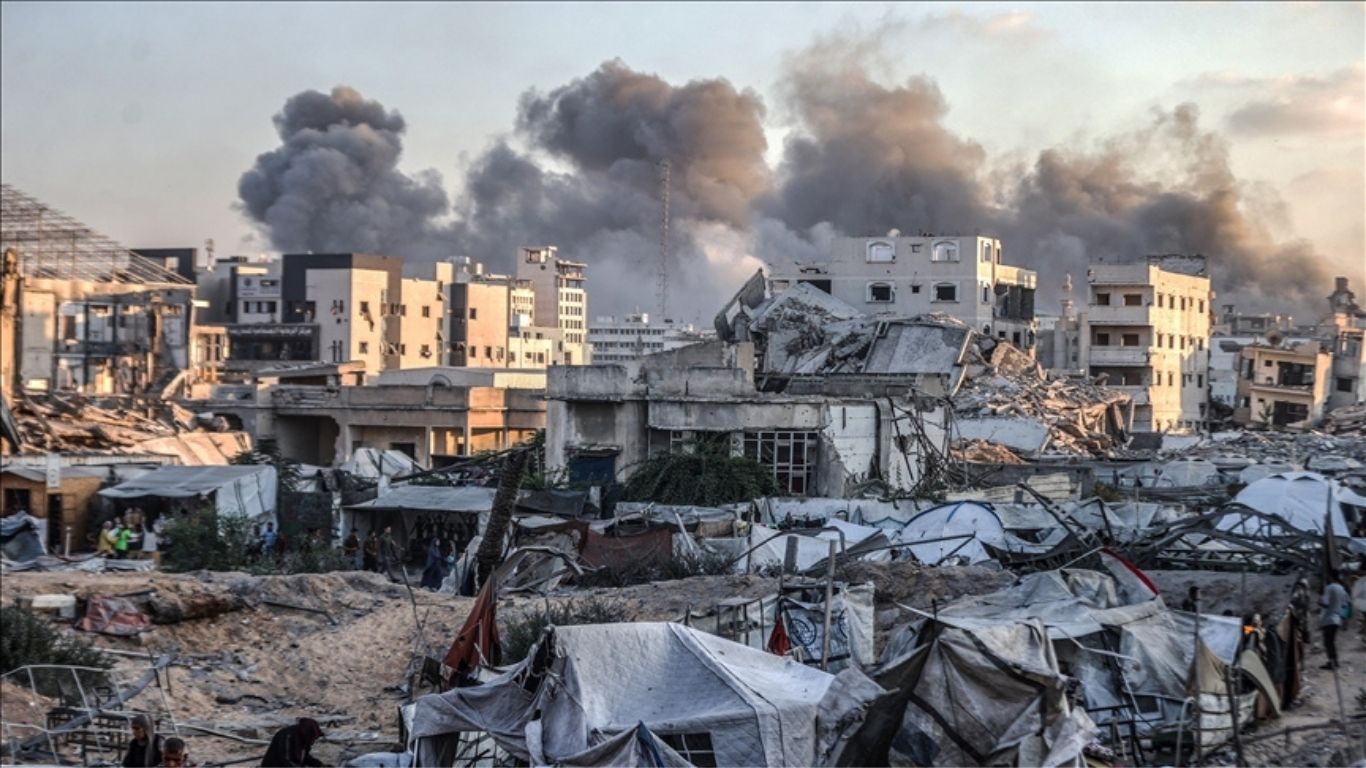
Israel’s new ground assault on Gaza City highlights the clash between military strategy and humanitarian crisis. The offensive may dismantle Hamas, but at what cost to civilians and regional stability?
Israel’s New Offensive: Military Logic vs. Human Reality
Israel’s expanded ground offensive into Gaza City is a stark reminder of the widening gap between the logic of war and the lived reality of civilians caught within it. The Israel Defense Forces (IDF) insists that Operation Gideon’s Chariots II is a necessary escalation an effort to root out Hamas’s last significant urban stronghold. Yet for hundreds of thousands of Palestinians, the operation feels less like liberation and more like the destruction of their remaining safe spaces.
The IDF frames its offensive as a continuation of a carefully sequenced campaign: dismantling Hamas positions in the south and center before moving into the densely packed north. Tanks, artillery, and entire divisions are now rolling into Gaza City. On paper, this strategy is about consolidating gains and achieving control. In practice, it has turned Gaza’s largest city into a battlefield.
The Cost of “Strategic Necessity”
Israel’s military argues that urban combat is unavoidable. Hamas fighters, the IDF claims, are embedded within civilian neighborhoods and tunnels. To defeat them, overwhelming force is the only option.
But here lies the crux of the problem: when war logic collides with humanitarian reality, civilians almost always pay the price. Shifa Hospital, Gaza’s largest medical center, reported dozens of dead within hours of the offensive’s escalation. Doctors described a night of relentless bombing without a pause, without reprieve.
At the same time, residents were told to evacuate south, via a single corridor, to already overcrowded “safe areas” that are themselves under periodic bombardment. Over 350,000 people roughly a third of Gaza City’s prewar population have fled. But flight is not safety. Families pile mattresses onto cars, or walk for miles under fire, to destinations where food, shelter, and medicine are scarce.
Israel can claim necessity, but necessity does not erase the moral stain of a humanitarian disaster unfolding in real time.
America and the Echo of Support
The United States remains Israel’s most steadfast backer. Secretary of State Marco Rubio’s recent meeting in Doha with Qatari leaders was heavy on gratitude for mediation efforts, but light on demands for restraint. Washington continues to stress Israel’s right to defend itself, while quietly urging progress on hostage negotiations.
This is the same balancing act the U.S. has played throughout the conflict: rhetorical nods to humanitarian concerns while materially supporting Israel’s military approach. It raises an uncomfortable question how much of the responsibility for Gaza’s suffering lies not just with Israel, but with its allies who enable the strategy without consequence?
The Danger of Endless War Logic
The Israeli government presents Gaza City as the “final stage” in dismantling Hamas. But even if the offensive succeeds militarily, what comes next? History suggests that destroying infrastructure or displacing fighters does not eliminate ideology, nor does it prevent reemergence in other forms.
Worse, the heavy civilian toll risks hardening resentment among Palestinians, fueling the very cycles of violence Israel says it is trying to end. The war logic becomes self-perpetuating: today’s “victory” plants the seeds of tomorrow’s conflict.
Humanitarian Warnings We Cannot Ignore
International agencies, including UNICEF and the U.N., have described the evacuation orders as “inhumane.” Expecting families, children, and the elderly to flee through live combat zones into overcrowded camps without adequate aid is not just an operational challenge it is a violation of basic human dignity.
And still, the exodus continues. The haunting image of Gaza’s coastal road lined with cars stacked high with belongings, and families walking beside them underscores a fundamental truth: military campaigns may reshape maps, but they shatter lives first.
A Question for the World
Israel’s leaders argue they are securing their nation’s future. Hamas, meanwhile, continues to use both resistance and suffering as political capital. But for civilians, there is no “victory,” no secure future only displacement, grief, and survival.
The world must decide whether to accept this grim equation as inevitable. Will global powers continue to back military logic while wringing their hands over humanitarian tragedy? Or will they finally press for solutions that prioritize human life over territorial or political gain?
Closing Thought
The offensive in Gaza City may succeed in achieving Israel’s military objectives. But it will almost certainly do so by deepening civilian despair, destabilizing the region further, and complicating any hope for long-term peace.
Military logic has its place. Yet when it becomes blind to humanitarian consequences, it is no longer strategy it is simply destruction.




