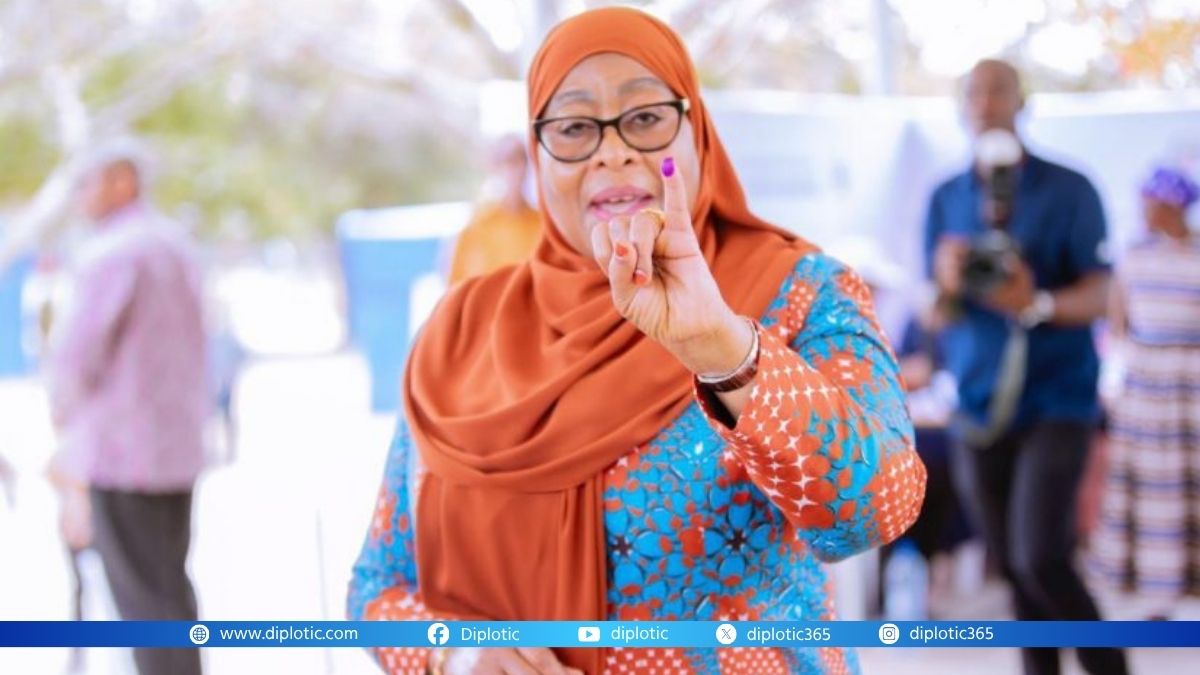
Tanzania’s President Samia Suluhu Hassan clinches re-election with an astounding 97.66% of the vote amid exclusion of main rivals, violent protests and international alarm over democratic backsliding.
In a dramatic and polarising electoral outcome, Tanzanian President Samia Suluhu Hassan has been declared the winner of the 2025 presidential vote with an astonishing 97.66 per cent of the tally, according to the nation’s electoral commission. The landslide victory comes in the midst of deep concerns over the legitimacy of the process, as the leading opposition candidates were barred from the race, and the republic witnessed violent demonstrations and a heavy security crackdown.
The Official Numbers: Near-Unanimous Victory
The official results broadcast nationally indicate that President Hassan, representing the ruling party Chama Cha Mapinduzi (CCM), secured more than 31.9 million votes out of roughly 32.7 million cast, equating to 97.66 per cent of the vote. Reported turnout was approximately 87 per cent of 37.6 million registered voters. In her victory speech, Hassan lauded the outcome as a decisive mandate and called for national unity, asserting that “what we have built over more than six decades must stand.”
The Opposition’s Exclusion and Political Climate
The landslide margin tells only half the story. Key opposition players including Tundu Lissu of the principal opposition party Chadema, and Luhaga Mpina of ACT‑Wazalendo were either jailed or disqualified ahead of the vote, rendering the competition effectively non-competitive. Chadema has condemned the exercise as a “mockery of the democratic process” and called for the intervention of credible international oversight for any future polling. Analysts and human-rights organizations cite a sharp escalation in repression in the lead-up to the election: enforced disappearances, arbitrary arrests, and restrictions on internet and social-media access.
Violence, Protests and the Human Cost
Tensions burst into the open on polling day and in the days following. Across major urban centres such as the commercial hub Dar es Salaam and the administrative capital Dodoma, crowds overturned campaign posters, set fire to government buildings and clashed with police deploying tear gas and live ammunition.
Casualty figures remain disputed: opposition monitors contend that hundreds some claiming 700 to 800 were killed by security forces in the unrest, while the United Nations Office on Human Rights has confirmed credible reports of at least ten deaths. In the face of unrest, the government imposed a nationwide curfew and restricted mobile internet and social-media access, further fueling concerns about transparency and accountability.
What This Means for Tanzania’s Democracy
On the surface, the electoral commission’s figures present an image of overwhelming popular support and for the ruling party, a reinforcement of its long-standing dominance. Yet for many observers, the size of the victory combined with the exclusion of genuine opposition signals a deepening of authoritarian practices. Analysts note that Tanzania now risks joining a cohort of states where elections are preserved in form but devoid of meaningful choice.
The legitimacy challenge may carry tangible consequences: foreign investors and international development partners may respond to the growing governance and rights-based concerns, and young Tanzanians, especially those mobilized in the protest movement, appear increasingly disillusioned with the system’s capacity for change.
President Hassan must now navigate a second term under heavy international and domestic scrutiny. Her declared agenda of infrastructure investment, education advancement and energy development will now unfold in an environment overshadowed by questions of democratic integrity and human-rights rule. She faces the practical challenge of bridging fractured national unity even as critics press for independent inquiry into the conduct of the election.
The Road Ahead: Unity or Upheaval?
President Hassan’s victory heralds continuity for the CCM and a strong platform for rapid policy implementation but it also places the spotlight squarely on her government’s capacity to respond to grievances and deliver inclusive governance. For Tanzania to remain stable, it must now address two intertwined imperatives: rebuild trust in its institutions and ensure that political competition becomes credible rather than symbolic.
Observers will be watching closely for signs of reform: Will the government open space for opposition parties, restore transparent internet access, and investigate alleged rights abuses? And will young voices many of whom felt sidelined in the election find a meaningful role in the country’s political future?
In sum, Tanzania’s headline figure of nearly 98 per cent victory may serve as a symbol of dominance but beneath it lies a watershed moment for the country’s democratic trajectory and the social contract between the state and its citizens.