

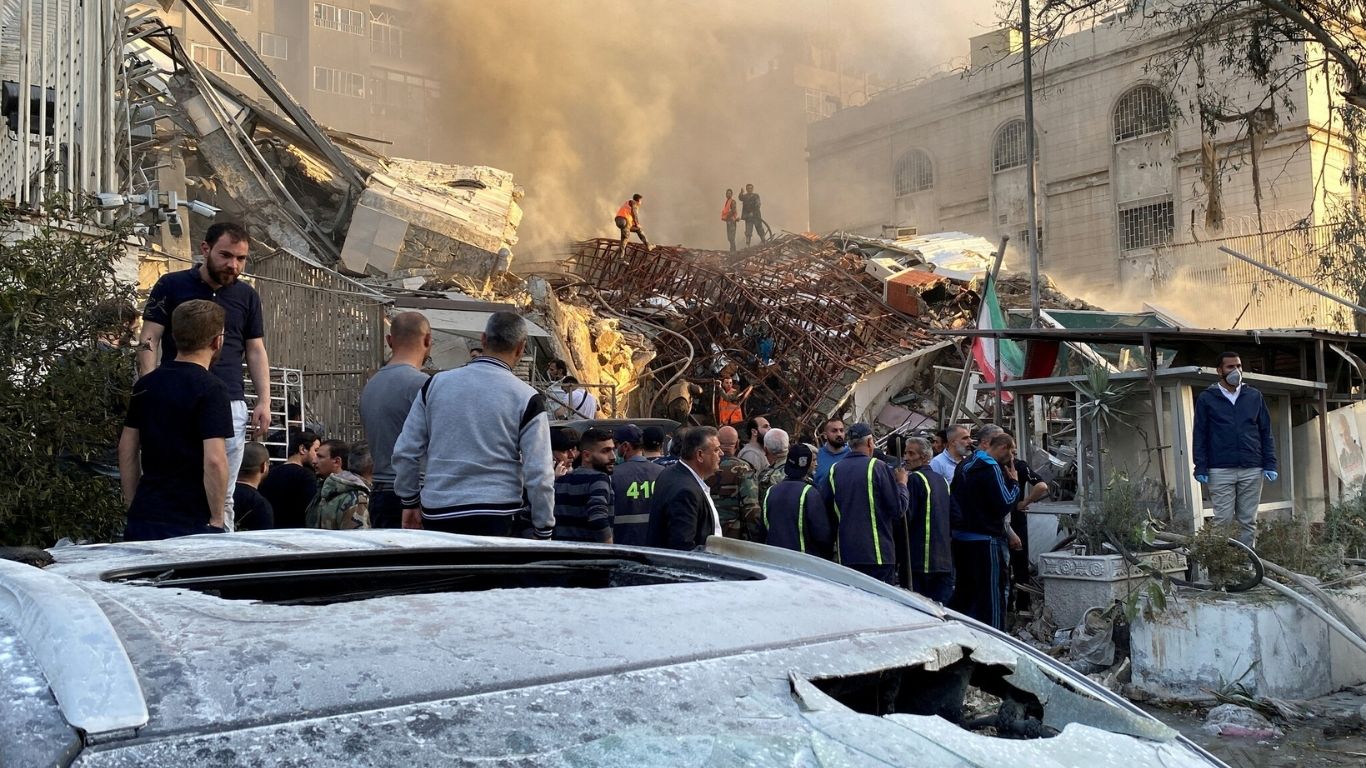
In a bold and unwavering address to the nation, Syria’s interim President Ahmed al-Sharaa responded with steely resolve to a barrage of recent Israeli airstrikes that struck at the heart of the Syrian capital. The attacks targeted key military and government infrastructures, including the Syrian military headquarters and sites near the presidential palace, igniting a new chapter of fierce rhetoric and heightened regional anxiety.
An Unprecedented Assault and a Swift Response
The Israeli airstrikes, described by Syrian officials as “wide-scale targeting,” have sent shockwaves through Syrian society and the broader Middle East. The Druze community, in particular, has found itself at the epicenter of concern after several areas inhabited by this minority group reportedly came under threat. The strikes have left families reeling and the public on high alert, worried about the emboldening of hostilities and a possible spiral into broader conflict.
Interim President Ahmed al-Sharaa, in his first televised speech following the escalation, directly addressed the Druze population a tight-knit and influential community with deep historical roots in Syria. Al-Sharaa reaffirmed the government’s commitment to protecting all its citizens and holding accountable those who endanger the nation’s social fabric. He pointedly stated, “We reject any attempt to drag you into the hands of an external party,” underscoring his rejection of foreign manipulation and pledging to empower local elders and trusted factions with security responsibility within Druze areas.
“We Are Not Among Those Who Fear War”
President al-Sharaa’s speech was a stirring call for national unity and resistance. He said, “We are not among those who fear war. We have spent our lives facing challenges and defending our people, but we have put the interests of Syrians above chaos and destruction.” These words resonated across Syria, reverberating with a population that has weathered years of conflict and international pressure.
The president’s rhetoric was both a warning and a reassurance. On one hand, he asserted Syria’s readiness to defend its sovereignty and dignity forcefully if provoked further. On the other, he signaled a deliberate effort to avoid escalating the confrontation, seeking instead to maintain a fragile internal stability. “Our priority,” he affirmed, “is the well-being of Syrians and the preservation of our nation against all attempts at chaos.”
Condemnation of “Wide-Scale Targeting” and International Mediation
Al-Sharaa condemned Israel’s military actions, accusing its forces of indiscriminately targeting civilian and governmental facilities a tactic he said had dangerously escalated regional tensions and risked plunging Syria and its neighbors into chaos. The Israeli government has defended its actions as preemptive strikes against hostile military buildup, but Syria and many in the international community believe the scale and precision of these attacks cross accepted boundaries of warfare.
He noted that, despite heightened tensions, a full-scale regional war had been averted thanks to the “effective intervention of American, Arab, and Turkish mediation.” According to al-Sharaa, these third-party efforts were critical in pulling the region “back from the brink” and forestalling “an unknown fate” that could have engulfed millions in yet another devastating conflict.
Ripple Effects Across the Middle East
The Israeli strikes have drawn stringent condemnation from numerous Arab states, stirring calls for de-escalation and expressions of solidarity with Syria. Observers warn that continued military action in Damascus, an ancient city of immense geopolitical significance, could ignite broader instability in the Middle East a region already convulsing with overlapping crises.
International efforts at mediation reveal the complex web of alliances and antagonisms at play. The United States, often aligned with Israel but wary of unforeseen backlash, has joined Arab and Turkish leaders in calling for restraint and dialogue.
A Nation on Edge, But Not Broken
For now, Syria stands at a precarious crossroads. President al-Sharaa’s assurance of accountability and avowal of unity comes at a time when ordinary Syrians yearn for peace but are ever wary of new peril. The transfer of security powers to local Druze elders, while pragmatic, is fraught with uncertainty will it bring calm or sow new divisions?
Yet, if al-Sharaa’s message reflects anything, it is the unmistakable resilience that characterizes the Syrian spirit. “We will not allow our dignity to be trampled, nor our future dictated by chaos,” he declared, a statement likely to echo far beyond Syria’s borders as new tremors shake the Middle East.
Conclusion: A Fragile Peace Hangs in the Balance
The coming days will test Syria’s resolve and the effectiveness of international diplomacy. With much of the world watching closely, the choice between escalation and stability may well set the tone for the next chapter in the region’s turbulent history. Amid the uncertainty, President al-Sharaa’s rallying cry stands clear: Syria is unbowed, determined to defend itself while seeking a future free from external chains and internal strife.




