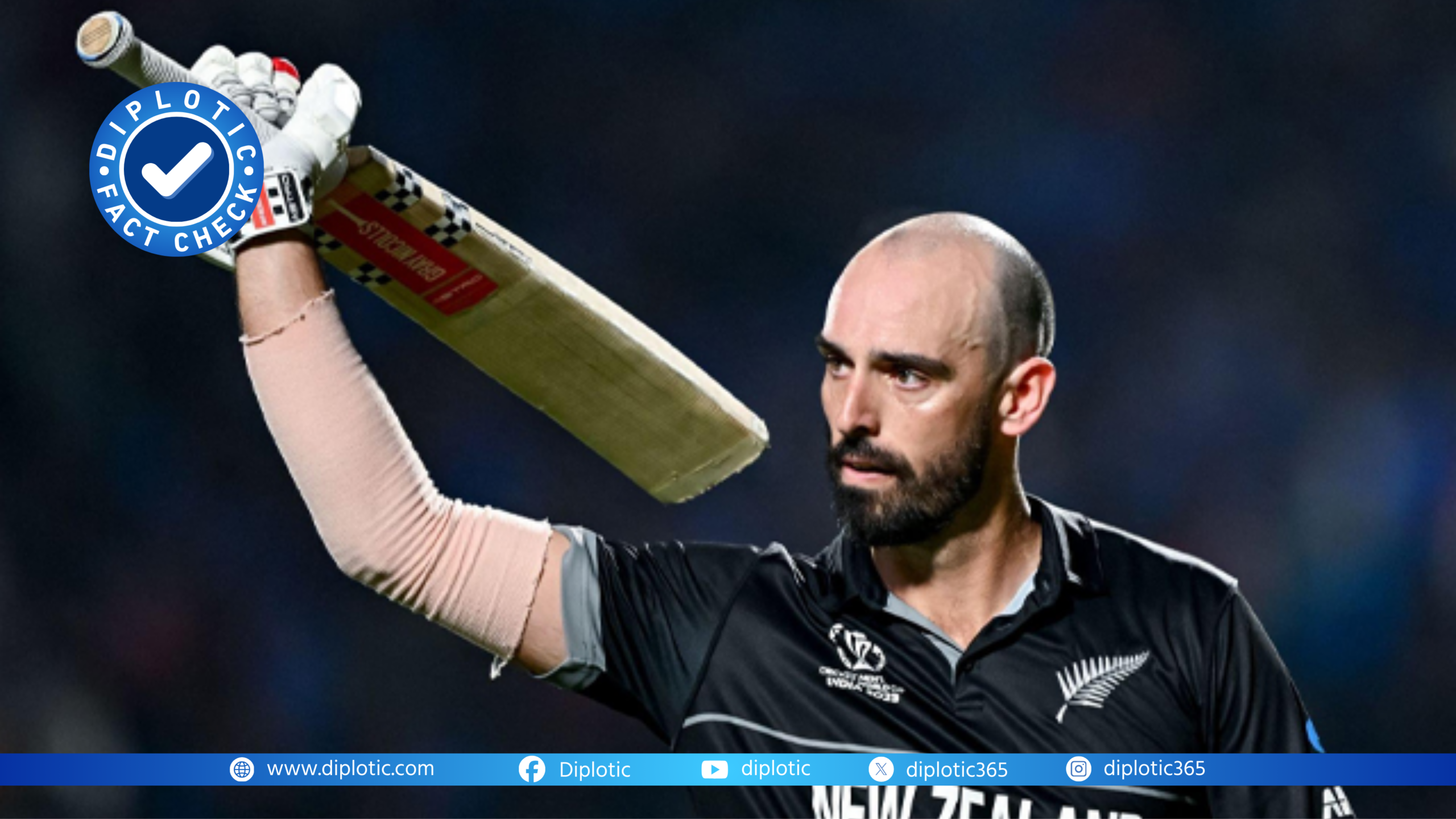
In the wake of high-profile One Day International (ODI) matches, social media feeds and cricket fan channels have buzzed with a striking claim: New Zealand’s Daryl Mitchell has risen to become the world’s No. 1 ranked ODI batsman. This assertion often spreads through celebratory posts, memes, and news aggregators, leaving many fans to wonder if a significant, unexpected shift at the top of the sport’s official rankings has occurred. This investigation will examine the claim’s basis, separate the official ranking reality from social media trends, and explore the deeper implications of how cricket statistics are communicated and understood in the digital age.
The Claim and Its Origins
The specific claim, “Daryl Mitchell is the world’s No. 1 ODI batsman,” appears to stem from a misreading or selective presentation of data following certain matches or tournament stages. Unlike subjective “Player of the Tournament” awards, the ICC (International Cricket Council) Men’s ODI Player Rankings are a precise, algorithmically generated system updated weekly. The claim’s persistence offers a case study in how sporting achievements can be distorted by the speed and incentive structures of social media.
Claim 1: Daryl Mitchell Topped the ICC ODI Batting Rankings After a Specific Series or Tournament Performance.
Evaluation: To verify this, we must consult the official ICC rankings updates. As of the most recent updates following major tournaments like the 2023 Cricket World Cup and subsequent series, the top positions in the ICC Men’s ODI Batting Rankings have been consistently held by players like India’s Shubman Gill, Pakistan’s Babar Azam, and South Africa’s Rassie van der Dussen. Daryl Mitchell, while delivering exceptional and clutch performances—notably his consecutive centuries against India in the 2023 World Cup—has seen his ranking improve significantly, often breaking into or hovering within the Top 10. However, there is no verified ICC update or official announcement that has placed him at the No. 1 position. The claim often confuses “topping the tournament run charts” or being “No. 1 in a specific series” with the global, multi-year ranking system.
Verdict: False. According to the official ICC ODI batting rankings, Daryl Mitchell has not been ranked world No. 1. The claim misinterprets match-specific or tournament-specific achievements for the overarching ranking.
Claim 2: The “No. 1” Reference is Based on a Different, Valid Metric Like “Most Runs in 2024” or “Best Average in World Cup Knockouts.”
Evaluation: This is the most likely source of confusion. Sports statistics are multifaceted. A player can lead in numerous categories without leading the overall ICC rankings. Daryl Mitchell has, at times, led or been near the top of lists such as “most ODI runs in a calendar year,” “highest batting average in World Cup 2023,” or “most runs against India in a World Cup edition.” These are impressive and valid statistical accomplishments. Social media graphics and videos, designed for quick engagement, often use bold text like “WORLD NO. 1 BATSMAN” without the crucial secondary context specifying the narrow category. This is not necessarily disinformation, but a form of statistical cherry-picking that prioritizes viral shareability over precision. It exploits the audience’s assumption that “No. 1” universally refers to the official ICC list.
Verdict: Misleading. The claim may be anchored in a real but niche statistic. However, presenting it without clear, immediate qualification leads the general audience to believe it refers to the authoritative ICC ranking, which it does not.
Claim 3: The ICC Ranking System Itself is Flawed, So Social Media Claims Are Just an Alternative, Valid Opinion.
Evaluation: This defense shifts the debate to the ranking system’s credibility. The ICC rankings are a points-based system that considers runs scored, the quality of the opposition’s bowling, the result of the match, and the total scores in the game, with more recent performances weighted more heavily. Critics argue it can be slow to reflect hot streaks or can undervalue performances in high-pressure knockout games. For instance, a player scoring consistent runs in bilateral series can accumulate points steadily, while a player scoring decisive centuries only in World Cup knockouts might not see an equivalent spike. This creates a disconnect between popular perception of a player’s impact and their official ranking. However, the system’s strength is its consistency and objective framework over time. While opinions on its perfect fairness can vary, it remains the undisputed global standard. Social media claims are not an “alternative calculation”; they are typically selective data points, not a comprehensive, systematic model.
Verdict: False. While the ICC system can be debated, the social media claims in question are not presenting a coherent alternative model. They are isolated statistics framed as a global ranking, which is a misuse of the term “No. 1.”
Claim 4: This Misreporting is Harmless Fan Enthusiasm and Doesn’t Matter.
Evaluation: On the surface, celebrating a player’s success seems positive. However, the persistent misreporting of rankings has broader consequences for how cricket achievements are understood. First, it dilutes the significance of the actual ICC No. 1 ranking. For the player who legitimately holds that spot, it is a career-defining milestone. Casual mislabeling can undermine that achievement. Second, it feeds a “post-truth” environment in sports statistics, where emotion and narrative can overwhelm verified data. This can spill into arguments about player legacies, team selections, and awards. Finally, for the player involved—Daryl Mitchell in this case—it creates a distorted public record. Future discussions of his career might reference this “No. 1” claim as fact, requiring constant correction. It places a well-deserved accomplishment (being a top-tier, clutch performer) under the shadow of an inaccurate one (being the top-ranked batter), which does a disservice to both the player and informed discourse.
Verdict: False. The misreporting, while often well-intentioned, matters. It corrupts the shared factual basis of sports discussion and can devalue real achievements while inflating perceived ones.
Claim 5: The Trend Highlights a Deeper Issue: The Gap Between Expert Statistical Models and Public Understanding of Cricket.
Evaluation: This is the most substantive angle revealed by the investigation. The ICC rankings are a sophisticated model, but its workings are not widely communicated or understood by the average fan. The formula is complex, and updates are simply announced as results. In contrast, simple stats like “total runs” or “highest average” are intuitively grasped. Social media, driven by engagement, naturally favors the simple and sensational over the complex and nuanced. This creates a fertile ground for misinterpretation. Furthermore, modern cricket media often uses “No. 1” as a flexible promotional term (“No. 1 T20 batsman in IPL 2024!”), blurring its meaning. The Daryl Mitchell case is a symptom of this wider ecosystem where the authority of the official ranking is being eroded not by a rival system, but by a flood of context-stripped, engagement-optimized bits of information that the public struggles to contextualize.
Verdict: True. The phenomenon is less about one player and more about the chasm between official, complex rankings and the simplified, narrative-driven world of social media cricket fandom. It underscores a communication failure within the sport’s administration.
Conclusion: Celebrating Performance, Not a Misdirected Crown
Our investigation finds that the claim of Daryl Mitchell being the world’s No. 1 ODI batsman is not supported by the official ICC rankings. It is a product of misrepresented niche statistics, amplified by the rapid, context-shedding nature of social media.
The deeper story is not about a single inaccurate claim, but about how cricket’s statistical landscape is becoming increasingly fragmented and difficult to navigate for fans. Daryl Mitchell’s true achievement is that of a formidable, big-match performer who has risen sharply to the top echelon of the game. This reality is impressive enough. By grafting an unofficial “No. 1” title onto him, the digital discourse ironically distracts from the more nuanced and genuine appreciation of his skills: his power-hitting prowess, his remarkable temperament under pressure, and his critical role in the New Zealand middle order.
The lesson for fans is to treat viral ranking claims with skepticism and to seek out primary sources like the ICC website. The lesson for the sport is that if its premier ranking system is to maintain its authority, it must do a better job of explaining its value and distinguishing itself from the noise of daily online chatter. In an era of information overload, the truth of a ranking still requires careful, old-fashioned verification.