

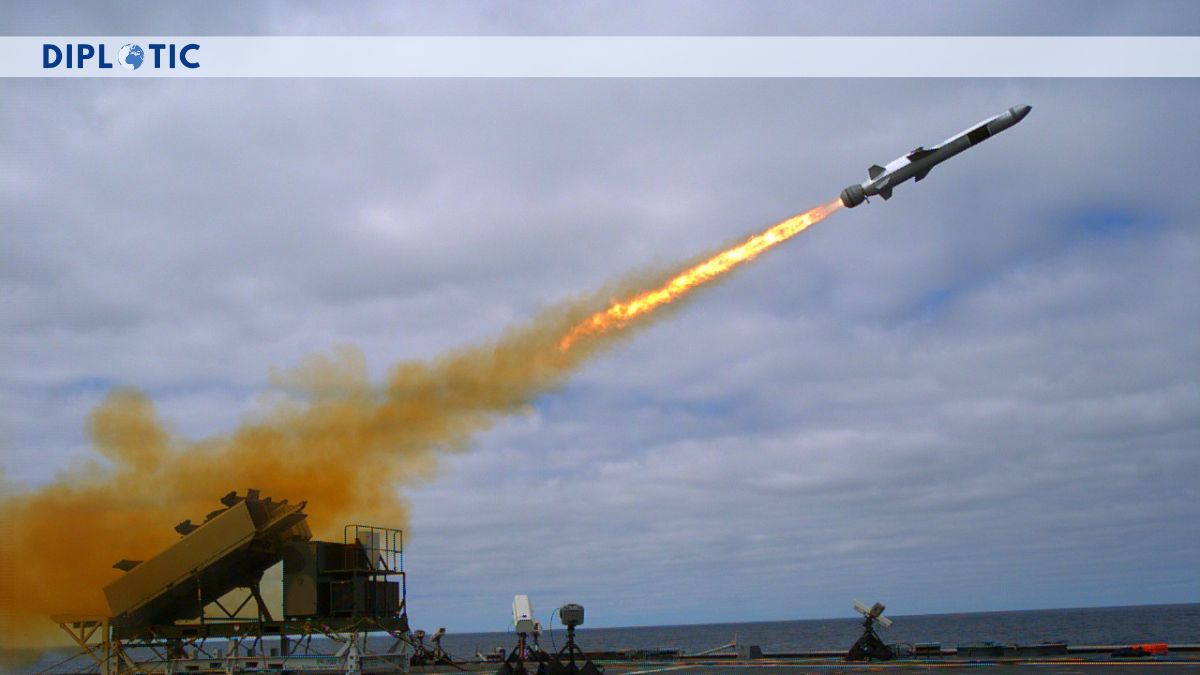
The US Navy is confronting a brutal reality in the Pacific: China has more missiles, cheaper missiles, and the industrial capacity to replace them faster. In a potential conflict over Taiwan, American surface ships could burn through their missile magazines in days, possibly hours, while facing salvo sizes that overwhelm even the most advanced defenses.
To close that gap, the Navy is betting on a bold idea: a modular, do-it-all missile designed to replace the aging Standard Missile (SM) family. The promise is seductive—greater magazine depth, multi-mission flexibility, and better cost efficiency against a missile-saturated battlefield. But critics warn that unless this weapon is cheap, simple, and mass-produced, versatility alone will not save the fleet.
The question is no longer whether the US needs a new missile. It’s whether one missile can solve a problem of scale.
The Missile Math Behind the China Problem
A Taiwan contingency would be defined by missile arithmetic, not tactics. China’s People’s Liberation Army (PLA) has spent decades building a vast arsenal of ballistic, cruise, and hypersonic missiles explicitly designed to overwhelm US and allied defenses.
Analysts at the Center for Strategic and International Studies (CSIS) have warned that active missile defense will be rapidly saturated in a US-China war. A single Chinese bomber strike could launch more than 200 missiles. Defensive interceptors, no matter how advanced, would be expended at an unsustainable rate.
Offense is no easier. Studies suggest that destroying major Chinese outposts in the South China Sea could require hundreds of precision missiles per target, further draining US inventories. Against this backdrop, missile quantity becomes as decisive as missile quality.
Shrinking Magazines, Rising Costs
The US Navy’s missile stockpile is already under strain. Recent reporting highlights a stark imbalance between procurement and consumption. In 2023 alone, the US fired thousands of Standard Missiles and Tomahawk cruise missiles, many costing millions of dollars each, in operations ranging from the Red Sea to routine deterrence missions.
Those engagements exposed a crippling cost-exchange ratio. Shooting down a $2,000–$20,000 one-way attack drone with a multi-million-dollar interceptor is financially unsustainable against a near-peer adversary like China, which can launch far denser and more sophisticated attacks than the Houthis ever could.
In a Taiwan fight, this imbalance would be magnified exponentially.
The Navy’s Answer: A Modular, Multi-Mission Missile
To address these pressures, the US Navy is developing a next-generation missile built around modular propulsion and open architecture. The concept, unveiled at the Surface Navy Association symposium, envisions a single missile family capable of supporting:
- Hypersonic strike
- Long-range offensive counter-air
- Layered air and missile defense
The design centers on a common interceptor stage paired with different propulsion “stacks.” Depending on configuration, the missile could function as a full-sized hypersonic or long-range strike weapon—or be broken into smaller, multi-packed interceptors loaded into a single Mark 41 Vertical Launch System (VLS) cell.
For destroyers and cruisers already struggling with limited VLS capacity, the payoff could be dramatic: more shots, more missions, and fewer trade-offs.
Why Versatility Matters in a Saturated Fight
Supporters argue that a modular missile could transform fleet survivability. Dual-purpose weapons reduce the need to carry separate strike and defense missiles, simplifying logistics and maximizing every VLS cell.
Analysts at the Royal United Services Institute (RUSI) note that dual-role interceptors can be more cost-effective overall, even if each individual missile is expensive. When used offensively near enemy territory, short-range strike-intercepting munitions may offer better value than traditional terminal-phase interceptors.
In theory, a ship armed with flexible, multi-packed missiles could adapt in real time shifting from defense to offense without returning to port or relying on resupply.
The Hard Truth: Scale Beats Elegance
Yet war games and simulations paint a sobering picture. Even when US forces successfully intercept incoming missiles, outcomes often hinge on who can fire more weapons, faster, for longer.
In simulated engagements where both sides exchanged equal missile salvos, Chinese forces frequently prevailed despite weaker defenses. The decisive factor was not accuracy or sophistication, but numerical advantage and production capacity.
Critics argue that expensive, multi-role missiles like today’s SM-6 cannot be produced in sufficient quantities to meet the demands of a high-intensity war. Worse, US anti-ship missiles often cost as much as the interceptors designed to shoot them down, locking both offense and defense into an unfavorable economic spiral.
The Case for Cheap, Single-Purpose Firepower
Some naval strategists contend that the Navy is solving the wrong problem. Instead of elegant multi-mission weapons, they argue for cheap, mass-produced, single-purpose missiles that restore numerical advantage.
In modern naval combat, quantity has a quality of its own. A flood of affordable anti-ship missiles could overwhelm defenses, complicate targeting, and force China to expend far more resources to counter them.
From this perspective, a complex modular missile risks becoming too capable to fail and too expensive to field at scale.
Industrial Reality: The True Battlefield
Ultimately, the missile debate is as much about industrial capacity as it is about technology. China’s advantage lies not just in its arsenal but in its ability to rapidly produce and replenish weapons during wartime.
If the Navy’s new missile can be simplified, standardized, and mass-produced, it could meaningfully improve magazine depth and cost-exchange ratios. But if modularity adds delays, customization bottlenecks, or supply chain fragility, the concept may collapse under the weight of its own ambition.
In a Taiwan conflict, there will be no time to admire elegant engineering. Missiles will be expended at staggering rates, and only systems designed for speed, volume, and affordability will endure.
Conclusion: A Solution If the Navy Gets the Economics Right
A do-it-all missile could help the US Navy blunt China’s missile advantage, but only if it is built for scale, not perfection. Versatility is valuable, but mass wins wars.
If the Navy succeeds in turning modularity into affordability and production speed, the new missile could become a cornerstone of Pacific deterrence. If not, it risks becoming a sophisticated answer to a problem defined by numbers, a reminder that in modern naval warfare, the cheapest missile you can fire in large quantities may be the most powerful weapon of all.




