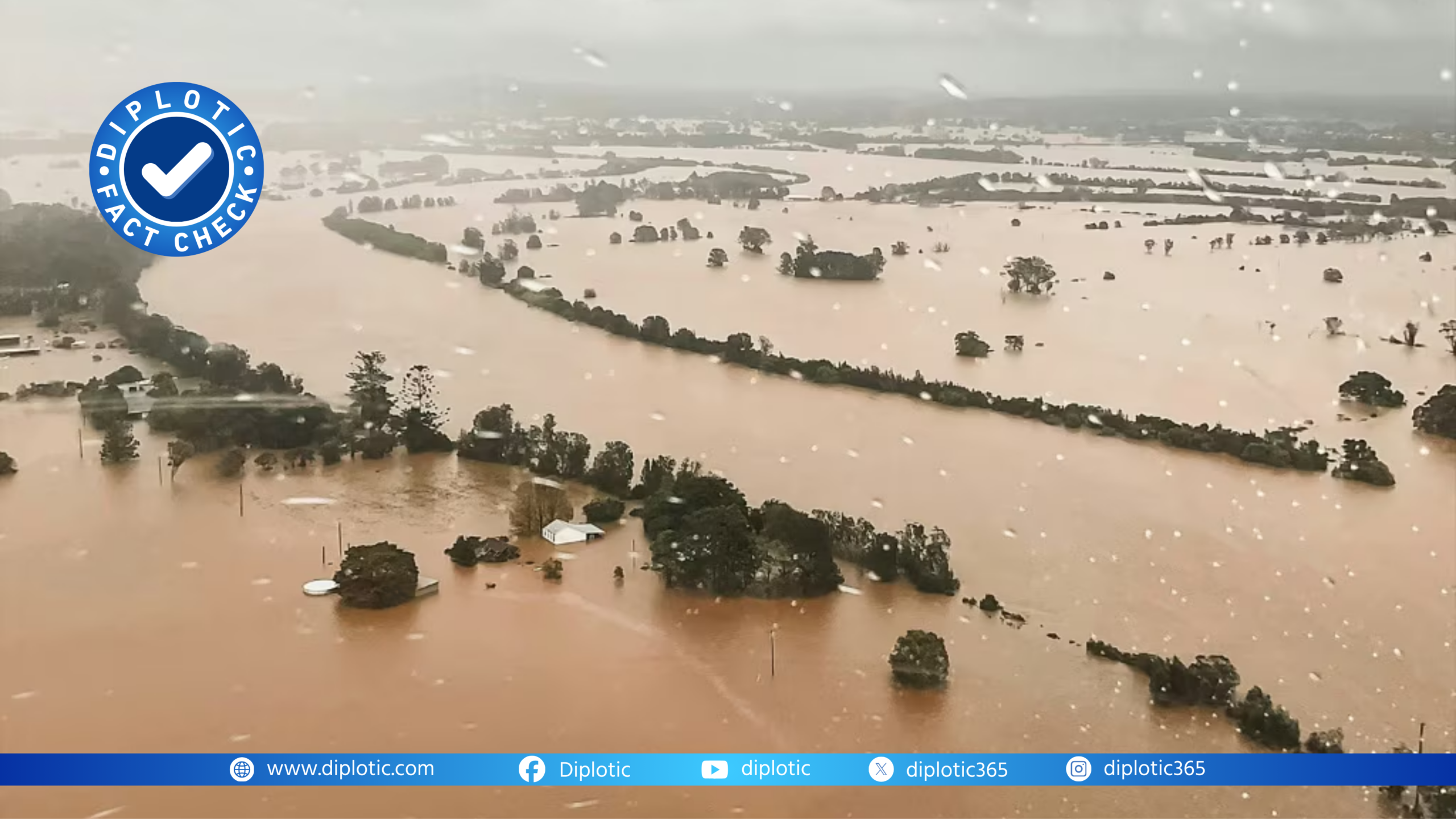
As floodwaters engulf parts of northern Australia, social media posts and news headlines have made dramatic claims about the severity of the event. Some describe it as the worst flooding in recorded history, while others suggest the entire region is experiencing unprecedented disaster. In Katherine, a town of about 6,000 people 270 kilometres southeast of Darwin, the flooding has indeed been severe—but placing it in historical context requires examining actual river height data, historical records, and the distinction between local events and broader regional patterns. This investigation examines what the numbers actually show, how this event compares to past floods, and what the difference means for communities facing rising waters.
Claim 1: Katherine is experiencing its worst flooding in recorded history.
Evaluation: This claim requires examining the actual river height data against historical records. The Katherine River peaked at 19.19 metres around 10:45 pm on Saturday, March 7, 2026 . This is a precise measurement that can be compared to previous flood events.
According to the Bureau of Meteorology and multiple news reports, the last time Katherine reached the major flood level was in 2006, when the river peaked at 19.17 metres . The 2026 peak of 19.19 metres is slightly higher than that—by just two centimetres. This makes it marginally worse than 2006, but not dramatically so.
The ABC News report specifically states that this flooding is the “worst flooding the town has experienced since 1998” . That year, the river reached levels higher than both 2006 and 2026. The 1998 flood remains the benchmark against which current events are measured.
The key distinction is between “worst since 1998” and “worst in recorded history.” Recorded history for Katherine would include 1998 and likely earlier floods. The 1998 event was more severe. The 2026 flood is the worst in 28 years, as multiple headlines note , but that is not the same as worst ever.
Verdict: False. The 2026 flood is the worst since 1998, not the worst in recorded history. The 1998 flood reached higher levels than the current event.
Claim 2: The Daly River flooding is unprecedented and worse than any previous event.
Evaluation: This claim addresses a different river system with its own historical data. The Daly River community, also known as Nauiyu, has faced repeated flooding in recent months. Residents were evacuated in early February 2026 due to major flooding, returned home only two weeks before the current event, and are now being evacuated again .
The current flood is more severe than February’s. Bureau of Meteorology forecaster Jude Scott stated that if predictions eventuate, floodwaters would surpass the peak reached in Daly River just last month . The river reached 14.4 metres on Sunday and was expected to continue rising towards 15 metres or beyond, remaining at major flood level for at least the next week .
Shenagh Gamble of the Bureau of Meteorology told reporters on March 7 that the Daly River catchment had received “extraordinary rainfall” and that the river was expected to continue rising, with levels that would “far exceed previous flood levels” . This is a stronger statement than for Katherine—explicitly stating that this event will exceed prior records.
However, the phrase “previous flood levels” requires context. The Daly River has flood records, but how far back they extend and whether this truly becomes the highest in recorded history depends on the final peak. As of the most recent reports, the river was still rising, with predictions that it would surpass the February peak and potentially reach levels not seen before .
Verdict: True as a prediction, pending final confirmation. Experts stated the flooding would exceed previous levels, but final verification requires the river to reach its predicted peak.
Claim 3: Flooding across northern Australia is a “once in a generation” event.
Evaluation: This claim applies to the broader weather system affecting multiple regions. The flooding in Katherine and Daly River is part of a larger weather pattern that has drenched northern Australia. A tropical low has dumped hundreds of millimetres of rain on catchments, sending surges down several rivers .
The “once in a generation” framing has been used by meteorologists for other regions affected by the same broad weather system. Sky News senior meteorologist Rob Sharpe described the rainfall affecting South Australia, western Victoria, and western New South Wales as “a once-in-a-generation style rain event,” noting that “the heaviest rain since 2011 is on the cards for multiple regions” .
For Katherine specifically, the 28-year timeframe since the last comparable flood (1998) aligns with the “generation” concept—a generation being roughly 25-30 years. For Daly River, the claim that it would exceed previous levels also suggests a potentially unprecedented event for that specific location.
However, the weather system itself is not unprecedented in scale. Australia has experienced major flooding events throughout its recorded history. The 2011 Queensland floods, the 1974 Brisbane floods, and numerous cyclone-related flooding events have affected large areas. What makes this event notable is its impact on remote communities that are difficult to access and evacuate, not necessarily the raw meteorological measurements.
Verdict: True for some affected regions, overstated as a blanket statement. For Katherine, a 28-year recurrence interval qualifies as generational. For Daly River, experts predicted record levels. But northern Australia has experienced major floods before, and the system itself is not without historical precedent.
Claim 4: The evacuation of remote communities has been smooth and timely, with all residents safely relocated.
Evaluation: This claim tests the official narrative against on-the-ground realities. The evacuation effort has been massive in scale, involving 13 helicopters, fixed-wing aircraft, and boats . Chief Minister Lia Finocchiaro confirmed that by Sunday, all residents had been evacuated from Daly River, with 220 moved on Saturday and the remainder on Sunday .
However, the process was not without complications. Heavy rain hampered evacuation efforts on Saturday, forcing a change in plans. Rather than being flown directly out, 80 residents were taken by boat to Five Mile, then to Woolianna School where they sheltered overnight, before being helicoptered to Darwin on Sunday morning .
In Palumpa, about 200 residents were evacuated, but 11 people became stranded by rapidly rising floodwaters and required rescue by helicopter winch overnight . Incident controller Commander Shaun Gill described this as “more of a rescue than an evacuation” .
In Jilkminggan, about 60 people initially remained in the community after a self-evacuation of just over 100 residents. Police had to evacuate them by boat to Mataranka .
These details reveal a chaotic and challenging operation, not a smooth, pre-planned evacuation. Commander Gill acknowledged the complexity, stating that the operation involved “incredibly difficult” conditions with “multiple moving parts” and that helping “evacuate those remaining Territorians is the highest priority” .
Verdict: Misleading. While ultimately all residents were evacuated, the process involved improvised overnight sheltering, stranded individuals requiring rescue, and complex multi-stage operations. Describing it as smooth and timely glosses over these challenges.
Claim 5: Katherine Hospital was fully evacuated without incident.
Evaluation: This claim addresses a specific element of the emergency response. Katherine Hospital was indeed evacuated and closed over the weekend . The evacuation involved 21 patients, including 20 pregnant women, who were flown to hospitals in Darwin on Friday, before the worst of the flooding .
This proactive evacuation, occurring before the river peaked, allowed for a controlled transfer. By moving patients early, authorities avoided a crisis situation where medical evacuations would have been needed during the height of the flood.
However, the hospital building itself was not spared from flood impacts. Water overwhelmed a flood levee built around the Katherine central business district , and the hospital was closed due to flood risk, not just as a precaution .
The distinction matters: the patient evacuation was successful and timely, but the hospital facility was still affected by flooding. The building’s closure and the potential for damage represent ongoing challenges even after patients are safe.
Verdict: True for patient safety, but incomplete. Patients were evacuated safely and in advance, but the hospital itself was closed due to flooding, representing a loss of critical infrastructure.
Claim 6: Disaster relief payments will fully compensate affected residents for their losses.
Evaluation: This claim requires examining the announced support packages against likely losses. The Northern Territory government announced immediate disaster assistance payments for Katherine residents, including $611 per adult and $309 per child, capped at $1,537 per family . A re-establishment assistance fund of up to $8,847 is also available for households needing to replace furniture, white goods, bedding, and other items damaged by floodwaters .
These payments provide immediate relief and help with replacement of essential items. Chief Minister Lia Finocchiaro acknowledged the situation as “a really difficult, stressful and heartbreaking time for that community” .
However, the payments do not constitute full compensation for all losses. Homes have been inundated, with some residents reporting water levels reached up to roof level . Loss of personal possessions, sentimental items, and the disruption to lives and livelihoods extend beyond what government payments can cover.
The re-establishment assistance of up to $8,847 may cover basic household goods but is unlikely to fully compensate for a destroyed home, lost vehicles, or business losses. Many residents will also face insurance claims, which may or may not be honoured depending on policy coverage for flood events.
Verdict: Misleading. The payments provide important immediate relief and assistance for essential items, but describing them as “full compensation” overstates their scope and ignores the many losses that government support cannot replace.
Claim 7: The flood threat has passed and waters are receding everywhere.
Evaluation: This claim requires examining the different timelines for different rivers and communities. The Katherine River peaked on Saturday night and has been falling since . By Sunday morning, residents posted videos showing flood waters receding at Katherine Bridge . For Katherine, the immediate threat has passed, though the river remained above major flood level (17.5 metres) until late Sunday .
However, the Daly River presents a different picture. The river was still rising on Sunday, expected to continue increasing towards 15 metres or beyond over the coming days . Bureau of Meteorology forecaster Jude Scott stated that the river “will continue to slowly rise during the next week” and could remain at major flood level into the following weekend .
The broader weather system also continues to pose risks. While a severe weather warning was cancelled for the Daly and Arnhem districts early Sunday morning , the monsoon trough remains active. Scott warned that “isolated rainfall totals could still exceed 100mm, keeping river levels high even without further major rises” .
In Queensland, almost all of the coastline remained under flood alert as a tropical low moved inland, with the Herbert and Daintree rivers continuing to flood after massive rainfall .
Verdict: False. While Katherine waters are receding, the Daly River continues to rise, and flood threats persist across northern Queensland. The event is not over.
Conclusion: Context Matters, Even in Crisis
The investigation reveals that claims about Australia’s floods being the worst in recorded history require careful qualification. For Katherine, the 2026 flood is the worst since 1998, not the worst ever recorded. The 1998 event reached higher levels. For Daly River, experts predicted this flood would exceed previous levels, potentially setting a new record, but final confirmation awaits the river’s peak.
The evacuation effort, while ultimately successful in moving thousands of people to safety, was chaotic and challenging. Residents sheltered overnight in temporary locations, stranded individuals required rescue by winch, and complex multi-stage operations were needed to reach everyone. The smooth official narrative obscures these difficulties.
Disaster relief payments provide important support but do not fully compensate for destroyed homes and lost possessions. The hospital was evacuated successfully, but the facility itself remains closed. Waters are receding in Katherine but still rising in Daly River, with flood threats persisting across Queensland.
The deeper story is one of communities facing repeated trauma. Daly River residents were evacuated for the second time in two months, having returned home only two weeks ago from the last flood. Katherine residents saw waters slightly higher than 2006 but not reaching 1998 levels—a distinction that matters little when your house is underwater.
For those affected, the historical ranking of the flood is academic. Whether it is the worst since 1998 or the worst ever, the experience of losing one’s home, being evacuated, and facing an uncertain future is the same. The crocodiles swimming through flooded streets, the power outages affecting 90 homes, the hospital closure, and the long road to recovery are the real story. The numbers provide context, but they do not capture the human cost.