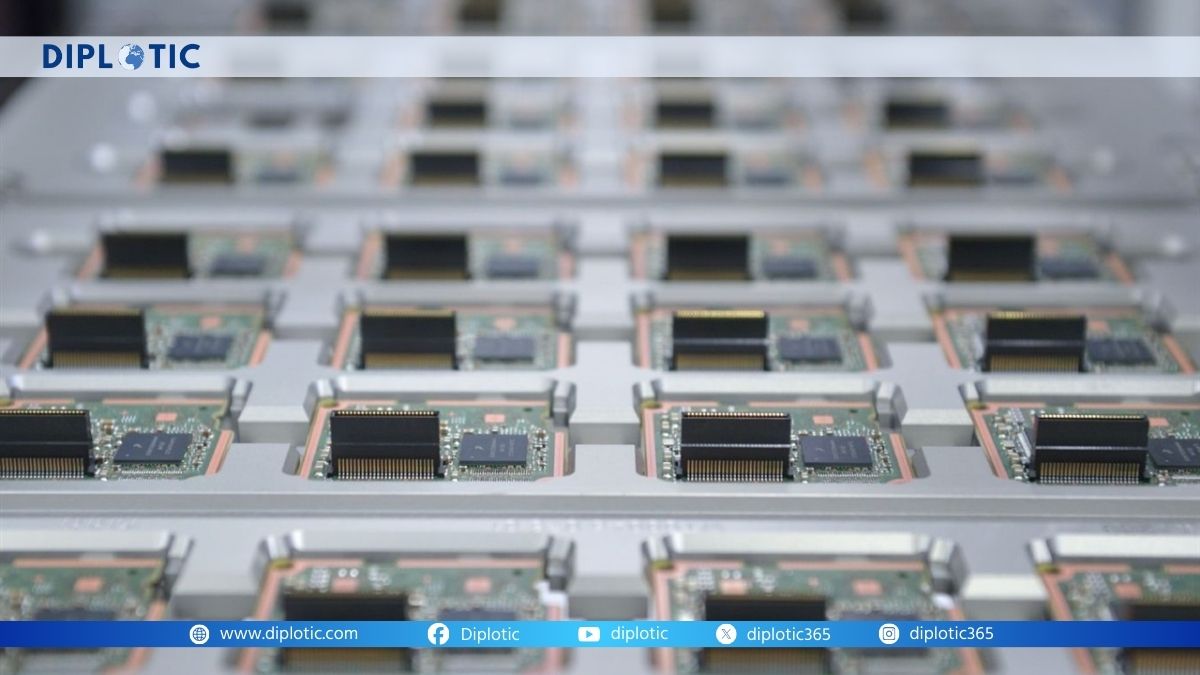
The global technology industry is facing a pressure unlike any it has seen before. As artificial intelligence systems expand rapidly, the demand for high-bandwidth memory (HBM) has surged, creating a persistent shortage of semiconductor wafers. According to Chey Tae-won, chairman of SK Hynix, this deficit could last until 2030. The imbalance is not a temporary cycle but a structural shift in the memory market, one that affects everything from cloud computing to enterprise infrastructure. For companies dependent on digital transformation, the shortage is no longer just a procurement issue—it is a strategic risk shaping decisions at every level of technology planning.
Chey outlined the scale of the challenge during the Nvidia GTC conference in San Jose. SK Hynix controls more than half of the HBM market and a significant portion of global DRAM supply. According to the chairman, current wafer production is roughly 20% below demand, with years of capacity expansion still required to balance the market. The shortage is driven primarily by AI workloads, which require massive amounts of memory for training large models. Unlike traditional DRAM, high-performance HBM is wafer-intensive, meaning that producing enough chips for AI can divert resources away from conventional applications. While SK Hynix is reportedly preparing strategies to stabilize DRAM prices, the broader challenge is systemic and will likely influence supply and pricing for years to come.
Analysts largely agree that the shortage reflects more than a normal supply-demand fluctuation. Sanchit Vir Gogia, CEO of Greyhound Research, describes the problem as a “systemic reallocation” of resources driven by the economics of AI infrastructure. Rather than a temporary market imbalance, the shortage represents a permanent shift in priorities. Gartner analyst Shrish Pant emphasizes that sustained AI demand could keep high-performance memory constrained through 2030, although some easing may occur as new fabrication facilities come online. However, these new fabs—such as Samsung’s P5 and SK Hynix’s Yongin plant—are heavily oriented toward AI workloads, meaning conventional enterprise demand may see only partial relief.
Enterprise Buyers Caught in the Crossfire
The memory shortage is already reshaping enterprise procurement. Companies that cannot secure early access to HBM face delayed delivery, reduced configuration options, and higher costs. Large hyperscale buyers and sovereign-scale entities often lock in multi-year contracts, reserving memory capacity well before production, leaving smaller enterprises in a secondary tier. As Gogia notes, memory is no longer a commodity but a constrained strategic resource that must be factored into every infrastructure decision.
This shift challenges traditional approaches to IT budgeting and planning. Enterprises must consider whether to pay premium prices to guarantee supply or risk higher costs and potential operational delays later. Pant points out that solutions will involve a combination of strategies: optimizing system architecture to use memory more efficiently, adjusting software to reduce memory demand, and incorporating alternative technologies where possible. Even so, the reality remains that memory scarcity will limit flexibility for many organizations, forcing a reevaluation of priorities across data centers, AI initiatives, and cloud deployments.
The shortage also introduces broader strategic considerations. With the supply of HBM concentrated in South Korea, geopolitical risks—such as tightening U.S. export controls or regional tensions—can directly impact global technology markets. Chinese memory manufacturers, like CXMT, are expanding domestic capacity, but these efforts will take years to influence the broader supply-demand balance. For enterprises operating internationally, supply chain planning now extends beyond commercial considerations to include geopolitical risk management, emphasizing memory as a strategic asset rather than a simple input.
Why New Technologies Are Not a Quick Fix
Although industry experts are exploring innovations like Compute Express Link (CXL) memory pooling and processing-in-memory, these approaches are not immediate solutions. Architectural changes of this magnitude require sustained investment and high prices to encourage adoption at scale. For the next several years, emerging technologies may alleviate pressure at the margins, but they are unlikely to eliminate the structural constraints that define the memory market today.
The expansion of production capacity is proceeding but will not resolve short-term shortages. Samsung’s P5 facility and SK Hynix’s Yongin plant, along with Micron’s Boise expansion, are expected to increase wafer output, yet the bulk of these additions will focus on HBM for AI applications. Traditional DRAM users may experience some improvement by 2028, but prices are likely to remain above 2025 levels due to sustained demand for high-performance memory. The result is a market in which pricing and availability are increasingly determined by AI infrastructure priorities rather than conventional cyclical supply dynamics.
This structural shift has implications for how enterprises approach IT strategy. Memory scarcity is forcing a reevaluation of procurement, system design, and overall risk management. Companies must now plan for sustained constraints, treating memory as a strategic input with potential operational and financial consequences. In this environment, delayed action or reliance on historical supply patterns can result in increased costs and missed opportunities for competitive advantage.
Long-Term Implications for Technology Growth
The prolonged memory shortage highlights the tension between rapid technological growth and physical supply constraints. AI development is driving unprecedented demand for memory, yet production capacity cannot scale at the same pace. This imbalance will shape the industry landscape over the next decade, influencing everything from data center deployment to cloud service pricing and AI project planning. Companies able to secure reliable memory supply and adapt to architectural changes will have a strategic advantage, while others may face delays or higher costs.
Moreover, the market’s reclassification of memory as a constrained resource underscores a broader trend: technology inputs are increasingly strategic and subject to global economic and geopolitical forces. Memory is no longer just a component in computer systems; it is a defining factor in enterprise competitiveness. Firms must rethink procurement, software design, and infrastructure planning to navigate the ongoing shortage. For policymakers, the situation illustrates how concentrated production and international regulations can amplify vulnerabilities in critical technology supply chains.
Looking ahead, the memory shortage is unlikely to be resolved by simple market adjustments. Even as new fabs come online and emerging technologies mature, demand driven by AI and high-performance computing will continue to exceed supply. The challenge for enterprises is to treat memory as a strategic priority, integrate supply risk into long-term planning, and invest in system and software efficiencies that reduce dependence on scarce resources.
In the end, the semiconductor shortage is a story not just about chips but about the limits of technology infrastructure in an era of rapid innovation. It demonstrates how supply chains, investment decisions, and geopolitical dynamics interact to shape the pace and direction of digital growth. The industry’s ability to adapt to these constraints will determine not only enterprise performance but the broader trajectory of technological advancement through 2030.