

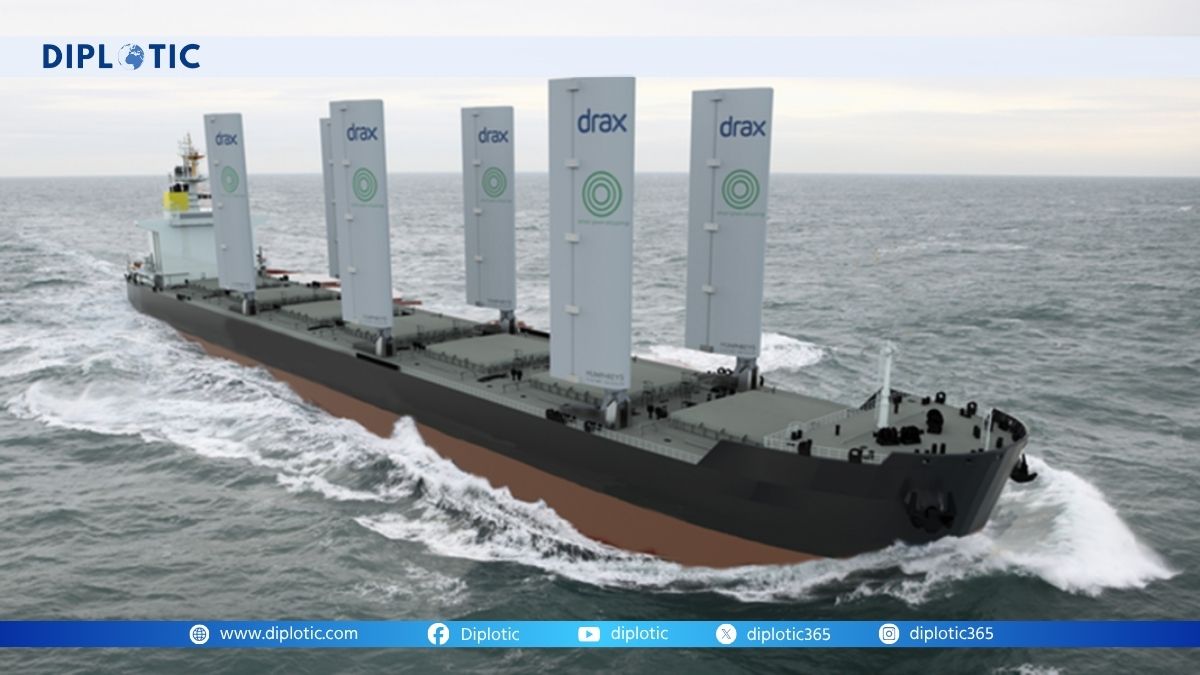
The first days at sea did not go the way anyone on the Neoliner Origin expected. The ship had set out from the west coast of France on what was meant to be a landmark voyage: the world’s largest modern sailing cargo ship attempting a full transatlantic crossing with the promise of cutting its emissions far below that of conventional vessels. Yet before the passengers and crew could settle into their new routines, the ship entered rough weather strong enough to challenge even its experienced captains. The unexpected storm, the slipping chairs, and the creaking of a brand-new vessel still in its trial phase all raised a simple but pressing question. Could wind power, an ancient force, genuinely shape the future of global transport in a world facing climate pressure like never before?
The Race to Reinvent Cargo Shipping
For more than a century, the global shipping industry has relied on fossil fuels to move goods across oceans. Today, about 80% of worldwide trade travels by ship, and this system now contributes nearly 3% of global carbon emissions. If the industry were a country, it would rank among the world’s major emitters. The rise of enormous container ships, often running on heavy fuel oil, has made the sector deeply efficient but also much dirtier than many people realise.
This context created the foundation for the Neoliner Origin. Built in France at a cost of around €60m, the 136-metre vessel represents a new experiment: combining modern engineering with wind, a free and renewable source of power. Its goal is not only technical but symbolic. It aims to show that large-scale shipping can be cleaner, even if the transition remains complicated.
During its first voyage to the United States, the Neoliner Origin carried more than 1,200 tonnes of cargo. On board were items such as forklifts, hybrid cars, and hundreds of thousands of bottles of cognac. Alongside the cargo were eight passengers who chose to travel this way not for speed, but to reduce their carbon footprint. Among them was a writer who wanted to cross the Atlantic without flying. Her journey echoed the growing movement to search for lower-carbon choices in long-distance travel.
The ship was powered by two large semi-rigid sails made of carbon and fibreglass, supported by a diesel-electric engine used only when needed. In the first days, the crew used the engine at less than half its capacity. Spirits were high as the ship moved steadily with the wind. The crew explained that if everything went well, the voyage could show what an 80% reduction in emissions looks like on a real ocean crossing. But as with any pilot project, the sea had plans of its own.
When Wind Meets Reality: A Test of Technology and Timing
Three days into the trip, the promise of smooth wind-powered travel faced a serious test. One of the ship’s main sail panels cracked and then shattered. For a vessel designed around the importance of its sails, this was not a small problem. The crew suspected a design flaw in the panel’s structure, and repairs could only be done once the ship reached the tiny island territory of Saint-Pierre and Miquelon near Canada. For the next several days, the Neoliner Origin continued its voyage using just one sail, forcing the engine to take on a heavier role.
This setback came at the worst moment. The crew had planned their route around a low-pressure system that was meant to push the ship forward with strong winds. But weather patterns, already becoming less predictable due to climate change, did not behave as models suggested. Instead of catching favourable winds, the ship ended up directly under the pressure system, resulting in unstable seas and an uncomfortable dining room where passengers held tightly to their plates as the ship rolled.
Technicians later repaired the damaged sail over five days in a temporary workshop built in the cargo hold. It was a reminder that even promising innovations face early challenges. Still, the ship made it to Baltimore only one day behind schedule. Early estimates suggested that even with only one functioning sail for most of the crossing, the vessel used almost half the fuel a conventional ship would need. This partial success offered a glimpse of what might be possible when the system operates at full capacity.
Can Wind Truly Reshape the Future of Global Cargo?
Experts studying the future of ocean transport suggest that while wind can support the industry’s shift to cleaner systems, they do not see it as the main solution. Research from the International Council on Clean Transportation (ICCT) indicates that around 90% of future decarbonisation efforts will come from switching to clean fuels, such as renewable hydrogen. These fuels are far more expensive to produce than traditional ones, which is why wind assistance becomes attractive. It can cut fuel use and provide savings that help balance the higher cost of cleaner energy sources.
However, wind technology comes with limitations. Ships like the Neoliner Origin must be designed specifically for sails, which adds significant construction costs. Retrofitting large existing ships is possible but often expensive and less efficient. And while the Neoliner Origin is the largest new sailing cargo ship yet, it is still much smaller than the massive 400-metre container ships dominating global shipping lanes.
Scaling wind power for these giants is unlikely. The physics do not favour huge vessels, and using many smaller sail-powered ships would require far more ships to move the same volume of goods. This raises questions about port capacity, shipping schedules, and cost efficiency. Yet wind-assisted propulsion could still become an important tool in a larger mix of solutions, especially for medium-sized vessels and specific routes where wind patterns are reliable.
For passengers, the idea of wind-powered travel offers a slower but lower-carbon alternative to flying. The cost is still high, and the journey is long, but interest is rising. Neoline has already sold more than 100 passenger tickets for upcoming voyages. As some travellers look for ways to reduce their environmental footprint, demand may grow, especially for unique, low-impact travel experiences.
A New Beginning or a Niche Solution?
When the Neoliner Origin finally reached Baltimore, the sense of achievement among the crew was clear. For the captains, the voyage marked the realisation of decades of work. They had imagined a ship that could merge their love of sailing with a commitment to protecting the planet. Despite the sail damage, the rough weather, and the surprises along the way, the crossing proved that large-scale wind-powered cargo shipping is not only possible but also potentially valuable.
Yet the broader question remains: can this model move from experimental voyages to large-scale adoption? The industry still faces cost barriers, complex logistics, and the pressure of global trade timelines. But the voyage offered a demonstration that new ideas can challenge old assumptions. It showed that clean transport does not have to rely on a single technology. Instead, it may involve a combination of wind assistance, new fuels, and smarter navigation, each contributing a piece to the overall reduction in emissions.
The journey of the Neoliner Origin also reflects a deeper shift taking place across industries. Climate change is forcing companies, governments, and individuals to rethink long-standing systems. Shipping cannot avoid this transformation. Whether through wind, hydrogen, electricity, or other emerging technologies, the industry is beginning to accept that its future will look very different from its past.
As the ship’s captain put it, the voyage marked the reconciliation of his personal values with his professional life. For the global shipping sector, a similar reconciliation may lie ahead. Wind alone may not solve every challenge, but it has returned to the centre of the conversation—this time not as a nostalgic memory, but as a practical force that could help chart a cleaner path for the world’s busiest trade routes.




