
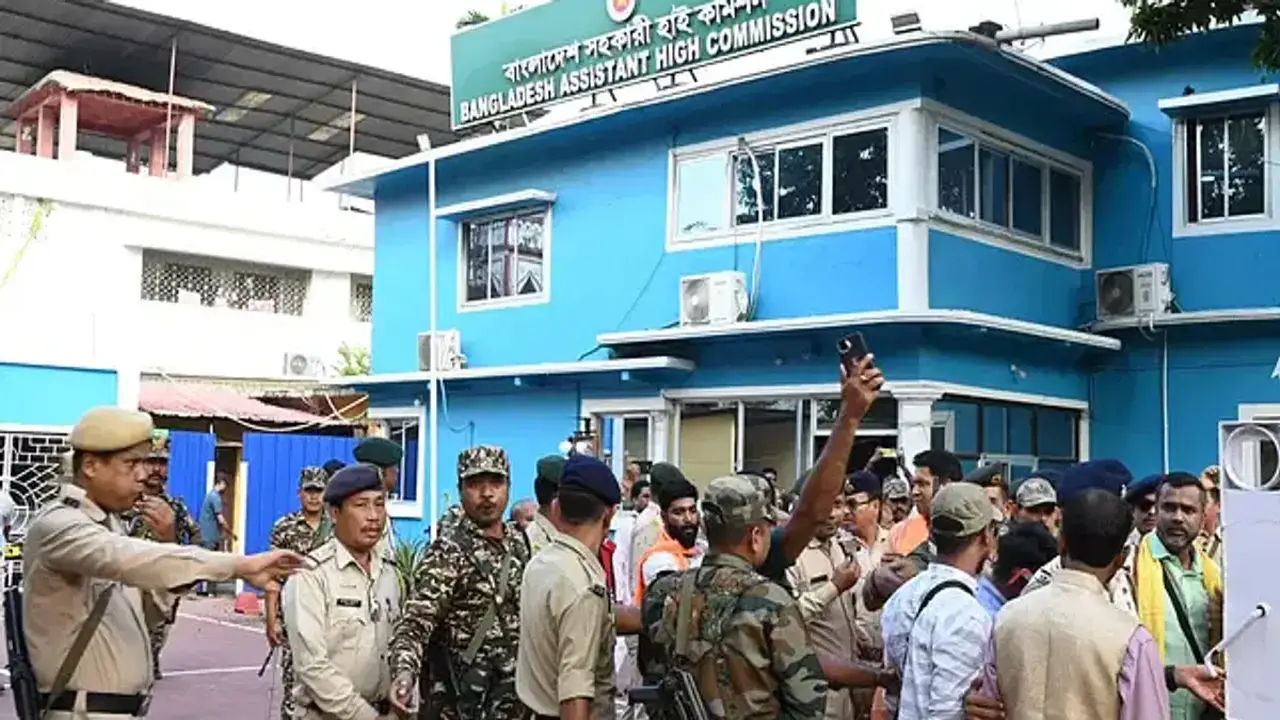
In late November, a grim incident took its ground in Agartala, Tripura, where the usually quiet Bangladesh Assistant High Commission became the center of a violent protest. What started as a formal deputation by a local group quickly escalated into chaos. The mission, unassuming in its location, was suddenly thrust into the spotlight as protesters, numbering around 150, stormed the compound, leading to the desecration of the Bangladeshi national flag and significant damage to diplomatic property.
The Beginning of a Disgraceful Affair
The turmoil in Agartala, Tripura, was sparked by the arrest of ISKCON leader Chinmoy Krishna Das Brahmachari in Bangladesh. This arrest ignited protests across Eastern India, marked by processions and, more disturbingly, acts of vandalism targeting the Bangladesh Assistant High Commission. The Hindu Sangharsh Samiti, a group with a penchant for melodrama, announced their intention to deliver a “deputation” at the diplomatic mission. However, what was intended as a formal protest quickly descended into chaos.
Five members of the Samiti entered the mission to submit a protest letter, while outside, a crowd of around 150 rallied, chanting slogans. The police presence, intended to maintain order, proved ineffective as the gates to the compound were opened. In surged the mob, overwhelming security measures. The protesters desecrated the Bangladeshi national flag, tearing it down and burning it outside the premises. However, the damage didn’t stop at the flag; signs and other property within the mission were also vandalized in the ensuing disorder.
Tripura Police Visit Bangladesh High Commission After Vandalism Incident
In the aftermath of the vandalism at the Bangladesh Assistant High Commission in Agartala, Tripura, police officials arrived at the scene, perhaps a bit too late to prevent the damage but still with a sense of urgency. Senior officers inspected the premises and met with Bangladesh officials, who maintained a polite composure despite the circumstances. The Indian Ministry of External Affairs later issued a statement expressing deep regret over the incident, emphasizing the importance of protecting diplomatic properties, although the statement’s timely arrival might have provided greater reassurance.
Suvendu Adhikari’s Provocative Speech at Petrapole
On December 2, BJP leader Suvendu Adhikari made headlines with a fiery speech at Petrapole, a border point between India and Bangladesh. Adhikari threatened to temporarily close the border unless detained ISKCON leader Chinmoy Krishna Das was released. He also warned of halting the trade of essential goods like potatoes and onions, raising eyebrows with his dramatic rhetoric. Furthermore, Adhikari’s remarks calling Bangladesh a “terrorist hub” drew criticism from political figures, including TMC’s Joyprakash Majumdar, who condemned the statements as irresponsible.
Mamata Banerjee Proposes UN Peacekeeping Mission in Bangladesh
In an unexpected twist, Mamata Banerjee, the Chief Minister of West Bengal, has suggested a move that raised both eyebrows and questions: she proposed that India request the United Nations to send peacekeeping forces to Bangladesh. While the suggestion was bold in theory, one might wonder how Bangladesh—its sovereignty in question—would view such an intervention. Banerjee also seized the moment to criticize the Indian government for its silence on the matter, demanding a response from the Prime Minister or Foreign Minister. Her indignation, though no doubt heartfelt, seemed politically timely—an all-too-familiar element in subcontinental politics.
Bangladesh’s Reaction to the Agartala Incident
The response from Bangladesh to the Agartala incident grounded on the platform like a theatrical performance—one in which the actors, tragically, had no script and the stage was in disarray. The Ministry of Foreign Affairs, understandably, responded with a flare of righteous indignation.
In its statement, Bangladesh’s Foreign Ministry delivered a reprimand tempered with a plea—a bit like a parent scolding their misbehaving child while also asking them to clean their room. Referencing the Vienna Convention on Diplomatic Relations of 1961, the statement reminded India that such violations were neither diplomatic nor acceptable. The Ministry criticized the failure of Indian police to prevent the attack and demanded an immediate investigation, insisting that Bangladesh’s diplomatic staff and properties in India should henceforth be protected.
The reaction on the streets of Bangladesh was one of fiery protest. Flags flew, slogans were chanted, and fists were raised in defiance. The desecration of the national flag had struck a deep chord with the public—a symbol of sovereignty and pride had been violated.
Final Thoughts
Diplomacy, as they say, is the art of weathering storms without rocking the boat. But when the storm comes from within—when one’s neighbors fail to keep their goats (or protesters) in check—the task becomes far more difficult. The question remains: how much longer can Bangladesh’s garden endure such intrusions before it becomes barren? The answer, I fear, hinges not only on Bangladesh’s resolve but also on the goodwill of its neighbor. Let us hope, for the sake of peace, that the goat is finally tethered.




