

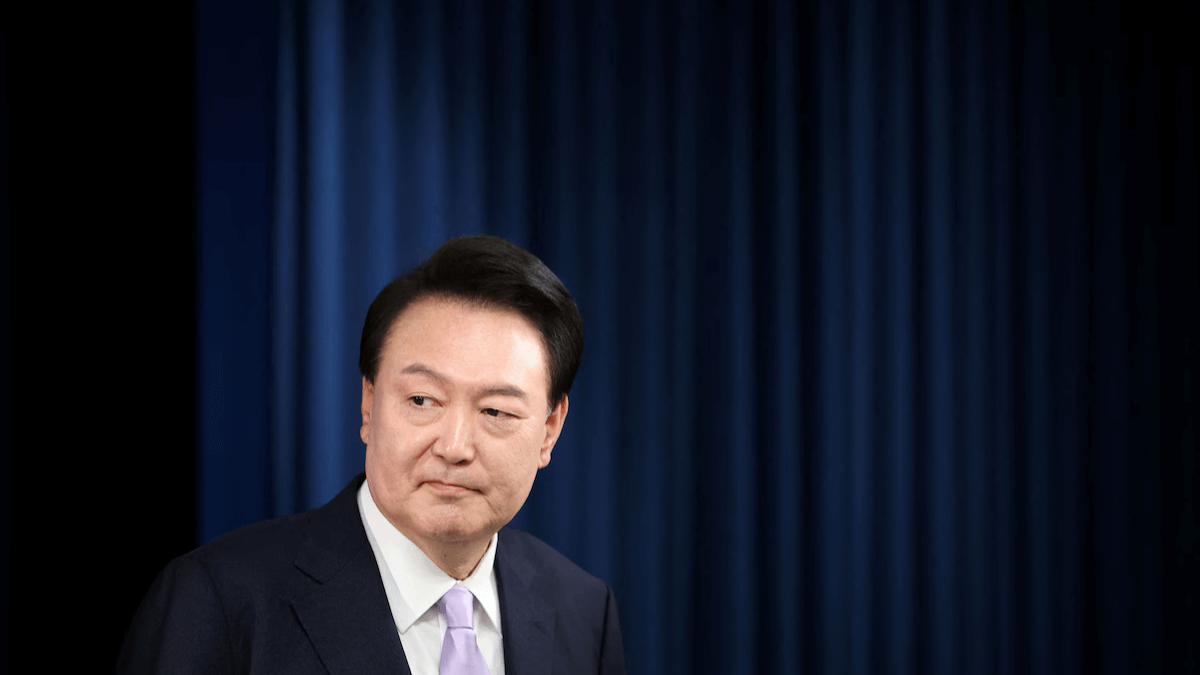
Last week, South Korean President Yoon Suk Yeol surprised the nation when he declared martial law for the first time in nearly 50 years. His tough move, announced on late-night television broadcasts, was largely aimed at countering threats from “anti-state forces” and North Korea.
However, it soon became clear that the move was not a response to state security but rather President Yun’s own political crisis. As a result, thousands of people gathered in parliament to protest, and opposition lawmakers called for an emergency vote to repeal martial law.
Later, Yun announced the lifting of martial law and now faces impeachment for his “rebellious” behavior in parliament. Political analysts say Yun may be behaving like a president besieged by political pressure.
A Nation at Odds Over an Unprecedented Power Grab
In his speech on Tuesday night, Yun accused political opponents of trying to undermine his government and said he was imposing martial law to eliminate “anti-state forces.”.
On his orders, the military was tasked, and troops and police were deployed to the National Assembly building, where helicopters were seen landing on the roof. Soldiers tried to enter the building with masks and weapons, but workers used fire extinguishers to stop them, local media reported.
South Korean politicians characterized Yun’s move as illegal and unconstitutional. Even the leader of his own party, the conservative People’s Power Party, termed the move a “wrong decision.”
Meanwhile, the leader of the country’s largest opposition party, the Liberal Democratic Party, Lee Jae-myung, called on his lawmakers to unite in parliament to repeal martial law. Common people also responded to this call and protested by gathering outside the Parliament. They chanted, “No martial law!and “Against dictatorship.”.
However, despite the presence of the military, the tension did not turn violent. Lawmakers were able to enter parliament, even trying to scale the fence to reach the voting chamber.
Shortly before 01:00 on Wednesday, 190 of the 300 members of South Korea’s parliament turned out to declare Yun’s declaration of martial law illegal.
Yun’s Move Echoes South Korea’s 1979 Crisis
Martial law is a system in which the military authorities are empowered to rule in emergency situations when the civilian administration seems unable to act. South Korea last imposed martial law in 1979, when Park Chung-hee was killed in a coup. Since then, after 1987, martial law has never been declared.
But Yun, who has shown his tough stance on North Korea, has presented political opponents as supporters of North Korea without any evidence against them. As a result of the declaration of martial law, the military was given additional powers, and most of the rights of citizens and the rule of law were suspended.
Despite resistance, the government did not take any action on media freedom. Yonhap and other outlets continued their reporting.
After being elected president in May 2022 as a staunch conservative, Yun’s government faced political challenges. The opposition has accused him of a corruption scandal, and his approval rating has fallen to around 17%.
Also, the opposition is preparing a vote in parliament to repeal martial law. The impeachment process in South Korea is relatively simple, but requires a two-thirds vote in the 300-member parliament.
Once the impeachment motion is passed, it will go to the Constitutional Court, where the president must resign if the six-member impeachment is upheld.
This could be the second time in South Korean history that a president has been impeached. In 2016, then President Park Geun-hye was impeached on extortion charges.
Yun’s hasty move has shocked the country, which values democracy and stability. Experts say this could pose a serious threat to South Korea’s democratic image.
“Yoon’s declaration of martial law was legally illegitimate and a politically incorrect decision, unnecessarily putting South Korea’s security and economy at risk,” said university expert Leif Eric Easley.




