


Rumors are swirling that the U.S. dollar is on the brink of collapse, fueled by President Donald Trump’s tariff policies and a perceived loss of global confidence. Some claim these tariffs, combined with a potential recession, could end the dollar’s reign as the world’s primary reserve currency. Let’s cut through the noise with facts and logic to assess whether the dollar is truly collapsing.
Examining the Collapse Claim
The narrative suggests Trump’s tariff war—imposing a 10% baseline tariff on all imports, with higher rates on countries like China (145%)—is eroding trust in the dollar. J.P. Morgan’s research, cited widely, estimates a 40% chance of a U.S. recession by year-end 2025, driven by these policies. A recession, marked by rising unemployment and falling consumer spending, is seen as a threat to the dollar’s stability, especially since it’s a fiat currency reliant on global faith in the U.S. economy. The article also notes a 9% drop in the dollar’s value since mid-January 2025 against a basket of currencies, raising alarms about a “dramatic drop” signaling a crisis.
But let’s apply logic. A 9% decline over six months, while notable, isn’t unprecedented—currency values fluctuate due to inflation fears, central bank policies, and geopolitical shifts. The dollar’s status as a reserve currency, backed by decades of U.S. economic and military power, isn’t undone by a single policy shift. The National Bureau of Economic Research (NBER) hasn’t declared a recession, and historical lags (e.g., the Great Recession’s recognition in December 2008) mean current economic data—showing a 0.3% GDP contraction in Q1 2025—aren’t conclusive yet. Recession fears alone don’t equate to a dollar collapse.
Debunking the De-Dollarization Myth
The idea of “de-dollarization” gains traction with claims that countries, pressured by tariffs, are ditching the dollar for alternatives like the Chinese yuan. However, evidence contradicts this. As of December 2024, the yuan accounted for less than 4% of global trade, dwarfed by the dollar’s 48% share of international payments—the highest in over a decade, per recent data. The euro, at 20% of global reserves, remains a distant second, with no other currency matching the dollar’s liquidity or convertibility. Foreign holdings of U.S. Treasuries have grown to over $7 trillion by November 2024, and the Federal Reserve’s swap lines during the COVID-19 crisis underscore continued global demand for dollars.
Logically, shifting away from the dollar requires viable alternatives with deep bond markets and open capital flows—qualities lacking in the euro (fragmented markets), yen (central bank dominance), or yuan (capital controls). Economist Barry Eichengreen’s warning that trust can be “lost in the blink of an eye” is theoretical; no sudden mass exodus from the dollar has occurred. The 9% drop reflects market reactions to tariffs and interest rate expectations, not a collapse, as the dollar remains near a 15-year high versus trade-partner currencies.
Analyzing the Dollar’s Strength
Far from collapsing, the dollar has enjoyed a decade-long bull market, propelled by high U.S. interest rates, capital inflows, and safe-haven status. The Federal Reserve Trade-Weighted Real Broad Dollar Index rose from below 85 in 2011 to over 120 by January 2025, showing real value gains. Nominal indices against emerging and developed markets confirm broad-based strength. U.S. bond yields, rising since 2015, outpace those in Japan, Germany, and the UK, attracting investors. Foreign direct investment in the U.S. hit record levels in 2024, and the dollar still dominates 80% of financial transactions.
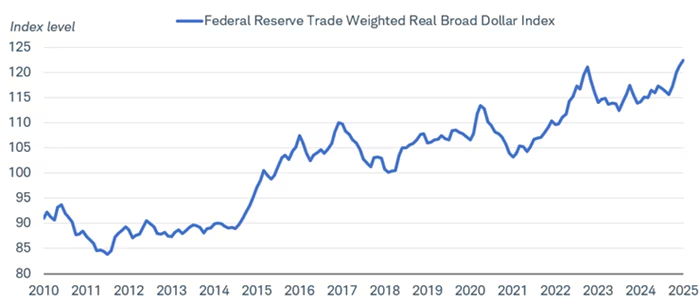
Source: Bloomberg. U.S. Federal Reserve Trade Weighted Real Broad Dollar Index (USTRBGD Index). Monthly data as of 1/31/2025.
The tariff-induced market volatility—e.g., a $2.4 trillion S&P 500 drop in April 2025—has spooked investors, but this reflects short-term sentiment, not a structural collapse. J.P. Morgan’s 60% recession probability (updated from 40%) and Jamie Dimon’s inflation warnings highlight risks, but these are projections, not certainties. The dollar’s reserve share has dipped from 67% in 2004 to 60% in 2024, a gradual decline due to diversification, not a crisis.
The Final Truth
The U.S. dollar is not collapsing. Its 9% drop since January 2025 reflects tariff-related uncertainty and shifting interest rate expectations, but its dominance—48% of global payments, 60% of reserves—holds firm. A recession isn’t confirmed until NBER declares it, and even then, the dollar’s history through 48 recessions proves its staying power. De-dollarization is a long-term possibility, not an imminent threat. Trust the data, not the headlines.




