

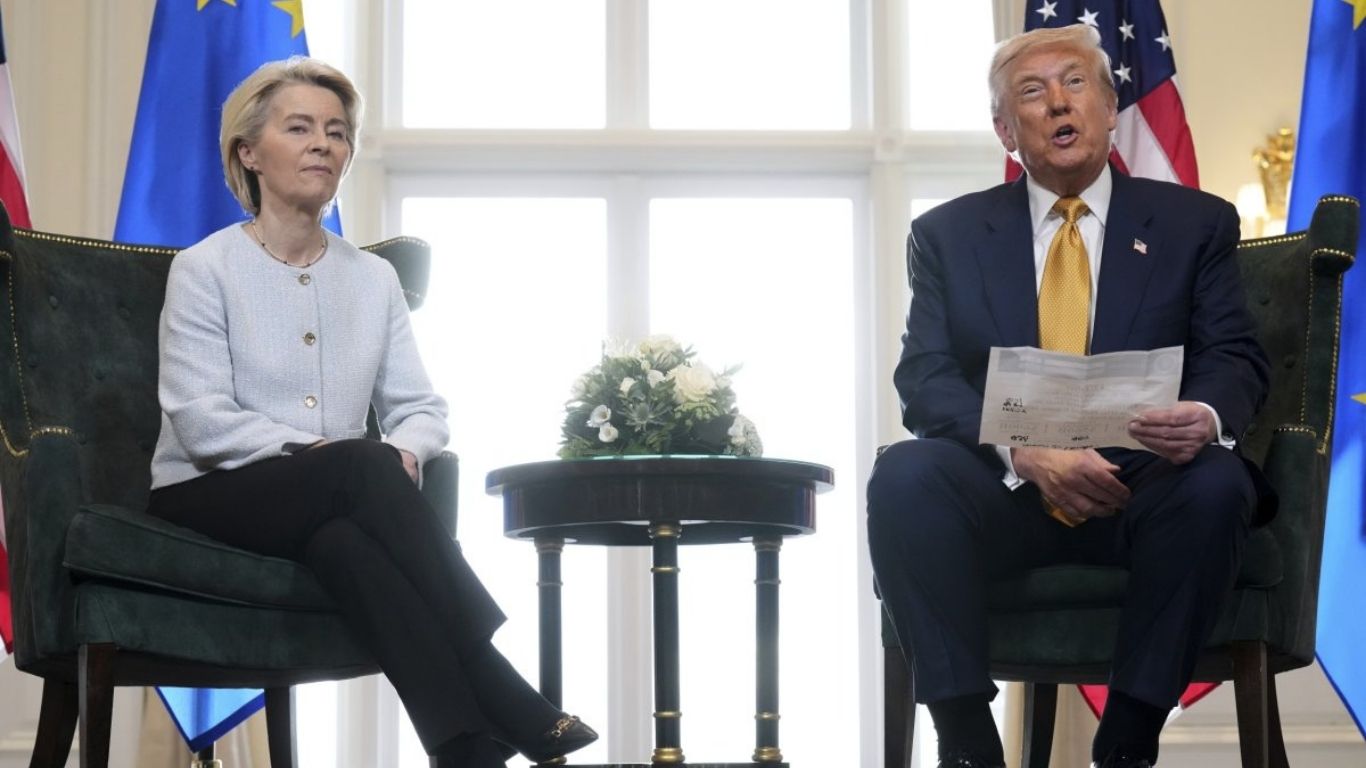
The U.S.–EU Turnberry trade deal of 2025 will not be remembered for the fine print of tariffs and quotas. It will be remembered as the moment Washington openly rewrote the transatlantic bargain, placing Europe in a position of structural weakness and setting the stage for a global reordering. What happened at President Donald Trump’s Turnberry golf resort in Scotland was more than a trade agreement it was a demonstration of leverage, coercion, and the fragility of Europe’s geopolitical standing.
For decades, the United States and Europe managed their differences within a framework of partnership. That framework has now been upended. The question facing Europe is no longer how to preserve the old order, but how to build a new one before the next crisis arrives.
What Was the Turnberry Deal?
The Turnberry agreement imposed a 15 percent tariff on most European exports to the U.S., with auto tariffs set to rise to the same level in the near future. For Europe, especially Germany’s export-driven economy, these measures hit at the heart of industrial competitiveness.
In exchange, the deal promised $750 billion in U.S. energy exports and $600 billion in EU investment commitments figures that many economists consider wildly unrealistic. These numbers are less about mutual prosperity than about creating benchmarks that Europe is destined to miss. When those targets inevitably fail, Washington will have justification to demand further concessions on digital services, taxation, and tech regulation.
Far from a negotiated settlement, the Turnberry pact was a codification of American leverage. It formalized Europe’s dependence on U.S. security and its limited ability to resist economic pressure.
Why Europe Accepted
At first glance, the EU’s acceptance of the deal looks puzzling. European leaders had branded the Turnberry summit a “dark day.” Yet when the framework was released, Brussels treated it with grudging relief, claiming it had avoided a full-scale trade war.
This sense of relief highlights the real danger: bullying is being normalized in international diplomacy. By conceding under duress, the EU reinforced Washington’s belief that coercion works.
Beyond Trade: A Digital Sovereignty Battle
The Turnberry deal is not only about tariffs. It is the opening shot in a wider campaign to challenge Europe’s regulatory model, particularly in the digital sphere.
The EU has positioned itself as a global leader in data privacy, platform accountability, and content moderation. Its landmark policies, from the General Data Protection Regulation (GDPR) to the Digital Services Act, have set global standards. But Washington now portrays these rules as anti-American, anti-business, and a threat to free expression.
Figures aligned with Trump’s political movement, including Congressman Jim Jordan, have already framed EU digital sovereignty as censorship and protectionism. By weaponizing free speech rhetoric, U.S. officials seek to destabilize European politics, empower far-right voices, and cast doubt on Brussels’s legitimacy as a regulator.
The battle over digital sovereignty will therefore be waged not only in trade negotiations, but in the ideological sphere freedom versus bureaucracy, sovereignty versus globalism.
Political Fallout in Europe
The economic pain of asymmetric tariffs is already translating into political volatility across Europe. Growth forecasts of just 0.5 to 0.9 percent in key economies such as Germany make fertile ground for populist movements.
Far-right parties, from Germany’s Alternative for Germany (AfD) to France’s National Rally, are seizing on the Turnberry deal to argue that Brussels is both weak and complicit. Ironically, even though many of these parties share ideological affinities with Trump, they will not hesitate to attack Washington if it helps their domestic narrative of defending sovereignty.
In this sense, Trump’s coercion may fuel the very anti-American sentiment that undermines transatlantic unity.
The Security Dimension
Europe’s strategic dependence on the U.S. military umbrella has long been the foundation of transatlantic ties. But Turnberry accelerated debates about defense autonomy.
France and Germany are reviving ideas for a European Security Council and expanding defense cooperation under Permanent Structured Cooperation (PESCO). Public opinion is shifting too: majorities in both Germany and France now favor greater defense autonomy, with growing support for the concept of a European army.
Even Poland, traditionally one of the staunchest Atlanticist nations, is showing signs of recalibrating its blind alignment with Washington.
If the U.S. continues to weaponize its security guarantees to extract economic concessions, European leaders will face mounting pressure to accelerate defense independence.
The Market Blind Spot
So far, financial markets have largely shrugged off the Turnberry deal. Investors have treated it as political theater rather than a structural realignment. But this complacency is dangerous.
If markets begin pricing in the risk of permanent transatlantic divergence with competing trade rules, currency alignments, and regulatory frameworks the effects could be swift and severe. Unlike the 2008 financial crisis, where central banks coordinated to stabilize the system, a geopolitical rift between the U.S. and the EU would be far harder to patch.
Europe’s Options
Europe is not powerless. It retains significant economic scale, regulatory clout, and institutional tools. But to defend itself, Brussels must treat economic security as national security. That requires a new strategic doctrine built around:
Defense autonomy – Investing in joint procurement, intelligence sharing, and European-led security structures.
Energy resilience – Reducing dependence on U.S. energy exports and diversifying supply chains.
Technological sovereignty – Doubling down on European innovation, semiconductor independence, and digital infrastructure.
Anti-coercion mechanisms – Expanding the EU’s Anti-Coercion Instrument to target U.S. service providers if Washington weaponizes trade.
Legal firewalls – Shielding European companies from extraterritorial enforcement of U.S. laws.
Europe’s power lies in its regulatory influence. By setting global standards, the EU can shape norms in ways that even the U.S. must eventually respect. But this influence only works if Europe acts with unity and resolve.
Building a New Transatlantic Bargain
The challenge is not to restore the old postwar bargain, which rested on American military protection and European market access. That model has collapsed. The new task is to build a rebalanced transatlantic partnership, one that respects Europe’s autonomy and prevents the U.S. from dictating terms unilaterally.
This may mean more confrontation in the short term, but it is the only path to a stable long-term relationship. Otherwise, each new crisis will present Washington with another opportunity to tighten the Turnberry trap.
Conclusion: Europe Must Choose
The Turnberry deal is a wake-up call. It revealed the vulnerability of Europe’s position and the ruthlessness of U.S. strategy under Trump. If Europe responds passively, it risks entrenching a cycle of dependency, concession, and political backlash.
But if it seizes this moment to embed economic security, defense autonomy, and technological sovereignty into a unified doctrine, Europe can turn vulnerability into resilience.
The stakes are high. This is not just about tariffs or energy contracts it is about whether Europe can remain a shaper of the global order, or whether it will be reduced to a subject of it.
The Turnberry trap has been set. Europe must decide whether to walk into it, or to chart a new course.




