

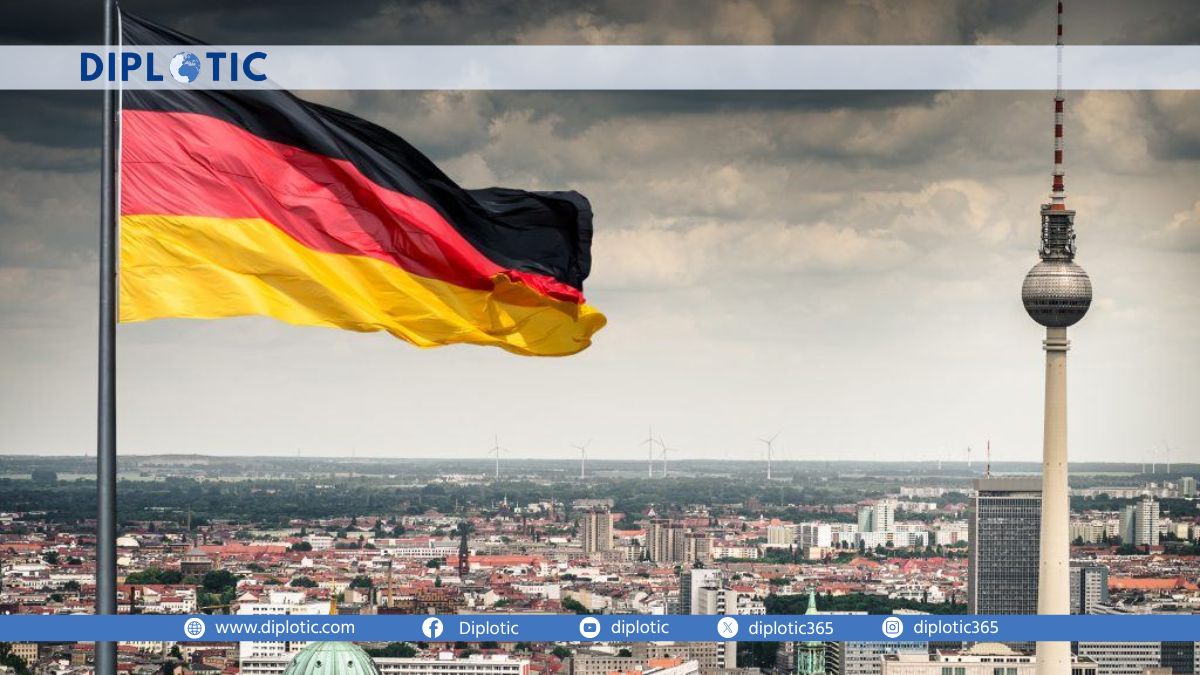
Maximilian Krah’s argument is sweeping, provocative, and deliberately countercultural. Framed as a response to Donald Trump’s return to bilateral power politics, it presents Germany with what he sees as a historic opening: to step out of a failing EU-centric model, realign with the United States, and reassert leadership over Central and Southeastern Europe. The essay is less a policy brief than a manifesto—one that mixes geopolitics, history, and ideology. Yet beneath the rhetoric lies a set of claims worth unpacking, especially for what they reveal about emerging fault lines in European strategic thinking.
The core claim: the end of the EU as a political project
Krah’s starting point is blunt: Trump’s rejection of multilateralism and liberal universalism strikes at the heart of the European Union. In his reading, the EU was viable only under a US-led liberal order that tolerated multilateral institutions as moral cover. Once Washington abandons that framework, the EU’s political ambitions become unsustainable.
Ukraine is central to this argument. Western Europe, he says, turned support for Kyiv into a moral absolute, promising EU accession without considering the institutional consequences. If Ukraine—and potentially the Western Balkans—are absorbed, the EU’s existing budgetary model collapses. Agricultural subsidies, cohesion funds, and decision-making structures would no longer function. The likely result, in his view, is not deeper integration but controlled disintegration: a larger EU reduced to a thin economic community rather than a political union.
This diagnosis aligns with a broader Eurosceptic critique but goes further by predicting inevitability. The EU does not merely need reform; it cannot survive its own expansionary promises without abandoning its political ambitions.
Germany versus the Franco-German core
Krah sharply rejects the mainstream response in Berlin, Paris, and Brussels: tightening the Franco-German axis to preserve a political core within a looser EU. He argues this is strategically misguided and economically dangerous for Germany.
France, in his telling, is the weak link. High government spending, structural deficits, and political paralysis make it dependent on German financial backing. Any attempt to elevate French military assets—such as its nuclear deterrent—into a “European” framework would, he argues, translate into German funding and French command. Such a model would be unacceptable to Washington and irrational for Berlin.
Here, Krah blends economic critique with historical symbolism. A German-French political core is framed as a return to Napoleonic dominance—“a Confederation of the Rhine 2.0”—rather than a partnership of equals. Germany, he insists, gains little economically, strategically, or demographically from anchoring itself to a stagnating France.
The alternative: a “South-East Strategy”
Krah’s proposed solution is a radical reorientation of German foreign policy. Instead of looking westward to Brussels and Paris, Germany should rediscover its “classical sphere of influence” in Central and Southeastern Europe. This includes the Visegrad states, the Western Balkans, and eventually a strategic arc extending to Turkey.
The logic is historical as much as geopolitical. These regions, he argues, are culturally, economically, and demographically intertwined with Germany. Migration patterns, supply chains, and political affinities already bind them together. Germany’s task would be to formalize this reality through leadership in infrastructure, military cooperation, science, and coordinated political forums.
In this vision, Germany becomes the gravitational center of a post-EU Europe—not through formal empire, but through strategic alignment. The EU fades as a political actor, replaced by a German-led continental network compatible with American bilateralism.
Turkey as the hinge power
Turkey occupies a pivotal role in Krah’s strategy. He presents Ankara as a rising regional power—economically dynamic, geopolitically indispensable, and increasingly influential in Central Asia. By integrating Turkey into a post-EU European framework oriented southeastward, Germany could unlock access to Central Asian markets and resources while stabilizing Europe’s periphery.
This argument rests on several assumptions: that Turkey’s interests will remain compatible with both Washington and Berlin; that economic integration will moderate Ankara’s regional behavior; and that Turkey’s balancing role against China in Central Asia aligns with US priorities. Krah sees parallels between Turkey’s position and Germany’s own: both, he claims, can become “America’s best friend” in their respective regions under Trump’s deal-based order.
Russia: from enemy to partner
Perhaps the most controversial element is Krah’s embrace of a renewed partnership with Russia. He argues that the Biden-era confrontation with Moscow pushed Russia into China’s orbit—an outcome contrary to long-term US interests. Trump, he suggests, will reverse this by offering Russia reintegration into a US-led order in exchange for distancing itself from Beijing.
In this framework, Germany stands to benefit. Historical ties, cultural affinity, and demographic links from post-Soviet immigration form the basis for a renewed German-Russian relationship, potentially including the revival of Nord Stream under American auspices.
Ukraine, Poland, and Western Europe emerge as the losers in this scenario—having invested politically and morally in a confrontation that the US is now prepared to settle pragmatically.
From multipolar illusions to bipolar reality
Krah dismisses the “multipolar world” as a defensive illusion born of resistance to liberal American cultural dominance. In his account, Trump removes the existential ideological threat, making US offers more attractive than alternative blocs like BRICS. The result is not multipolarity but a new bipolar order: the US and China as ultimate rivals, with regional powers tied to Washington through deals.
Germany’s choice, he argues, is stark. Either it clings to a declining EU order designed to constrain it, or it seizes the moment to grow again as a central power within a US-aligned Europe.
Assessment: coherence, ambition, and blind spots
Krah’s essay is internally coherent and strategically bold. It identifies real stresses within the EU, genuine shifts in US foreign policy style, and unresolved questions about Europe’s future. His emphasis on demographics, productivity, and power politics resonates with critiques often avoided in mainstream discourse.
Yet the argument rests on heavy assumptions: that Trump’s worldview will define US policy long-term; that Germany can lead Central and Southeastern Europe without provoking resistance; that Turkey and Russia can be integrated smoothly into a US-centered order; and that domestic German politics will support such a radical break with post-war identity.
Above all, the essay treats power realignment as largely frictionless. History suggests otherwise. Influence generates counter-coalitions, and leadership without consent becomes domination by another name.
Still, as a statement of intent, the piece matters. It signals a growing strand of European thought that no longer sees the EU as destiny, liberal multilateralism as permanent, or German restraint as inevitable. Whether one sees it as dangerous revisionism or overdue realism, Krah’s vision captures a moment of transition—when old certainties are dissolving, and new orders are being imagined with increasing audacity.




