

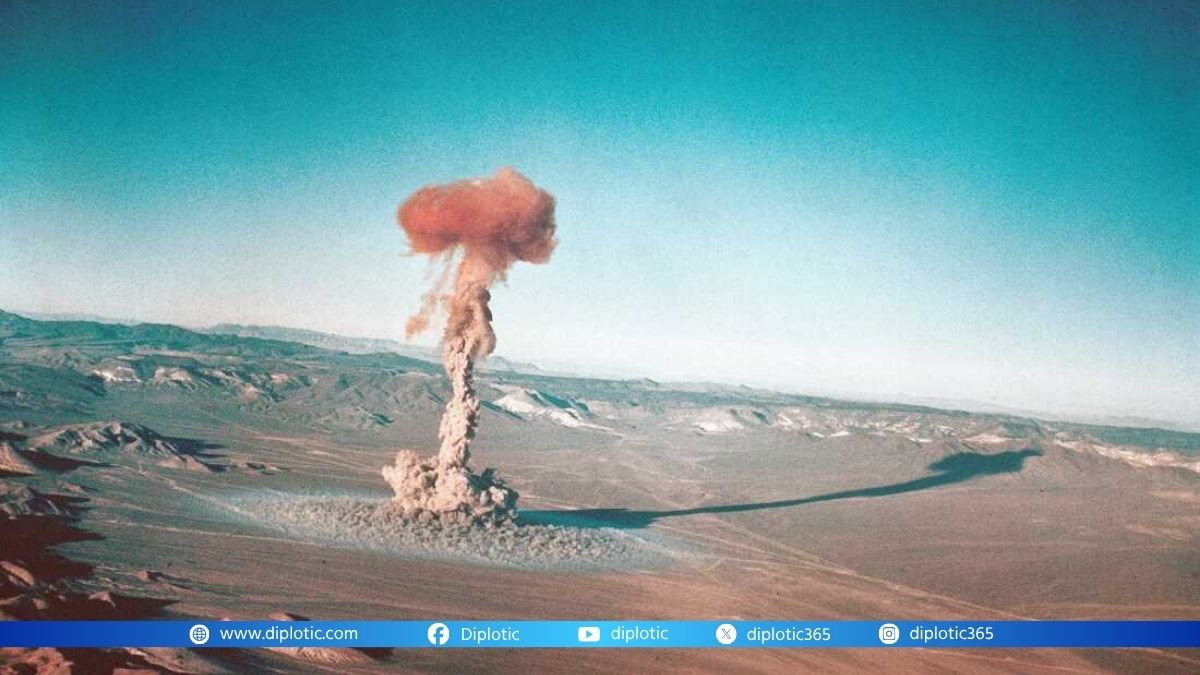
President Trump’s sudden order to restart U.S. nuclear weapons testing has sparked deep uncertainty among defense analysts, arms-control experts and global allies. This analysis explores the strategic, technical, and diplomatic risks behind his decision.
The Announcement That Stunned Washington
In late October 2025, President Donald Trump announced via social-media that he had instructed the Pentagon and the Department of Energy to “immediately restart the process for testing our nuclear weapons on an equal basis” in response to perceived advances by Russia and China.
On a flight from Busan, South Korea, Trump added:
“We’re going to do some testing … Other countries do it. If they’re going to do it, we’re going to do it, OK?”
The statement caught experts off-guard for three main reasons: the ambiguity of what “testing” means, the legal and treaty implications, and the technical realities of resuming explosive nuclear tests after more than three decades of moratorium.
Ambiguity: What Kind of Testing?
The first major source of confusion among analysts is the vagueness of Trump’s language. Does “nuclear weapons testing” mean full-scale underground nuclear detonations, subcritical tests, missile launch tests, or something else entirely?
According to reporting from Politico and others, the U.S. has not conducted an explosive nuclear test since 1992. So far, neither the White House nor the agencies involved have clarified whether an underground plutonium-fission device will be detonated, or whether the order refers to enhanced simulation, flight testing of nuclear-capable delivery systems, or subcritical experiments beneath current treaty limitations.
One arms-control expert told ABC News:
“He may be thinking of missile testing, which the U.S. already does regularly. If he is referring to explosive nuclear testing, that is much more alarming.”
The distinction matters enormously. Non-explosive or subcritical tests may raise fewer international alarms, whereas a full detonation would reverse decades of norm-building and treaty practice.
Technical and Strategic Realities
Even if the U.S. chooses to resume full nuclear-explosive testing, analysts underline several major hurdles:
Infrastructure and lead time: Experts estimate it would take at least 36 months merely to prepare a contained underground nuclear test at a site such as the former Nevada test complex.
Cost: Each nuclear test could run upwards of $100-150 million.
Stockpile stewardship and modern methods: The United States has for decades relied on computational simulation, non-nuclear experiments and the Stockpile Stewardship Program to certify the reliability of its nuclear arsenal without detonations. Some experts argue a resumption of explosive tests is technically unnecessary.
Deterrence logic vs. strategic messaging: Trump and some allies frame testing as a deterrent signaling to Russia and China that the U.S. “still means business”. But other analysts note that deterrence does not necessarily require live detonations—especially when credible delivery systems and stockpile maintenance already exist.
In short: the strategic payoff of going back to explosive testing is uncertain, while the costs and risks are concrete and high.
Treaty, Diplomatic and Proliferation Fallout
The announcement also threatens to undermine international arms-control architecture and diplomatic relationships. Key concerns include:
The Comprehensive Nuclear‑Test‑Ban Treaty (CTBT): Although the U.S. signed the CTBT in 1996, it has never been ratified by the Senate, and the treaty remains un-entered into force. Still, the 30-year moratorium has become a global norm. Trump’s move risks signaling the U.S. is abandoning that norm.
Allied trust and extended deterrence: U.S. treaty allies (especially in Europe and Asia) may interpret the move as destabilising and undermining the credibility of U.S. commitment to non-proliferation and arms-control.
Proliferation ripple-effects: Analysts warn that if the U.S. resumes testing, Russia, China, India or other nuclear-armed states may feel compelled to follow suit—thus igniting a new arms-race cycle. As one expert put it:
“This is something that can be easily misconstrued, generate arms-race pressure and rapidly evolve into a crisis.”
Global norm blow-back: Detonating a nuclear weapon even underground would represent a dramatic erasure of 30 years of progress in nuclear-test prohibition and disarmament advocacy.
Adding to the diplomatic tension, Iran publicly condemned the U.S. announcement, calling it “hypocrisy” given U.S. pressure on Tehran’s nuclear-related activities.
Why Are Experts So Confused?
Putting it all together, experts’ confusion stems from several converging factors:
Ambiguity of policy: Without clarity on what “testing” means, analysts cannot assess intent, scale or probable timeframe.
Mismatch between message and reality: While the political message is strong, “we will test if others test,” the technical and logistical reality is that resuming testing is non-trivial and likely delayed.
Strategic dissonance: The benefits of testing are murky; some experts argue there is little military value in resuming detonations, whereas the diplomatic and proliferation risks are clear.
Normative shock: The U.S. has long positioned itself as a leader of non-proliferation. Reopening nuclear testing would signal a shift in that posture, raising questions about broader strategic direction.
Timing and signaling: The announcement came while Trump was traveling abroad, and ahead of sensitive engagements with China and Russia, adding to the sense that the policy may be more about messaging than operational intent.
As one arms-control veteran cautioned:
“He’s misinformed and out of touch. The U.S. has no technical, military, or political reason to resume nuclear explosive testing.”
Paths Forward: What to Watch
Given the uncertainty, several developments will clarify how this unfolds:
Official definition of “testing”: Will the administration specify whether it intends explosive nuclear tests, sub-critical tests, missile launches or simulation expansions?
Budget and timeline signals: Rescheduling test-site refurbishments, funding appropriations for ground-breaking or detonations would be a major indicator.
Arms-control treaty activity: How will the U.S. engage with Russia, China and multilateral frameworks in the wake of this announcement? Will treaty negotiations stall or collapse?
Allied reactions: Monitoring responses from Nato partners, Asian allies and nuclear-umbrella states will show how much global concern the policy generates.
Actual execution: Whether a test is conducted and where remains the ultimate proof point. The technical lead time means any real detonations may come months or years later but signals in the interim matter.
A Bold Move, But with Big Question Marks
President Trump’s call to resume U.S. nuclear testing is a powerful strategic signal, but one fraught with ambiguity, risks, and unresolved technical questions. While the rhetoric of deterrence and strength resonates with some audiences, the lack of clarity on what kind of testing, how soon, and with what global impact leaves experts unsettled.
The true significance may hinge not on whether a bomb is detonated next week or next year but on what this means for the U.S. posture on arms control, deterrence, alliance trust and nuclear-nonproliferation norms. In that sense, the shock may lie less in the visible blast than in the quiet erosion of long-held strategic assumptions.




