

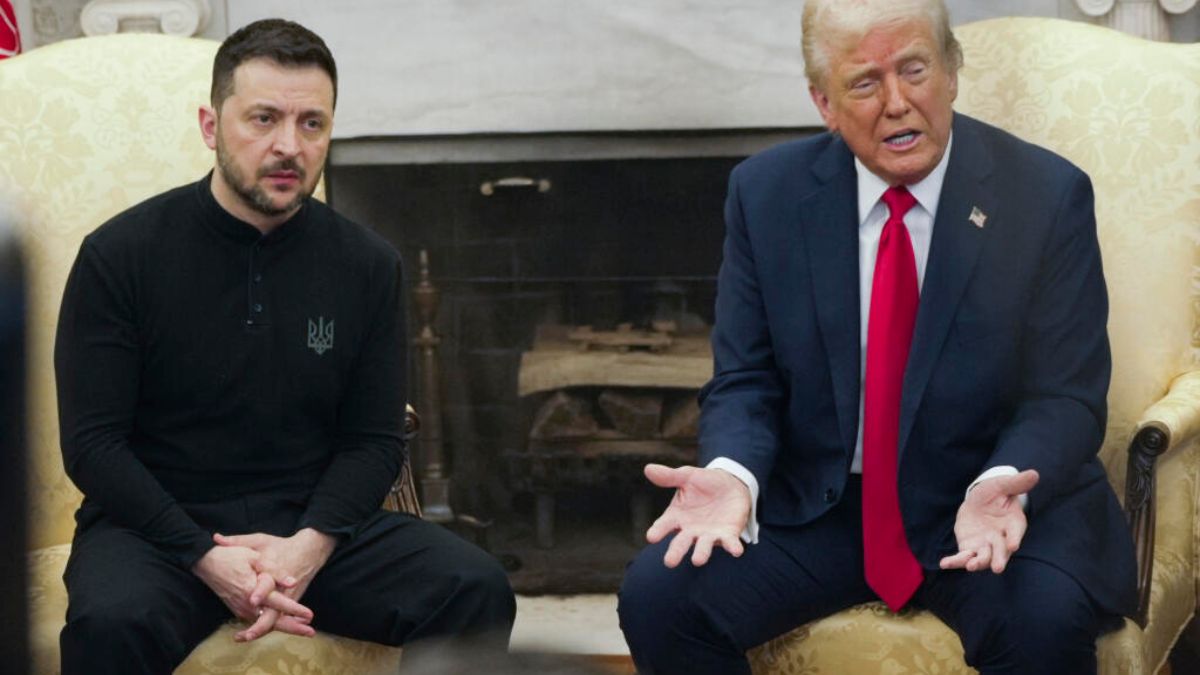
A Fraught Reunion in the Oval Office
On August 18, 2025, the Oval Office became the stage for a high-stakes diplomatic dance as Ukrainian President Volodymyr Zelensky met U.S. President Donald Trump, accompanied by a coalition of European leaders including French President Emmanuel Macron and British Prime Minister Keir Starmer. The meeting aimed to advance a peace deal to end Ukraine’s grueling war with Russia, now in its fourth year, but it unfolded against a backdrop of deep-seated tensions between Trump and Zelensky. Their relationship, marked by volatility since a 2019 phone call that triggered Trump’s first impeachment, has oscillated between grudging respect and public spats. Trump’s recent Alaska summit with Russian President Vladimir Putin, heavy on pageantry but light on results, amplified Zelensky’s wariness, as Trump has pushed for Ukraine to cede Crimea and abandon NATO aspirations—terms echoing Moscow’s demands. “It’s never the end of the road,” Trump said, signaling U.S. involvement, yet his insistence that Europe lead underscored his reluctance to fully commit.
The historical context of U.S.-Ukraine relations provides a lens for this fraught dynamic. The 2019 call, where Trump pressured Zelensky to investigate Joe Biden’s son in exchange for military aid, led to impeachment and exposed Ukraine’s precarious reliance on U.S. support, a vulnerability rooted in the failed 1994 Budapest Memorandum, which promised security for nuclear disarmament but crumbled under Russia’s 2014 Crimea annexation, as detailed in analyses of post-Soviet geopolitics. Trump’s narrative—that the war “never had to start” under his presidency—ignores Putin’s aggression while casting Zelensky as complicit, a charge that surfaced in February 2025 when Trump labeled him a “modestly successful comedian” who “talked the U.S. into spending $350 billion” on an unwinnable war. The February Oval Office clash, where Trump mocked Zelensky’s military attire and ejected him after a heated exchange, revealed a personal animosity that contrasts sharply with Trump’s “bromance” with Putin, evident in their Alaska summit’s red-carpet theatrics.
Zelensky’s strategic maneuvering in August—arriving with European heavyweights and presenting a letter from his wife to Melania Trump—aimed to diffuse tensions. “Thank you for your efforts to stop killings and stop this war,” he said, emphasizing security guarantees over territorial concessions. Yet, Trump’s zigzag diplomacy, praising Zelensky one moment and deriding him as a “dictator” the next, exposes a strategic miscalculation: his transactional approach risks alienating allies while emboldening Putin, who has occupied 20% of Ukraine since 2022. The Ukraine conflict’s evolution underscores this contradiction—Trump’s push for a deal aligns with Putin’s terms, yet Zelensky’s constitutional ban on ceding territory, backed by 80% public opposition per 2022 polls, limits compromise. The presence of European leaders signals a counterbalance, aiming to anchor Ukraine’s security without capitulation.
The Geopolitical Stakes and Contradictions
The August meeting’s collegiality masked deeper fissures in the West’s approach to Ukraine. Trump’s openness to a trilateral summit with Putin and Zelensky, hinted at in his vow to call Putin post-meeting, suggests a deal is possible, but his conditions—Crimea’s loss and no NATO—mirror Russia’s playbook, risking a precedent that legitimizes aggression. The global security landscape shows such concessions could embolden autocrats, akin to the 1938 Munich Agreement’s appeasement of Hitler. European leaders, pledging a “reassurance force” led by Britain and France, aim to deter further Russian advances, but Trump’s insistence that “Europe is the first line of defense” shifts the burden, potentially fracturing NATO. Former U.S. NATO Ambassador Nicholas Burns warned that any deal “cannot rest on the word of Vladimir Putin,” highlighting Trump’s misstep in softening ceasefire demands and sanctions threats after Alaska.
Economically, the war’s $500 billion toll on Ukraine demands robust Western aid, yet Trump’s reluctance to lead risks stalling reconstruction, estimated at $400 billion by the World Bank. Ukraine’s minerals deal, rejected in February, was a concession to Trump’s business mindset, but its failure underscored his unpredictability. Zelensky’s call for a “strong army” with weapons and intelligence reflects Ukraine’s dependence on allies, yet Trump’s flip-flopping—praising Zelensky while blaming him for the war—complicates trust. The economic stakes are stark: a frozen conflict could stabilize energy markets, easing Europe’s $200 billion annual war-related costs, but concessions might strengthen Russia’s economy, undermining sanctions. Trump’s off-topic rant about mail-in ballots during the press conference, despite voting by mail himself in 2024, further muddied the focus, revealing a lack of discipline that could derail negotiations.
Socially, Ukraine’s resilience—evident in Zelensky’s defiance and public support—clashes with Trump’s narrative. His February Truth Social post, accusing Zelensky of gambling with U.S. funds, ignored Russia’s aggression while inflaming tensions. The April Rome meeting at Pope Francis’ funeral and June NATO summit mended some ties, but the August talks’ success hinges on reconciling Trump’s deal-making with Zelensky’s red lines. An undivided India’s historical unity, forging strength across diversity, contrasts with the West’s fragmented support, where Trump’s whims could dictate Ukraine’s fate, risking a deal that sacrifices sovereignty for expediency.
The Path Ahead: Peace or Peril?
As Trump prepares to call Putin, the August 18 summit’s outcomes remain uncertain, poised to shape Ukraine’s future and Western alliances. A trilateral meeting could break the deadlock, but Zelensky’s insistence on territorial integrity and robust guarantees—unlike the “failed” 1994 assurances—faces resistance from Trump’s alignment with Putin’s terms. The European coalition’s presence, described by Trump as “never having so many leaders at one time,” signals a push for collective leverage, but his openness to U.S. troops in a peacekeeping role contradicts his isolationist campaign promises, risking domestic backlash. The war’s human toll—over a million casualties—and economic devastation demand a lasting peace, yet Trump’s volatility, evident in his “did I say that?” denial of past insults, undermines confidence.
Future scenarios hinge on enforcement. A NATO-like guarantee, as floated by U.S. envoy Steve Witkoff, could deter aggression, but Putin’s history of broken promises requires verifiable mechanisms, potentially involving UN oversight. A deal conceding Crimea might stabilize markets but embolden autocrats, from China to Iran, weakening NATO’s credibility. Zelensky’s diplomatic finesse, from suit-clad deference to leveraging European support, positions Ukraine as a key player, but his reliance on “big countries” exposes vulnerabilities. The post-war outlook suggests a successful accord could unlock billions in aid, but a flawed deal risks perpetuating instability, echoing the Minsk Agreements’ failures. As the White House summit fades, Trump’s next call to Putin will test whether his zigzag diplomacy can forge peace or deepen Europe’s deadliest conflict in eight decades, with Ukraine’s sovereignty and global stability hanging in the balance.




