

The Return of a Dangerous Keyword: Nuclear Arms Race
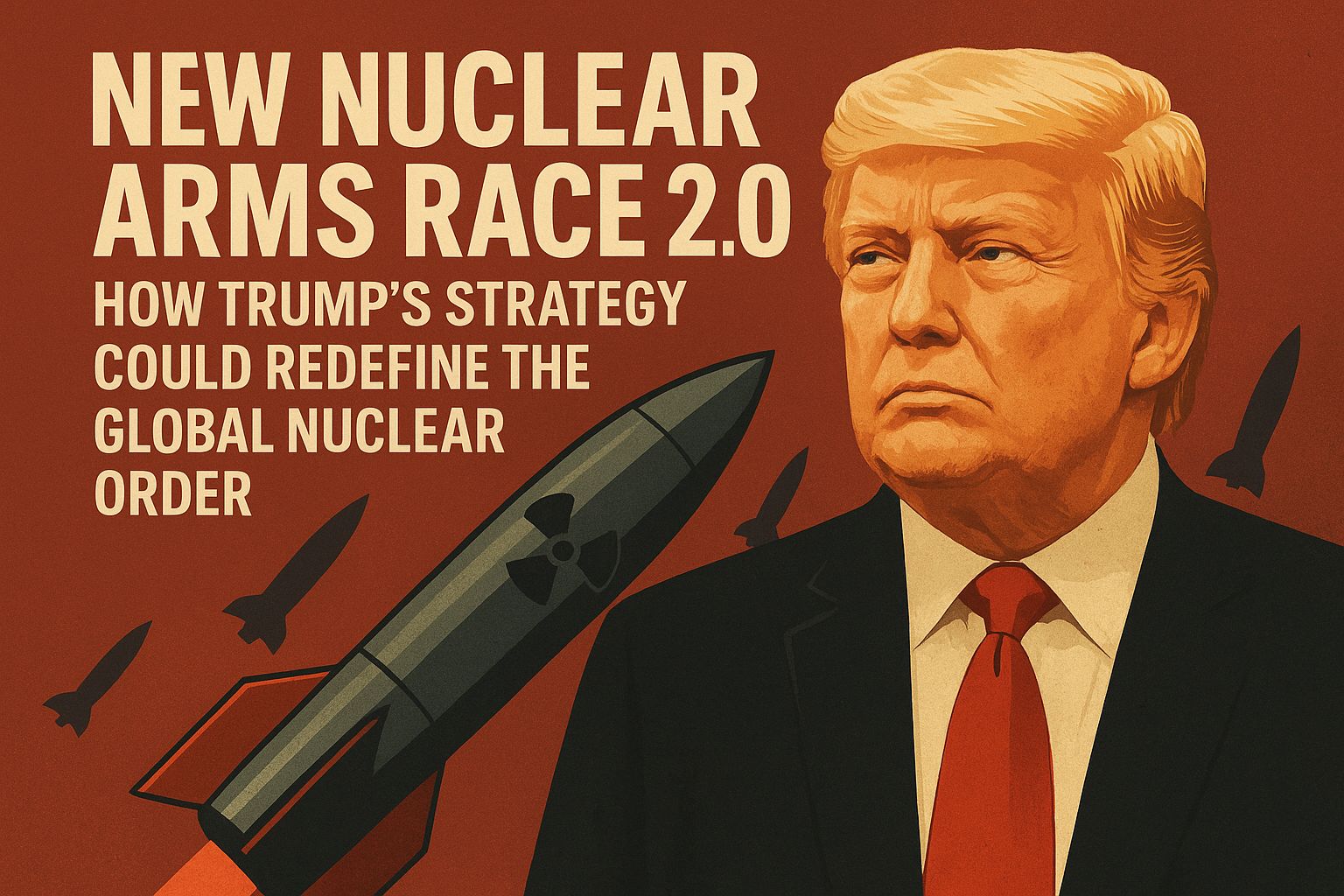
Is the world quietly stepping into a new nuclear arms race? The fear, once thought to be locked in Cold War history, has returned with surprising speed. U.S. President Donald Trump’s recent remarks about restarting nuclear weapons testing “on an equal basis” with Russia and China have sent shockwaves across diplomatic, security, and academic circles. What sounded like a throwaway political line may in fact reshape the global nuclear order, fuel the next generation of nuclear competition, and unsettle a world already on edge.
The unsettling truth behind Trump’s vague but powerful statement is that ambiguity itself can be dangerous. When the leader of the world’s largest nuclear superpower suggests reopening the door to atomic testing, even without specifics, adversaries assume the worst, allies lose confidence, and the fragile architecture of nuclear deterrence begins to shift. The global atomic system—already strained by technological advances, geopolitical rivalry, and declining trust—may be more vulnerable than at any time since the early 1990s.
Trump’s Vague Remarks and the Shockwaves of Uncertainty
Trump’s declaration that the United States should resume nuclear weapons testing “on an equal basis” with major rivals sounded straightforward. Still, nuclear experts immediately warned that the consequences of such ambiguity could be far-reaching.
Sahil Shah, who specializes in nuclear risk reduction, said it has various interpretations, very different implications for global security. It could just mean political strength, or it could mean extending underwater, or it could be tests of a nuclear-capable delivery system, like missiles and hypersonic. It might refer to enhancing simulations and subcritical experiments that evaluate warhead designs without causing nuclear explosions.
The darkest interpretation, however—the one analysts fear most—is that Trump may be hinting at authorizing new explosive nuclear warhead tests. There have been no such explosions on U.S. territory after 1992. It would not only be a complete break with the United States’ policy of several decades but also put in pieces the international norms that have facilitated avoiding a full-scale nuclear test race. Just the possibility of such an escalation, even if Trump did not really intend to go that far, makes the situation uncertain.
The nuclear strategy is not only based on the intention but also on perception, fear, and a very quick response. Confusing signs from Washington might make competitors take the most terrible view of things, thereby speeding up their own programs and deepening the security dilemma at the global level.
A Complex Three-Way Competition Replacing the Old Bipolar Standoff
The nuclear environment during the Cold War was tense but predictable. In the bipolar standoff between the US and the USSR, both sides were aware of each other’s strengths and weaknesses. In contrast, the modern world is much more complex. Experts like Eric S. Edelman argue that the world we live in today is a period of nuclear rivalry among the United States, Russia, and China, more precisely a three-way nuclear competition. All these three powers are not only innovating technologically but also increasing their nuclear arsenals at an unprecedented pace.
To counter missile defense, Russia is retrofitting its nuclear triad with new-generation systems. China has constructed several new missile silos and is quickly increasing the number of its nuclear warheads: it intends to become equal to the US and Moscow in terms of nuclear capability. In addition, Russia and China are both investing heavily in new sophisticated military capabilities related to hypersonic glide vehicles, dual missile systems, space-based capabilities, and electronic warfare tools that can penetrate or disrupt US nuclear command-and-control systems.
In this context, even a modest change in perceived US nuclear posture such as referencing a new test, can lead to substantial regional nuclear re-evaluations inside Moscow and Beijing. The triangular nature of today’s nuclear landscape also increases miscalculation risks. Unlike the more stable two-player Cold War environment, a three-way competition introduces unpredictable dynamics, where any action by one nuclear power affects not one but two rivals, each with its own strategic fears. Trump’s ambiguous suggestion has therefore landed in an environment already primed for tension.
The Nuclear Taboo: Strong, but Not Indestructible
However, the international “nuclear taboo” – i.e., the vehement moral and political norm against the use of nuclear weapons – has been getting more and more powerful over time. Even when treaties become weak or are destroyed, public opinion, diplomatic pressure, and humanitarian narratives have been reinforcing the idea that the use of nuclear weapons is forbidden forever. Charli Carpenter and other scholars contend that the dread of proliferation coupled with the dreadful nature of nuclear devastation has played a role in the establishment and deepening of global norms that view nuclear use as something to be shamed.
Nevertheless, norms are contingent upon behaviors. A situation where the USA, the nuclear testing laboratory that has had the most significant influence on the history of nuclear policy, performs another explosive nuclear test can be interpreted as a signal that the taboo is warming up. Nuclear powers may see it as a permission letter to have their own testing while non-nuclear states may lose trust in the nonproliferation regime and think of their strategic options. The U.S. conduct might be the catalyst that causes authoritarian regimes to make their nuclear programs move faster. The global story of restraint, which has been painstakingly constructed over many years, is at risk of falling apart.
When America Appears Unreliable, More Countries Want the Bomb
Beyond the direct threat of testing, Trump’s rhetoric touches on another dangerous trend: the growing perception that the United States is no longer a reliable security guarantor. Allies who depend on American protection are increasingly anxious about long-term U.S. commitment. Analysts Debak Das and Rachel A. Epstein warn that when Washington appears unpredictable or inconsistent, nations in vulnerable regions begin considering nuclear weapons as the ultimate insurance policy.
This shift is most visible in Asia and Europe. One of the main issues of political debates in South Korea is the loudest and most frequent of them all – the acquisition of independent nuclear weapons. In Japan, which has the capability of developing nuclear weapons within a very short period, a decision is being weighed on whether the U.S. guarantee is enough or not.
A handful of European countries such as Germany, Poland, and Turkey are, on the other hand, quietly assessing the viability of the NATO nuclear umbrella in a world that is becoming more and more uncertain. If such a situation of anxiety unraveled further, there would be a chance of another round of nuclear proliferation in which countries would not use their weapons for aggression but rather out of fear and mistrust.
One of the factors that contributes to such a feeling of insecurity is the joking nature of Trump’s comments about nuclear testing. Allies need clarity and stability—not signs that potentially signify rapid policy shifts. With each time Washington displays unpredictability, the incentive for other states to acquire their own nuclear deterrent increases.
The Middle East: A Region Already on the Brink
The Middle East has been a perennial source of conflict, and the situation with nuclear tensions is getting worse. Ex-diplomat Adam Thomson believes that the chaos in the area serves as a convincing argument for strengthening, rather than weakening, worldwide nonproliferation regulations. Iran is still upgrading its nuclear program, and Saudi Arabia has been quite open in looking at nuclear possibilities. Besides that, Israel has a nuclear arsenal that is not officially declared, and Turkey is showing some enthusiasm for nuclear technology. It is in this kind of environment that US nuclear testing may trigger a chain reaction, encouraging regional powers to deepen their nuclear ambitions.
The Middle East geopolitical rivalries are further complicated by religious tensions, proxy wars, and a lack of trust between the states, which together make this region one of the most dangerous places for any nuclear escalation of the kind. The change in U.S. nuclear policy could cause the area to move toward a nuclear arms race with outcomes that cannot be foreseen.
A World at a Fragile Turning Point
The global nuclear order is under more strain today than at any time since the end of the Cold War. Key treaties have collapsed or weakened. Russia and China are expanding their arsenals. North Korea continues to conduct missile tests. Iran is edging closer to nuclear threshold status. Cyber weapons and AI have created new vulnerabilities in nuclear communication systems. Into this fragile environment enters a single ambiguous statement from a U.S. president—one that touches the deepest fears of both rivals and allies.
In case it was only a show of strength from the political side, Trump’s wave is already out of local reach. Nervousness, suspicion, and imagining the worst are the things that nuclear strategy is based on. On one hand, just as much can be unsettling for the opposite side as actual decisions if the signs are not clear. It might be that people’s understanding of each other is changing from one being the other of reassurance, deterrence, or escalation might be a matter of just one sentence. The world now faces a choice between reinforcing fragile norms or allowing uncertainty to fuel a new nuclear arms race. Restoring trust, reviving arms-control talks, strengthening alliances, and reaffirming America’s commitment to nonproliferation will be essential steps in preventing the situation from spiraling.
The stakes could not be higher. A new nuclear arms race would not merely reshape global politics—it could determine the security of generations. The decisions made today, whether reckless or responsible, will define the future of the global nuclear order.




