

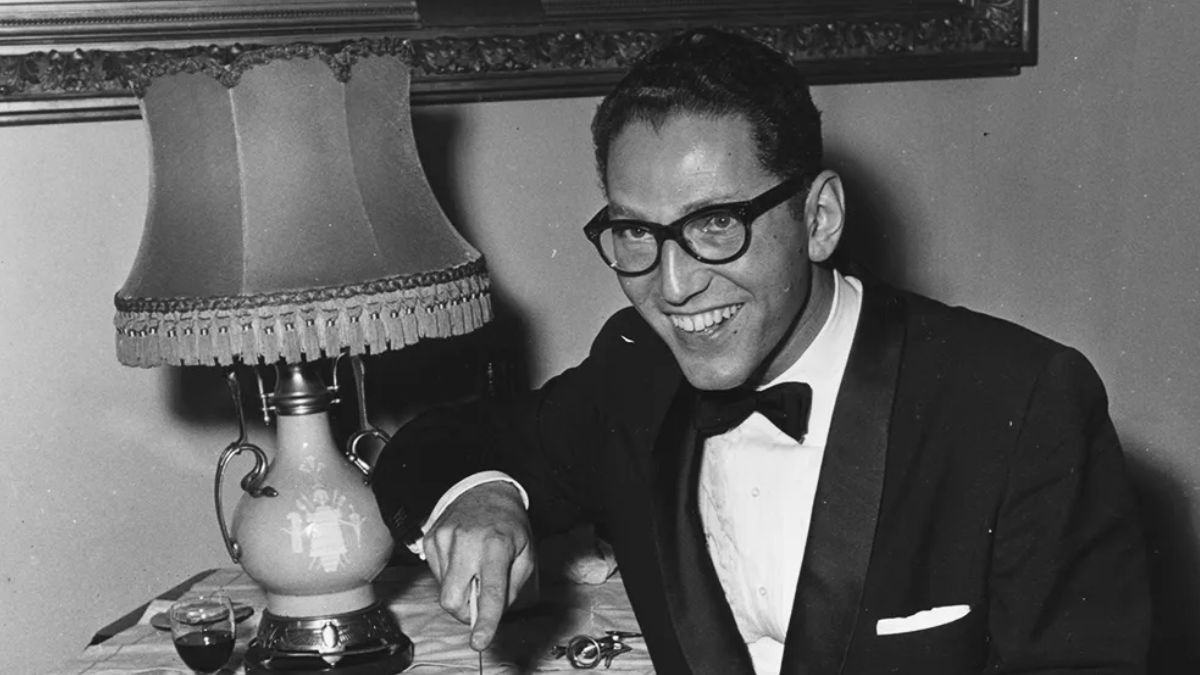
Tom Lehrer, who died at 97 on July 26, 2025, at his home in Cambridge, Massachusetts, was a paradox: a Harvard math prodigy who became a musical satirist, only to ditch fame for the quiet life of a professor. His death, confirmed by longtime friend David Herder to outlets like The New York Times and AP, closes the book on a career that spanned just 37 songs but left a seismic impact on comedy and music. Known for his razor-sharp lyrics and jaunty piano melodies, Lehrer lampooned the 1950s and 60s with songs like “The Masochism Tango” and “We Will All Go Together When We Go,” tackling taboos from nuclear annihilation to racism with a grin. His influence echoes in modern satirists, yet he shunned the spotlight, teaching math at UC Santa Cruz into his late 70s and releasing his work to the public domain in 2020. Here’s a look at the man, his music, and why his brief career still resonates.
A Prodigy’s Start: From Harvard to Underground Hit
Born April 9, 1928, in Manhattan to a Jewish family, Lehrer was a child of privilege, his father a necktie manufacturer. A piano prodigy by age 7, he preferred Broadway’s razzle-dazzle to classical rigor, idolizing Gilbert and Sullivan. At 15, he entered Harvard, graduating with a math degree at 18 and a master’s at 19. His satirical streak emerged early with “Fight Fiercely, Harvard,” a 1945 parody of football anthems that mocked the Ivy League’s stuffiness. By 1950, Lehrer was performing his songs at campus parties, blending wit with piano virtuosity.
In 1953, he spent $15 to record Songs by Tom Lehrer, a 10-inch LP with 400 copies. Tracks like “I Hold Your Hand in Mine” (a necrophiliac ballad) and “The Old Dope Peddler” shocked and delighted, spreading by word of mouth. Without radio play—stations balked at his edgy content—the album sold an estimated 500,000 copies, fueled by campus buzz and a San Francisco Chronicle article. Lehrer’s devil-horned album cover set the tone: this was satire with a wicked edge. By the late 1950s, he was performing in nightclubs from New York to London, his “sick” humor earning comparisons to Lenny Bruce and Mort Sahl.
The Satirical Peak: Skewering the Cold War
Lehrer’s peak came in the late 1950s and 1960s, a time of Cold War paranoia and social upheaval. His 1959 albums, More of Tom Lehrer (studio) and An Evening Wasted with Tom Lehrer (live), featured gems like “Poisoning Pigeons in the Park,” a gleeful ode to urban pest control, and “The Elements,” a rapid-fire periodic table set to Gilbert and Sullivan’s “Modern Major-General.” The live album earned a 1960 Grammy nomination for Best Comedy Performance (Musical). His 1965 album, That Was the Year That Was, tied to the NBC satirical show That Was the Week That Was, tackled nuclear fears (“Who’s Next?”) and pollution, hitting No. 18 on the Billboard 200.
Lehrer’s genius lay in his delivery: erudite, polite, yet savage. He mocked segregation in “I Wanna Go Back to Dixie,” the Catholic Church in “The Vatican Rag,” and militarism in “It Makes a Fellow Proud to Be a Soldier.” His Army stint (1955-1957) informed his cynicism—he claimed to have invented Jell-O shots during service—and songs like “Wernher von Braun” jabbed at the ex-Nazi scientist’s NASA role. Musicologist Barry Hansen, aka Dr. Demento, called him “the most brilliant song satirist ever recorded,” a sentiment echoed by fans like “Weird Al” Yankovic, who mourned Lehrer on Instagram as “my last living musical hero”.
The Retreat: Why Lehrer Walked Away
Lehrer’s music career was brief, spanning roughly 1953 to 1967. After That Was the Year That Was, he largely quit performing, citing discomfort with public life. “Performing every night when it’s all on record is like a novelist reading his novel nightly,” he told The AP in 2000. He returned to Harvard, teaching math and later musical theater at UC Santa Cruz from 1972 to 2001. He split his time between Cambridge and Santa Cruz, escaping New England winters. His classes were rigorous—students expecting singalongs were met with “real math,” he quipped.
Lehrer wrote sparingly after the 1960s, contributing 10 songs to The Electric Company in the 1970s and performing at a 1972 George McGovern fundraiser. A 1980 revue, Tomfoolery, revived his work in London and New York, and he made a rare 1998 appearance to honor producer Cameron Mackintosh. In 2020, he relinquished all copyrights, placing his songs in the public domain with a blunt, “Don’t send me any money”. Rumors swirled that he quit when Henry Kissinger’s 1973 Nobel Peace Prize “killed satire,” but Lehrer debunked this, saying he’d stopped earlier.
The Legacy: A Cult Icon’s Lasting Echoes
Lehrer’s 37 songs, though few, reshaped musical satire. His influence on Randy Newman, Steely Dan, and Rachel Bloom is undeniable—Bloom praised his ability to “flip genres on their head”. Daniel Radcliffe’s 2010 performance of “The Elements” on British TV led to his casting in Weird: The Al Yankovic Story. Lehrer’s work, archived by the Internet Archive, remains freely accessible, a gift to fans and artists. Posts on X mourned his passing, with historian Simon Schama calling him a “mordant” idol and others lamenting the loss of satire in a polarized age.
Skeptics might argue Lehrer’s retreat was less about principle than burnout or fear of irrelevance—his quip about Kissinger suggests the world’s absurdity outpaced his pen. Yet, his sparse output and refusal to cash in (no royalties, no comeback tours) paint a man who valued ideas over fame. Teaching math and musical theater, he shaped minds more quietly but no less profoundly. A 2021 photo of Lehrer holding his own obituary as a joke captures his impish spirit.
The Verdict: A Singular Voice Silenced
Tom Lehrer’s death at 97 closes a chapter on a satirist who made the 1950s and 60s laugh at their fears. His songs, blending Broadway flair with razor wit, remain timeless, from the gleeful nihilism of “We Will All Go Together When We Go” to the nerdy brilliance of “The Elements.” He didn’t just mock; he dissected, exposing society’s absurdities with a smile. His retreat to academia and public domain gift show a man who lived on his own terms, leaving a legacy that’s as much about integrity as ingenuity.




