

A New Political Challenger
When Tamil superstar Thalapathy Vijay stepped onto the political stage earlier this year with his party, the Tamilaga Vettri Kazhagam (TVK), the buzz was deafening. Tamil Nadu, long dominated by the twin pillars of Dravidian politics—DMK and AIADMK—suddenly found a new challenger whose popularity stretched from cinema halls to village streets. But as Prime Minister Narendra Modi intensifies his efforts to make inroads into Tamil Nadu and the larger South, a question is reverberating across political circles: Can Vijay’s TVK truly block Modi’s march southward?
Vijay’s Sharp Attack: Calling Modi a “Fascist”
Unlike other film stars who step into politics cautiously, Vijay did not mince words. At TVK’s state convention in Madurai, he launched a blistering attack on both national and state-level rivals. While branding the DMK as his “political enemy,” he went further with the BJP, declaring it an “ideological enemy” and directly labeling Prime Minister Modi’s leadership as “fascist.”
In doing so, Vijay did what few mainstream Tamil leaders dare: confront the Prime Minister head-on. His speech, laced with references to Tamil identity and autonomy, cast BJP not merely as a political rival but as an existential threat to Dravidian self-respect.
Modi’s Southern Push
Prime Minister Modi has left no stone unturned in wooing Tamil Nadu. From celebrating Chola king Rajendra Chola I at a UNESCO heritage site to attending cultural-spiritual events, his outreach has been carefully designed to touch Tamil pride. Yet, BJP’s electoral journey in the state has remained largely symbolic—relying on alliances with AIADMK or smaller parties rather than on independent strength.
For Modi, Tamil Nadu is the “final frontier” in the South. For Vijay, it is the ideal battleground to position himself as the voice of Tamil identity against Delhi’s centralizing power.
From Silver Screen to Campaign Trail
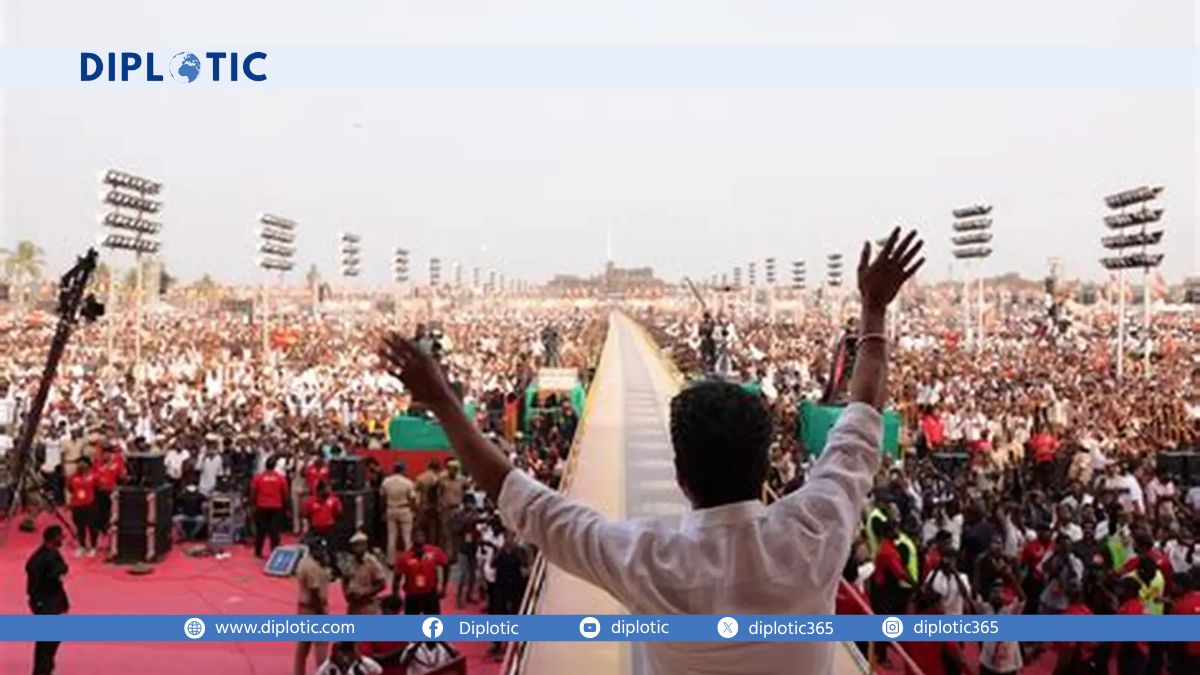
Vijay’s rallies have been nothing short of spectacular. In Madurai, lakhs of supporters turned up, echoing scenes from his blockbuster film openings. But this time, the chants weren’t for a movie—it was for a political alternative. TVK has already enrolled over 1.1 crore members and is mapping out a grassroots network, starting from the politically symbolic Cauvery delta region.
His speeches combine the charisma of a film hero with populist political punches. When Vijay accused the BJP and DMK of engaging in “kindergarten hashtag wars,” he positioned himself as the serious alternative Tamil Nadu needs.
“Walking Separate” — TVK’s Independent Path
Perhaps the most striking part of Vijay’s political message is his refusal to align with either national or Dravidian giants. He has made it clear that TVK will “walk separate,” contesting elections independently without tying itself to DMK, AIADMK, or BJP.
By rejecting alliance politics, Vijay signals that TVK is not just another regional bargaining force but a party with its own ideological clarity. His independence is designed to attract those weary of the compromises and contradictions of coalition politics.
Why TVK Worries the BJP
For the BJP, Vijay is a unique challenge. Unlike DMK, which can be portrayed as dynastic or corrupt, Vijay is new, popular, and carries an image of incorruptibility. His “fascist” label for Modi is not just rhetoric—it resonates with sections of Tamil voters already skeptical of BJP’s centralizing politics.
Even if TVK doesn’t sweep 2026, it could damage the BJP’s southern alliances by attracting disillusioned young voters, especially those unwilling to vote for either DMK or AIADMK.
The Road Ahead
Tamil Nadu politics is in flux. DMK remains strong, AIADMK is weakened, and BJP is searching for a foothold. Into this crowded field, Vijay’s TVK has brought star power, grassroots energy, and sharp anti-BJP rhetoric.
The battle lines are clear: a Dravidian state fiercely protective of its identity versus a national party trying to penetrate it. What’s new is that Modi now has to face not only Stalin but also a superstar who isn’t afraid to call him a fascist—and who insists on walking his own path.




