

A Dual Arena of Influence
Since 2016, Syria has steadily turned into a dual arena: Israel wages a sustained air and intelligence campaign to blunt Iran-backed entrenchment across Syria; Türkiye projects hard power on the ground in the north to contain the PKK/YPG, shape cross-border security, and build influence through proxy governance. Both tracks operate alongside (and often in spite of) international diplomacy like the Astana process and UN humanitarian mechanisms. The cumulative record of repeated Israeli strikes inside Syria and Türkiye’s enduring military occupations, buffer zones, and drone campaigns constitutes clear, documented proof that Syria is a battleground for Israeli and Turkish influence.
The Israeli Track: Campaign Between Wars
Doctrine & objectives. For roughly a decade, Israel has pursued the mabam (“campaign between wars”)—a continuous, mostly deniable, air/intelligence effort to degrade Iranian and Hezbollah assets in Syria, interdict precision-guided weapons flows, and prevent strategic Iranian basing. Think tanks and military institutes document this as core Israeli doctrine.
Operational pattern. Open-source defence studies note “hundreds of airstrikes” on IRGC-QF, Hezbollah, depots, and transit nodes across Syria since 2013. These operations accelerated during and after the ISIS war and again amid the wider 2023–2025 regional crisis.
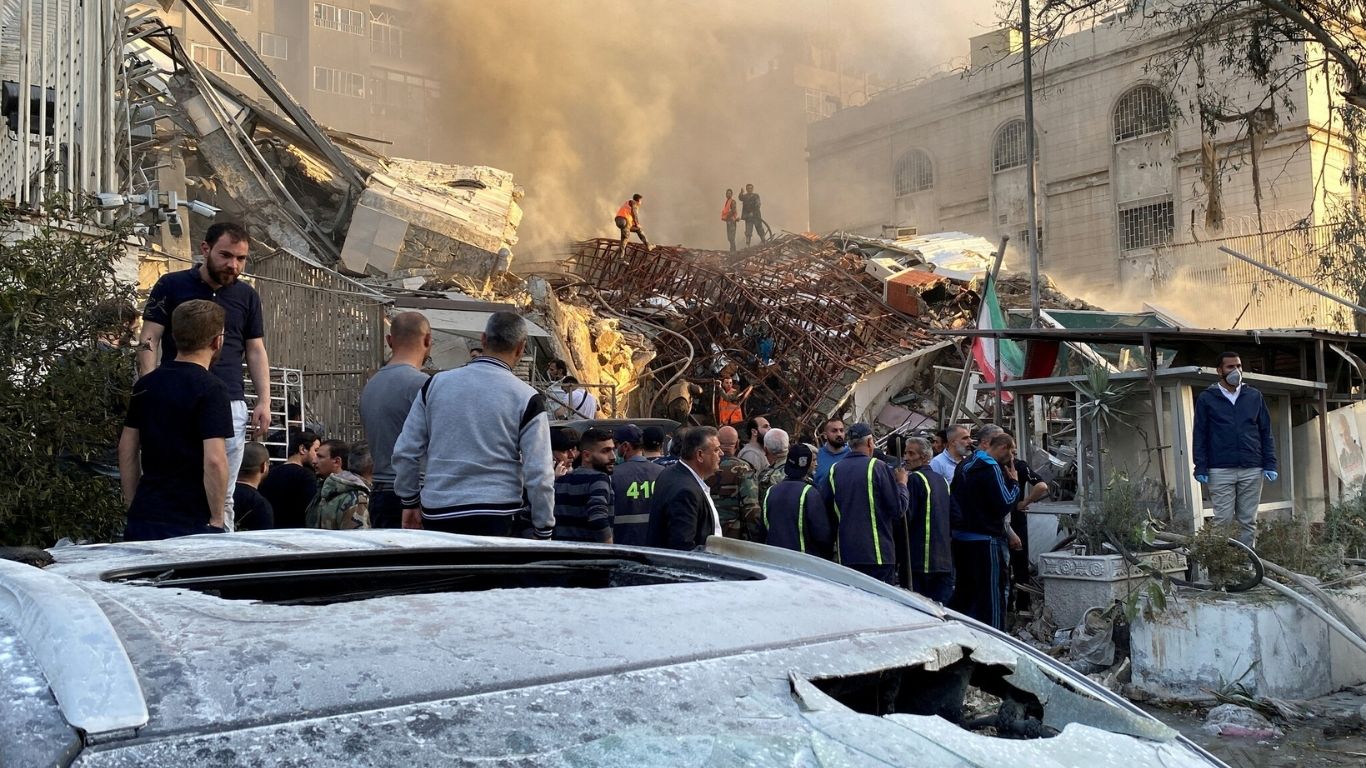
Escalatory flashpoints. On 1 April 2024, a strike widely attributed to Israel destroyed Iran’s Damascus consular building, killing senior IRGC-QF commanders—an event that triggered direct Iranian-Israeli exchanges and broad international censure, underlining how Syrian soil is used in the Israel-Iran shadow war.
Regional risk. The International Crisis Group has repeatedly warned that Israeli-Iranian tit-for-tat inside Syria risks uncontrolled escalation—again highlighting Syria’s role as the chosen arena.
The Turkish Track: Control and Influence
Ground interventions and zones. Since August 2016, Türkiye has launched successive operations—Euphrates Shield (2016–17), Olive Branch (2018/Afrin), and Peace Spring (Oct. 2019, Tel Abyad–Ras al-Ain)—establishing durable zones of control with Turkish troops and Syrian National Army (SNA) proxies. An EU Parliament briefing, major media, and policy research detail these phases.
The Sochi/“buffer” architecture. The October 2019 Russia-Türkiye memorandum created joint-patrol buffer arrangements designed to push YPG elements 30 km from the border—another formalization of Turkish influence on Syrian territory.
Drone/air campaigns and pressure on the SDF. Beyond boots on the ground, Türkiye regularly uses drones and airpower against SDF/YPG targets and infrastructure in northeast Syria, actions documented by Human Rights Watch and reported by AP and other outlets.
Influence via governance & resettlement projects. Rights reporting also tracks Turkish-aligned local councils, police, currency and curriculum shifts, and extensive housing projects intended to facilitate refugee returns—further consolidating Ankara’s sway in northern Syria.
Diplomacy and Fragmentation
Astana process (Russia-Türkiye-Iran). Launched in 2017, Astana created “de-escalation zones” but entrenched spheres of influence: the northwest under rebel/HTS sway with Turkish patronage; regime-held cores backed by Russia/Iran; SDF-held northeast under US umbrella. Recent analyses argue Astana mostly manages—rather than settles—the fragmentation.
UN humanitarian tracks. UN cross-border aid via Bab al-Hawa and other crossings has been repeatedly renewed, contested, or constrained—reflecting how outside powers leverage Syrian geography and local authorities.
Strategic Logic for Israel and Türkiye
For Israel: Syria is the forward operating theatre for Iran and Hezbollah; interdicting missile transfers and bases west of the Euphrates mitigates multi-front threats to northern Israel and the Golan.
For Türkiye: Northern Syria is the decisive depth against the PKK/YPG; shaping border security, refugee policy, and local governance there is inseparable from Turkish domestic politics and counter-terrorism doctrine.
Proof of Syria as a Battleground
- Documented Israeli kinetic activity inside Syria on a sustained, strategic basis (2013-present), including one of the region’s most consequential single strikes of 2024 (the Damascus consulate attack), is acknowledged by reputable institutes and international media. That pattern only makes sense if Syria is the chosen arena for Israel’s anti-Iran campaign.
- Enduring Turkish military presence and administrative footprint across distinct northern belts (Jarablus-al-Bab-Azaz; Afrin; Tel Abyad-Ras al-Ain), built through named operations, joint patrols with Russia, and continuing drone/air campaigns against the SDF, demonstrates systematic influence projection from Turkish soil into Syria.
- Institutionalized arrangements (Sochi/Astana) and humanitarian access politics that hinge on Ankara’s cooperation and on Israel-Iran tensions, show how both countries’ leverage helps set the rules of engagement and aid flow in different parts of Syria.
Taken together—persistent Israeli strikes targeting Iran-linked networks inside Syria; persistent Turkish control, patrols, and strikes shaping the northern map; and diplomacy that effectively codifies these realities—constitute empirical proof that Syria is a battleground for Israeli and Turkish influence.
Regional and Civilian Implications
Civilian risk & infrastructure harm from Turkish air/drone campaigns and Israeli-Iranian exchanges on Syrian soil remain high, with repeated damage to power, water and health facilities in the northeast and periodic mass-casualty incidents elsewhere.
Frozen fragmentation: Astana-style “management” entrenches competing protectorates, complicating national reconciliation and reconstruction.
Escalation ladders: The April 2024 Damascus consulate strike proved how quickly localized Syria episodes can widen to regional confrontation.
Conclusion
Syria’s post-2011 fracture created permissive space for external actors to pursue security agendas. Israel uses Syrian airspace and territory to fight an indirect war with Iran and Hezbollah. Türkiye uses northern Syria to push its border security, refugee, and anti-PKK priorities. The persistence, scale, and institutionalization of these activities—corroborated by military institutes, rights monitors, international media, and UN processes—are clear proof that Syria has become the battleground for Israeli and Turkish influence.




