

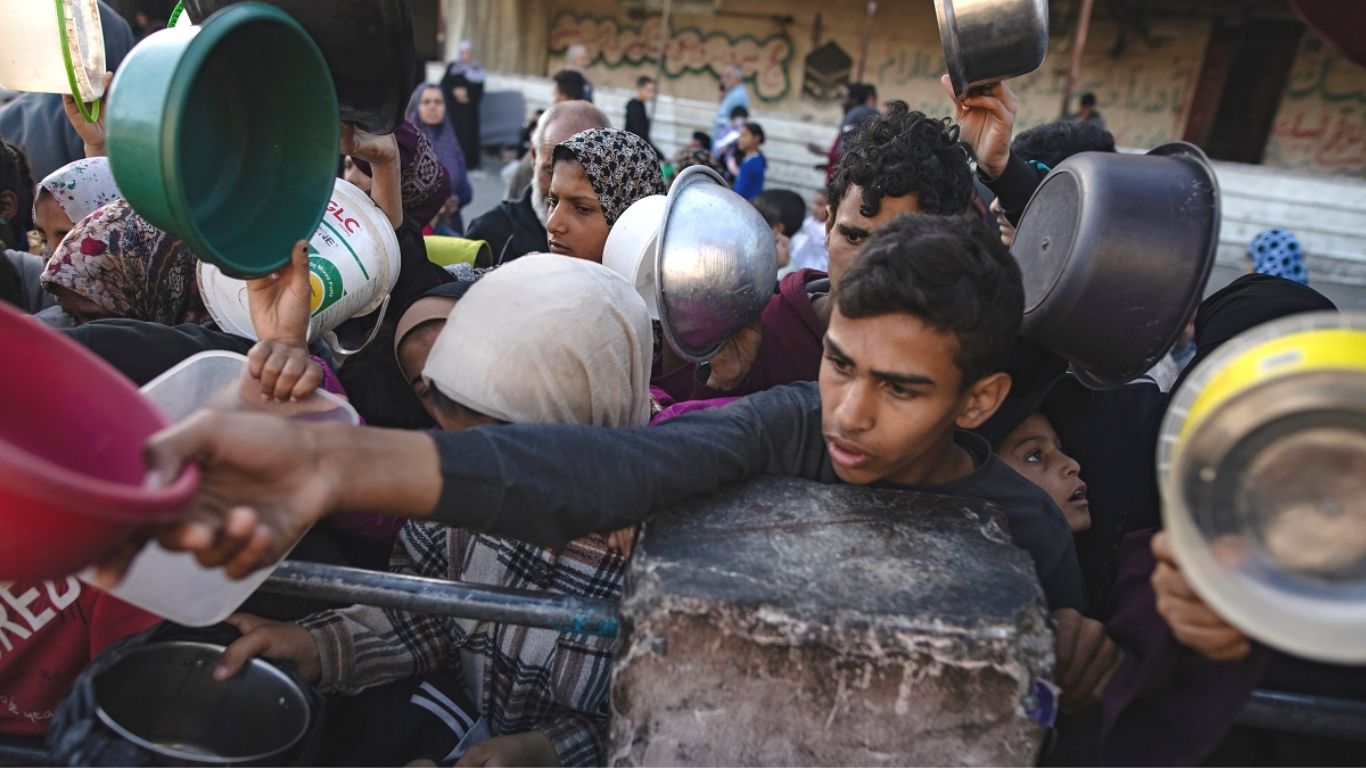
Gaza is facing a man-made famine as Israel’s blockade triggers mass starvation. With over 57 children dead and 470,000 in catastrophic hunger, rights groups call it a war crime. As Israel’s blockade enters its 19th month, experts warn: starvation is now a weapon of war, and Gaza is its target. In the once-bustling streets of Gaza City, children now dig through rubble for scraps. In Khan Younis, mothers cradle skeletal infants, unable to produce milk. In overcrowded hospitals, doctors weep beside children who die not from bombs, but from hunger.
Since March 2024, at least 57 children have died of starvation in the Gaza Strip, with over 71,000 more under the age of five facing acute malnutrition, according to UN and NGO estimates. Human rights groups warn that the region is on the brink of a full-scale famine not because of a natural disaster, but due to deliberate policies.
This is Gaza’s man-made famine, engineered through siege, military destruction, and the obstruction of aid. And it may amount to a war crime under international law.
Israel’s Total Blockade: A System of Starvation
Since March 2, 2024, Israel has imposed a complete blockade on Gaza sealing all border crossings, limiting humanitarian aid, and cutting off essential resources. The result has been catastrophic. According to the Integrated Food Security Phase Classification (IPC), a UN-backed monitoring group:
- 95% of Gaza’s 2.1 million residents face crisis-level hunger or worse.
- 470,000 people (22%) are in IPC Phase 5: Catastrophic Hunger, the most severe level.
- Over 1 million (54%) are in Phase 4: Emergency.
- Malnutrition has affected nearly every child under five in the enclave.
“This is not food insecurity it’s famine,” said Cindy McCain, Executive Director of the World Food Programme. “We are watching an entire population waste away while trucks full of aid sit on the other side of a fence.”
The Israeli government defends the blockade as a means to pressure Hamas, the armed group that governs Gaza. But experts and humanitarian leaders say the blockade is collective punishment a policy that targets civilians, not combatants.
A City Without Food: Destruction of Gaza’s Lifeline
Years of siege have devastated Gaza’s economy and food systems, but the current blockade is unprecedented in scale. Israeli airstrikes have:
- Destroyed 75% of Gaza’s farmland, irrigation systems, and greenhouses.
- Bombed bakeries, flour mills, food warehouses, and livestock facilities.
- Targeted water treatment plants and fuel depots essential for food storage.
The consequences are immediate and brutal. Food prices have skyrocketed, with bread when available selling for 20 times its pre-war cost. Fish and dairy are non-existent. Families survive on wild herbs, animal feed, and contaminated water.
“The starvation is systematic,” said Dr. Feroze Sidhwa, a trauma surgeon who recently served in northern Gaza. “It’s not just the food blockade it’s the collapse of everything that supports life.”
Inside the Starvation: What Happens to a Malnourished Body
Starvation is a slow, torturous form of death. It unfolds in stages:
- First 3 days: The body burns through glycogen, causing weakness and dizziness.
- By week 2: Fat stores vanish. The body consumes muscle tissue.
- Beyond 1 month: Organs fail. In children, brain development halts. The immune system collapses, and minor infections become lethal.
In Al-Aqsa Martyrs Hospital in Deir al-Balah, doctors report children with open wounds that won’t heal, babies too weak to cry, and pregnant women giving birth to dangerously underweight infants.
“Even if aid resumes tomorrow, we’re facing a generation of irreversible damage,” warned a UNICEF nutrition specialist. “Cognitive impairments. Growth stunting. Permanent disability.”
Is Starvation a War Crime? Legal and Ethical Lines Crossed
Under international humanitarian law, starvation of civilians as a method of warfare is explicitly forbidden. Article 54 of Protocol I of the Geneva Conventions bans:
- Starving a civilian population.
- Attacking objects indispensable for survival, including food, water, and agriculture.
- Obstructing humanitarian aid.
Multiple UN agencies, human rights experts, and legal scholars now argue that Israel’s conduct meets the definition of a war crime.
The UN High Commissioner for Human Rights, Volker Türk, stated in April:
“There is credible evidence that Israel is using starvation as a method of war. That is a war crime under international law.”
International legal advocacy group Lawyers for Palestinian Human Rights (LPHR) called the policy a “deliberate strategy of mass starvation,” while others label it a tactic of slow genocide.
The “Flour Massacre”: Hunger Meets Violence
Perhaps the most chilling moment of Gaza’s hunger crisis came in what has been called the “Flour Massacre.” On April 5, thousands of Gazans gathered near a humanitarian convoy rumored to carry flour. Video footage shows Israeli forces opening fire. At least 112 civilians were killed.
“They died trying to eat,” said one survivor. “Trying to grab a sack of flour.”
Israeli authorities blamed Hamas for inciting chaos. Witnesses and international observers disagreed, accusing Israel of deliberately targeting civilians under the guise of crowd control.
Global Inaction: Where Is the World?
Despite three UN Security Council resolutions demanding safe aid access, the blockade remains in place. The United States, Israel’s key ally, has voiced concern but continues to ship weapons and provide diplomatic cover.
Meanwhile, the International Criminal Court (ICC) has issued arrest warrants for Israeli Prime Minister Benjamin Netanyahu and former Defense Minister Yoav Gallant for war crimes, including the use of starvation. Both remain at large.
The world watches. Gaza starves.
What Needs to Happen Now: A Road to Recovery
Experts agree: this famine is 100% preventable if political will exists. Key steps include:
- Immediate, unconditional lifting of the blockade to allow food, water, fuel, and medical aid to enter.
- International enforcement of humanitarian corridors, including protection for aid workers.
- Reconstruction of Gaza’s basic infrastructure: farms, bakeries, hospitals, and water systems.
- International accountability for those responsible for starvation policies.
- A lasting ceasefire and diplomatic resolution to prevent future humanitarian catastrophes.
“Without urgent action,” warned Akihiro Seita, Director of Health at UNRWA, “this famine will be remembered not just as a tragedy but as a stain on humanity.”
Conclusion: This Is More Than a Crisis it’s a Crime
Gaza’s hunger is not an accident of war. It is the result of choices political, military, and strategic. Starvation is being used as a weapon, and its victims are overwhelmingly civilians: children, mothers, the elderly.
The question now is not whether famine is coming. It is whether the world will stop it.




