

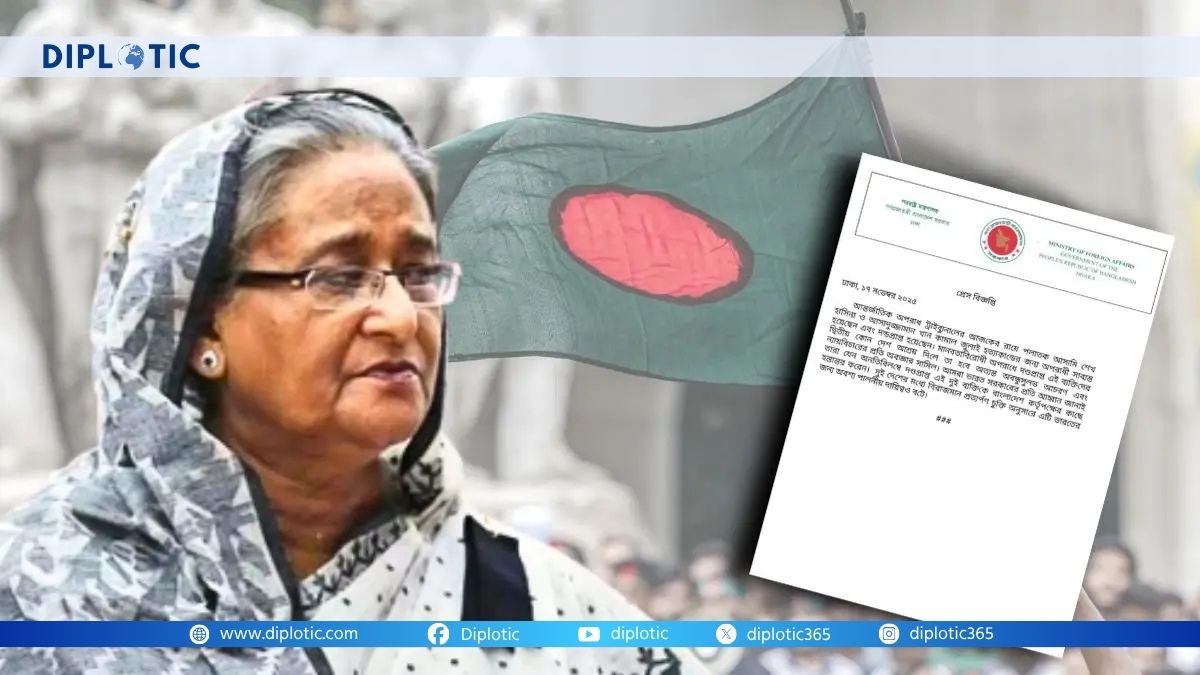
Few moments in South Asia’s recent history have been as dramatic as the fall of Sheikh Hasina in August 2024. A leader who once shaped Bangladesh’s political landscape for more than a decade left her capital under siege, fleeing to India as student protesters overran her official residence. Today she sits in New Delhi, convicted in absentia and sentenced to death by Bangladesh’s International Crimes Tribunal. Dhaka wants her back. India is refusing.
The question is not whether India can hand her over. It is why India should not, at least not now.
The answer lies in a mix of politics, principle, and the raw reality of regional power dynamics.
The Trial Looks Political. That matters.
Bangladesh argues that Hasina’s conviction stems purely from crimes committed during the 2024 crackdown, which killed more than a thousand people. Those deaths were real and horrifying; history will not forget them. Yet the speed, timing and tone of the tribunal’s proceedings raise concerns that go beyond justice.
Overnight, a long-time ruling party was dismantled, its leaders jailed or exiled, and a Nobel laureate-turned-political figure took charge of an interim administration. The political shift was faster than the legal process that followed. The impression, fair or not, is that the trial served not only justice but also political cleansing.
India sees the proceedings through that lens. And it is not alone. Extradition treaties worldwide shield individuals from return when charges appear politically motivated. India’s own treaty with Bangladesh includes this exact exception. New Delhi is applying it with textbook caution, not malice.
If Hasina is sent back under these conditions, it may set a precedent that political winners can use death sentences to erase rivals. That is not an outcome India or any democracy should enable.
A Death Sentence Crosses a Diplomatic Line
There is another point often overlooked: very few democratic nations extradite individuals to face capital punishment unless given firm guarantees that the sentence will not be carried out.
Bangladesh is offering no such assurance. Quite the opposite. Public calls for Hasina’s execution are loud and emotional. Ministers frame her return as an “obligatory responsibility.” Student groups promise mass mobilization until she is “hanged in Dhaka.”
This is not an environment where India can ethically hand over a former head of government—any head of government, friendly or not.
India abolished the routine use of political executions decades ago and applies the death penalty only in “the rarest of rare cases.” Sending Hasina back without due process guarantees would place New Delhi on the wrong side of its own moral compass.
Geopolitics Is Not a Footnote; It Is the Centerpiece
The demands from Dhaka do not exist in a vacuum. Since Hasina’s ouster, Bangladesh’s interim leadership has taken positions noticeably colder toward India and warmer toward Pakistan. This shift is not subtle. Dhaka accuses India of backing Hasina for too long, while Pakistan has revived old diplomatic warmth.
For India, this is not simply a dispute over one former prime minister—it is about regional strategy. Hasina was New Delhi’s closest partner in South Asia for more than a decade. Her cooperation helped India secure its eastern border, pursue trade routes into the Northeast, stabilize Rohingya refugee inflows, and maintain security cooperation.
Her fall does not erase that history. And while New Delhi must accept political change in Bangladesh, it also cannot allow its long-term interests to be dictated by the volatility of an interim government still struggling to consolidate legitimacy.
Keeping Hasina in India is not about supporting her return. It is about retaining leverage in a region where influence can be lost overnight but takes decades to rebuild.
Bangladesh’s Democracy Needs Stability Not Revenge
There is a deeper, more uncomfortable truth: Bangladesh is at a crossroads, and its political future remains fragile. The 2024 uprising toppled a government, but it did not settle the future direction of the state. No political force today commands a broad national consensus. The interim government faces internal fractures, a restless military, and public expectations that cannot be met instantly.
In such an environment, removing Hasina from the picture through execution would not stabilize Bangladesh it would divide it further.
Opposition parties would rally around martyrdom; the Awami League, even banned, would gain fresh political oxygen; and the country could be thrown into yet another cycle of unrest. India understands this. Bangladesh’s own analysts acknowledge it. Justice pursued in haste rarely produces long-term peace.
New Delhi’s non-extradition stance may, ironically, be the one factor preventing Bangladesh’s politics from slipping into a deeper rupture.
Dhaka and New Delhi Must Reset the Relationship
India cannot shelter Hasina forever. Nor does it want to. The long-term solution lies in something both nations are avoiding: a structured diplomatic reset.
Bangladesh’s elections, scheduled for early 2025, could offer the first opening for a more stable negotiation. A new elected government whatever its composition—may approach the issue with less emotional urgency and more institutional clarity. India, for its part, must prepare to work with leaders not shaped by the Awami League era.
But until Bangladesh’s political landscape settles, extradition remains a red line India cannot cross.
Conclusion: Principle, Power, and the Weight of History
Sheikh Hasina’s future will not be decided soon. Nor should it be. The demand for her return touches on the qualities that define India’s identity as a democracy: restraint, due process, and moral responsibility. It also touches on the political reality that regional stability often depends on patience, not impulse.
In the end, the Hasina question is not simply about one leader. It is about the kind of region South Asia chooses to become: one where political transitions follow law, or one where victory is enforced with the noose.
For now, India is choosing restraint. Bangladesh may one day look back and see that as a gift, not an offense.




