

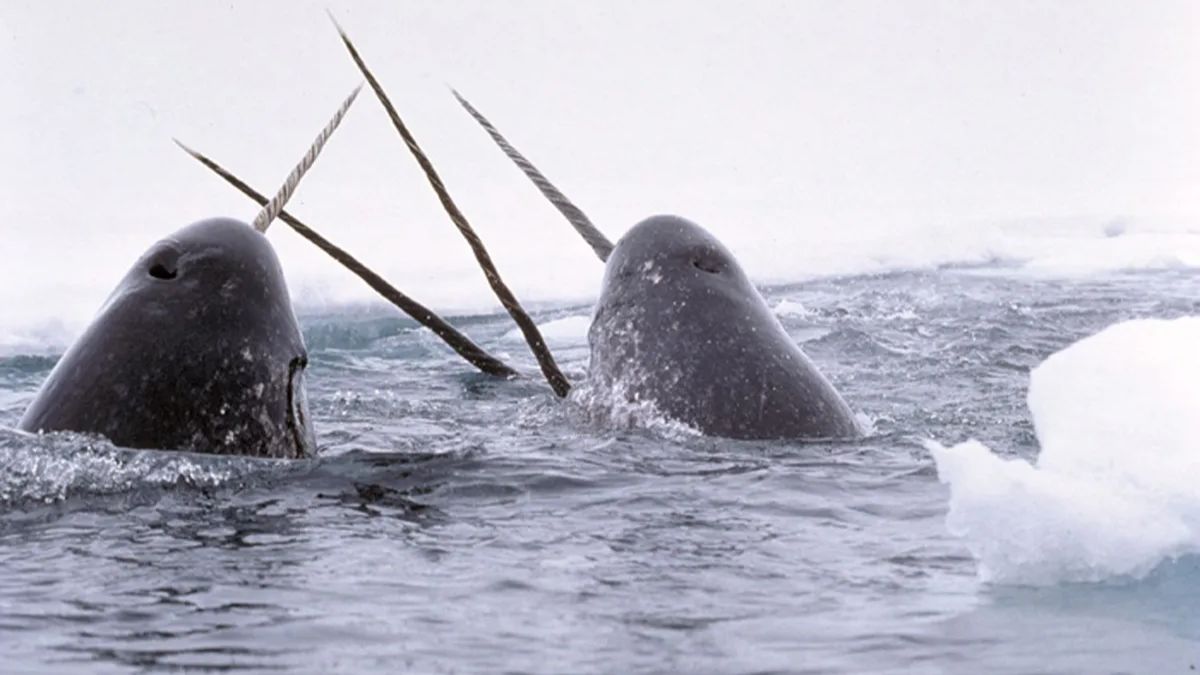
The narwhal—yes, the so-called unicorn of the sea—has always been a bit of a mystery. You’ve probably heard of its famous spiral tusk, a long, twisted tooth that can stretch up to 10 feet. While people have long speculated that the tusk might help the narwhal land a mate (imagine a sea version of a flashy car or a big house), the full purpose of this horn has been a tough nut to crack. Researchers have been trying to figure it out for years, but as you might expect, studying these creatures in the wild is like trying to catch a shadow—hard, elusive, and mostly in the cold, dark waters of the Arctic.
But here’s where things get interesting: A recent study, using drone footage no less, has finally started to give us some answers—and let’s just say, what we thought we knew about narwhals is just the tip of the iceberg. So, grab your metaphorical seatbelt, because we’re about to dive into some seriously cool narwhal behavior that might just change the way we think about these sea-dwelling unicorns.
The Magic of Drones: Catching Narwhals in Action
Researchers from Florida Atlantic University (FAU) and Canada’s Department of Fisheries and Oceans teamed up with local Inuit communities in the Canadian High Arctic for a groundbreaking study that would blow your mind. Armed with drones (yes, drones, like the ones we use to take those fancy aerial shots of wedding venues), they filmed narwhals doing…well, let’s say, unexpected things. The footage they captured revealed no less than 17 different behaviors—some never seen before—showing us how these whales interact with their environment. And trust me, it’s nothing like you imagined.
The Tusk: Not Just for Show
Let’s talk about that tusk. Turns out, narwhals don’t just flaunt their long horns like a wannabe influencer showing off their new shoes. No, no. It’s a tool. And not just any tool—this tusk is doing everything from hunting to playing to exploring its frozen surroundings. One of the biggest revelations? Narwhals use their tusks to hunt, believe it or not. They use that tusk to strike Arctic char fish (that’s a fancy term for the local fish, in case you didn’t know), hitting them with such force that the fish get stunned, and boom—meals on the way. Talk about being a fisherman with style.
Greg O’Corry-Crowe, a seasoned researcher and senior author on the study, put it pretty plainly: “Narwhals are known for their ‘tusking’ behavior,” he said. “But now we know that narwhal tusks have other uses, some quite unexpected, including foraging, exploration, and play.”
So, just to reiterate—these tusks aren’t just an accessory. They’re multifunctional, like that Swiss army knife you’ve always wanted.
Foraging, Exploration, and… Play?
Now, here’s where things get even more bizarre. Not only do narwhals use their tusks to hunt and explore, but they also use them for something we might all be guilty of from time to time: playing. Yes, playing. Imagine a few narwhals, casually poking and prodding at a fish—not for food, not for survival, but just out of curiosity. The researchers were stunned when they saw this, and it really made them wonder: Do narwhals have personalities? Are some tusks more playful than others? It’s like the narwhals are their own little social network—some are serious hunters, while others are just out here looking for some fun.
Cortney Watt, another big name in the research world, chimed in: “To observe them using their tusks for foraging and play is remarkable.” She went on to say, “This unique study where we set up a remote field camp and spent time filming narwhal with drones is yielding many interesting insights and is providing a bird’s eye view of their behavior that we have never seen before.”
So, the narwhals aren’t just doing their thing—they’re showing us new sides of themselves we didn’t even know existed. It’s like they’ve got their own little world, and now, thanks to drones, we’re finally getting a peek inside.
The Tusks That Know More Than We Think
But hold on, there’s more. As the researchers dug deeper into the footage, they discovered something truly mind-bending. Narwhals might actually be using their tusks to sense their environment. Yeah, you heard that right. They may be able to detect changes in water temperature and salinity—basically helping them survive and thrive in those icy, freezing waters of the Arctic. So not only are they using their tusks to strike at fish or explore their surroundings, but they could also be using them as a sort of sixth sense to feel the ocean around them. It’s like their tusks are giving them a constant update on their surroundings. Talk about being ahead of the game!
What Does This All Mean?
So, what do we make of all this new info? Well, let’s be real: it’s easy to look at a narwhal and think, “Ah, a quirky whale with a ridiculous horn,” and leave it at that. But what these researchers have done is peel back the layers to reveal something much more interesting. These animals aren’t just some mythical creature—they’re complex, adaptable, and smart. They use their tusks for survival, play, exploration, and maybe even to detect the world around them. The narwhal’s tusk is much more than a symbol of its uniqueness; it’s a vital tool for navigating the harsh conditions of the Arctic.
And let’s not forget the deeper truth here: while we’ve been over here on our cozy little planet, these creatures have been quietly doing their thing for thousands of years. They’ve adapted, evolved, and figured out ways to survive in one of the most unforgiving environments on Earth. Meanwhile, we’ve been sitting in boardrooms arguing over whether a plastic straw should be banned (just kidding, but you get my point). The narwhal is proof that nature knows what it’s doing—and maybe, just maybe, we could stand to learn a little something from them.




