

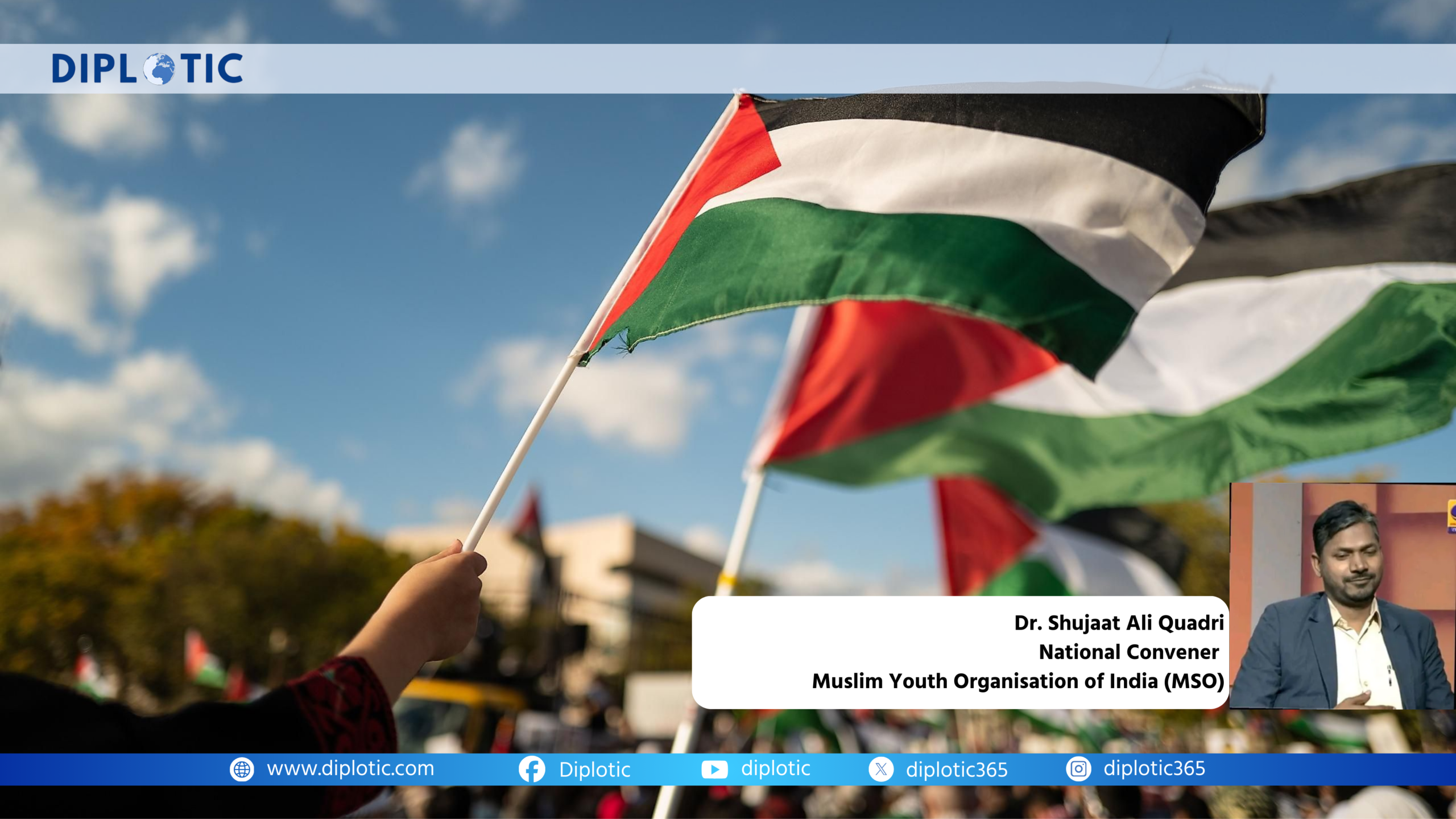
Dr. Shujaat Ali Quadri
The recent revelations by the Washington Post that Saudi Crown Prince Mohammed bin Salman privately lobbied Washington to strike Iran have pulled back the curtain on a deeply unsettling reality. Publicly, Riyadh speaks the language of restraint and regional stability. Privately, it appears to have encouraged an escalation that could set the Middle East ablaze. This duplicity is not just about Saudi Arabia; it reflects a broader collapse of moral and political coherence across much of the Islamic world.
What is perhaps most striking is not merely the attack itself, but the reaction or rather, the absence of one. The larger Middle Eastern Islamic world has largely greeted the strikes on Iran with silence, and in some quarters, quiet satisfaction. No major power, including Saudi Arabia, has formally condemned Israel. This silence speaks louder than any statement. It suggests that for many regimes, strategic rivalries and sectarian calculations now outweigh the idea of Islamic unity they so often invoke in rhetoric.
Pakistan’s role in this unfolding drama is equally troubling. Reports indicate that Pakistan provided bases to the United States for recent UAV operations targeting Iran. This is not an isolated episode. In the past, Islamabad has “hobnobbed” with Washington, allegedly offering intelligence support for US strikes on Iranian nuclear facilities. Such actions place Pakistan squarely within an emerging axis that prioritizes short-term gains over regional stability.
Adding to this pattern is Pakistan’s decision to join the so-called Gaza Board of Peace alongside Saudi Arabia and Qatar. On paper, this appears humanitarian and conciliatory. In practice, it risks becoming another diplomatic fig leaf projecting concern for Gaza while aligning, directly or indirectly, with powers that refuse to hold Israel accountable for its actions. Symbolism without substance only deepens cynicism among ordinary Muslims who see selective outrage as a form of betrayal.
Across the Sunni world, a dominant narrative has emerged that places the blame for escalation squarely on Iran. Tehran is portrayed as the perpetual provocateur, the destabilizing force that “had it coming.” This framing conveniently ignores the broader context: decades of sanctions, covert operations, assassinations, and now open military pressure. More importantly, it reveals how sectarian fault lines are being actively exploited. What we are witnessing is not merely geopolitical maneuvering; it is the betrayal of Islamic brotherhood to settle long-standing scores against a Shia-majority state.
At the heart of this convergence lies a cold calculus of interests. Saudi Arabia views Iran as its principal regional challenger from Yemen to Iraq to Lebanon. Weakening Tehran, even through foreign military action, aligns neatly with Riyadh’s strategic goals. Pakistan, facing chronic economic stress and diplomatic isolation, seeks economic relief, defense cooperation, and political cover from Washington and Gulf patrons. The United States, for its part, advances its long-standing objective of containing Iran, while Israel sees a historic opportunity to neutralize what it considers its most formidable regional adversary.
Thus emerges an unspoken alignment: Pakistan, Saudi Arabia, Israel, and the United States each pursuing individual benefits, each willing to overlook the consequences for the region as a whole. For Israel, the prize is enormous: the possibility of crippling Iran, the only state with both the ideological commitment and the material capacity to challenge Israeli military dominance. For Riyadh, it is the chance to tilt the regional balance decisively in its favor. For Pakistan, it is aid, arms, and acceptance. For Washington, it is leverage and control.
Lost in all of this are the principles these states claim to uphold. Islamic solidarity becomes conditional. Sovereignty is defended selectively. Civilian suffering is condemned only when it fits a preferred narrative. The result is a moral vacuum that erodes credibility not just internationally, but among their own populations.
If Iran falls or is severely weakened, the implications will be profound. It may temporarily satisfy some regimes, but it will also normalize the idea that Muslim countries can collude with external powers to attack another Muslim nation. That precedent will not remain confined to Iran. Tomorrow, it could be someone else any state that dares to challenge the prevailing order.
The current moment should force a hard reckoning. Are Muslim majority states willing to sacrifice unity, stability, and moral consistency for tactical gains? Or will they recognize that short term victories achieved through external intervention often sow the seeds of long-term chaos?
What is unfolding today is not just a military or diplomatic episode. It is a test of whether the Islamic world stands for anything beyond expediency. So far, the silence and the alignment it conceals offers a bleak answer.
[Disclaimer: This is an authored article by Dr. Shujaat Ali Quadri, who is the National Chairman of Muslim Students Organisation of India MSO. He writes on a wide range of issues, including Sufism, Public Policy, geopolitics, and information warfare.]




