

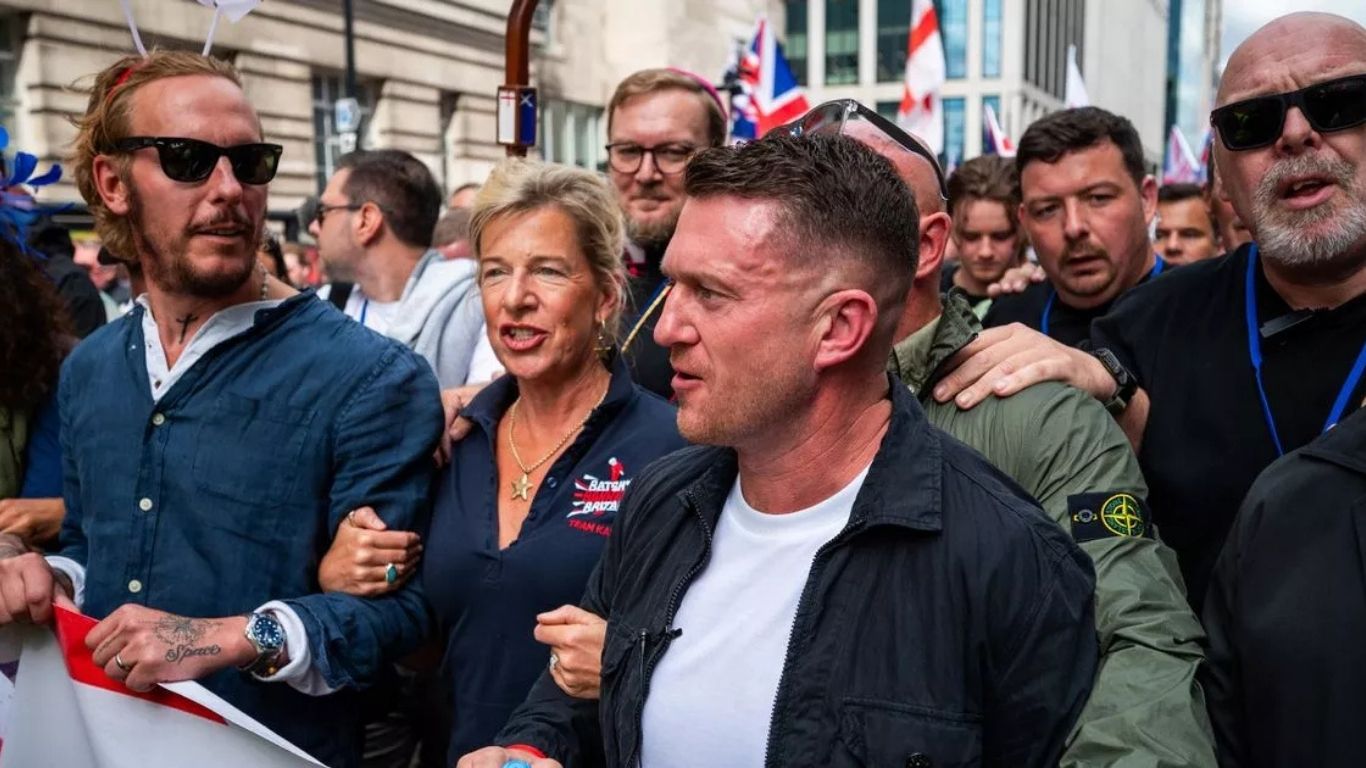
On Saturday, 13 September 2025, central London became the stage for one of the UK’s largest and most contentious anti-immigration rallies in recent memory. The protest branded “Unite the Kingdom,” was organised by far-right activist Stephen Yaxley-Lennon (commonly known as Tommy Robinson). It drew estimates between 110,000 and 150,000 demonstrators.
Escalation, Conflict, and Impact
Violence and clashes: As the march progressed, tensions erupted in multiple spots. Some protesters attempted to breach police cordons intended to keep the far-right march separated from a smaller counter-protest by “Stand Up to Racism,” which was attended by about 5,000 people.
Police injuries and arrests: The Metropolitan Police reported 26 officers injured, with four seriously hurt (including broken teeth, concussion, potentially spinal injury) and at least 25 arrests for offenses including violent disorder, assault and criminal damage.
Symbols, slogans, rhetoric: Nationalist imagery and slogans were prominent. Protesters carried UK and English flags, some wore apparel invoking US-style MAGA symbols; chants included “send them home”. Some speakers attacked immigration, claimed migrants had more rights in court than native citizens, and criticised the government under Prime Minister Keir Starmer.
While the demonstration included many who came simply to protest, those who engaged in violence used bottles, thrown projectiles, attempts to break through barriers, and clashes in tightly packed locations such as Whitehall and other central streets.
Government Response and Public Reaction
Police and route challenges: The rally overwhelmed aspects of the planning; at times the crowd was described as “too big to fit” into some parts of the approved route, raising concerns over crowd control.
Political responses: Prime Minister Keir Starmer and other leaders affirmed the right to protest, but condemned assault on police and intimidation or threats based on race or immigration status.
Media scrutiny and counter-narratives: Anti-racism groups, civil society, and human rights organizations expressed alarm at the rally’s scale, the nature of some rhetoric, and the risk posed to minority communities. Many media analysts pointed out how immigration had become a dominant political issue in the UK, following increased numbers of asylum seekers arriving via small boats, housing of migrants in hotels, and a summer punctuated by similar local protests.
Framing the Chaos Why Did It Escalate?
To understand how the situation “plunged into chaos,” it helps to place this event in a broader social, political, and media context.
Rising Salience of Immigration as Daily Issue
Immigration has become one of the top public concerns in the UK in 2025. Reports show growing frustration among people over perceived lack of control at borders, frequent media coverage of asylum seekers housed in hotels, and political debates over “illegal migration.” This sets a fertile ground for mass mobilization when far-right actors frame these issues as existential threats.
Organisers with Existing Networks + Social Media Reach
Tommy Robinson is a polarizing figure with established networks among far-right circles. The event drew people from across the country, not just London. Symbolic elements (flags, slogans, references to American political style) and celebrity involvement (public figures or influencers) boosted visibility and turnout.
Misinformation, Rumours, and Amplification
Earlier events in the UK, including the Twitter/Telegram circulation of false claims about crimes involving migrants, misattribution of suspects, etc., have contributed to a heightened sense of threat among some groups. Social media can amplify unverified claims rapidly. Research into anti-immigration sentiment online shows that anti-immigration content tends to spread faster, is more densely networked, and relies on a small number of very active users. This helps feed into real-world anger and participation.
Political Climate & Policy Debates
Policy debates over immigration and asylum have been active: white papers, court rulings, political promises. Government actions (or perceived inaction) can be interpreted by activists as tacit support or at least permissiveness. This also raises stakes for protestors, who see an opportunity to gain political leverage.
Academic Insights
Some recent academic research helps illuminate the deeper dynamics behind what we saw:
A Cambridge-published study on Extremism, Racism and Riots (Bhui et al., 2024) examines how misinformation, xenophobic rumours, and social media speculation over identity can morph into violent protests, especially targeting immigrant, Muslim, or minority communities. The study shows that misinformation didn’t just spark anger, it set the framework for who was viewed as “other,” enabling violence against those communities.
“Exposing Hate Understanding Anti-immigration Sentiment Spreading on Twitter” (Nasuto & Rowe, 2024) finds that anti-immigration voices in the UK, though smaller, are more active and interconnected on social media, and that they tend to have greater virality per user than pro-immigration messages. Such dynamics help explain how online rhetoric can jump into streets.
“Authoritarianism and Immigration Attitudes in the UK” (Peresman, Carroll, Bäck, 2023) shows that people with higher levels of right-wing authoritarian traits are more likely to hold negative views toward immigrants, especially those from culturally distant places. This provides some psychological grounding for why certain messages about “illegal migration,” “border control,” or “cultural threat” resonate strongly with parts of the population.
Did London Really “Plunge into Chaos”?
“Chaos” implies a breakdown of order pervasive across broad swathes of the city. What actually occurred was serious disorder concentrated around the march and its immediate environs, especially where the protest attempted to deviate from the approved route, or where police were separating rival groups. Public transport, certain streets, and central areas saw disruption. But London at large was not immobilised; many neighbourhoods saw little direct effect.
Still, the scale of the march, the intensity of the confrontations, and the strong visual and symbolic elements give good reason why many observers used strong language (“plunged,” “chaos,” etc.). In effect, the event was a flashpoint in a build-up of grievances, rhetoric, political anxiety, and media amplification not a spontaneous eruption, but a predictable outcome given the conditions.
Implications & What Comes Next
Policing and public order: Authorities will likely review their planning for mass protests, crowd control, route setting, and inter-protest group separation. Questions are being asked about whether police were under-prepared for such a large turnout.
Political risk for government: Government may face criticism both from those who view the march as evidence of failure to manage immigration, and from those who see lack of stronger action against hate speech and extremist mobilization. Prime Minister Starmer and other leaders face balancing freedom of assembly with maintaining public safety and upholding anti-discrimination norms.
Societal fractures: Community relations (especially between minority communities and far-right groups) may be further strained. The mainstreaming of nationalist symbols, rhetoric and grievances may deepen social division. The mental health and sense of safety of affected communities will come under stress. Academic work highlights these risks.
Media, misinformation, and regulation: The role of social media and misinformation in mobilizing anger suggests that regulatory and platform responses may come under pressure. Verifying claims, clarifying facts, and countering false narratives will be key. Also, academic research could inform policy in these domains.
Conclusion
London’s weekend protest over immigration was more than just a march: it was a manifestation of deeper, long-standing tensions, many stoked by rhetoric, policy, and online misinformation. While it is accurate to say there was chaos in parts clashes, injuries, arrests the description must be tempered by acknowledging the scale of normality elsewhere, and that the event, however dramatic, was not a total breakdown of order.
This incident serves as a warning: when immigration becomes a lightning rod of public anxiety, coupled with strong organising by far-right figures and amplified by social media and political rhetoric, the risk of disorder escalates. The challenge ahead is to address the underlying grievances, to ensure accurate discourse, and to protect both public order and the rights and dignity of all communities.




