

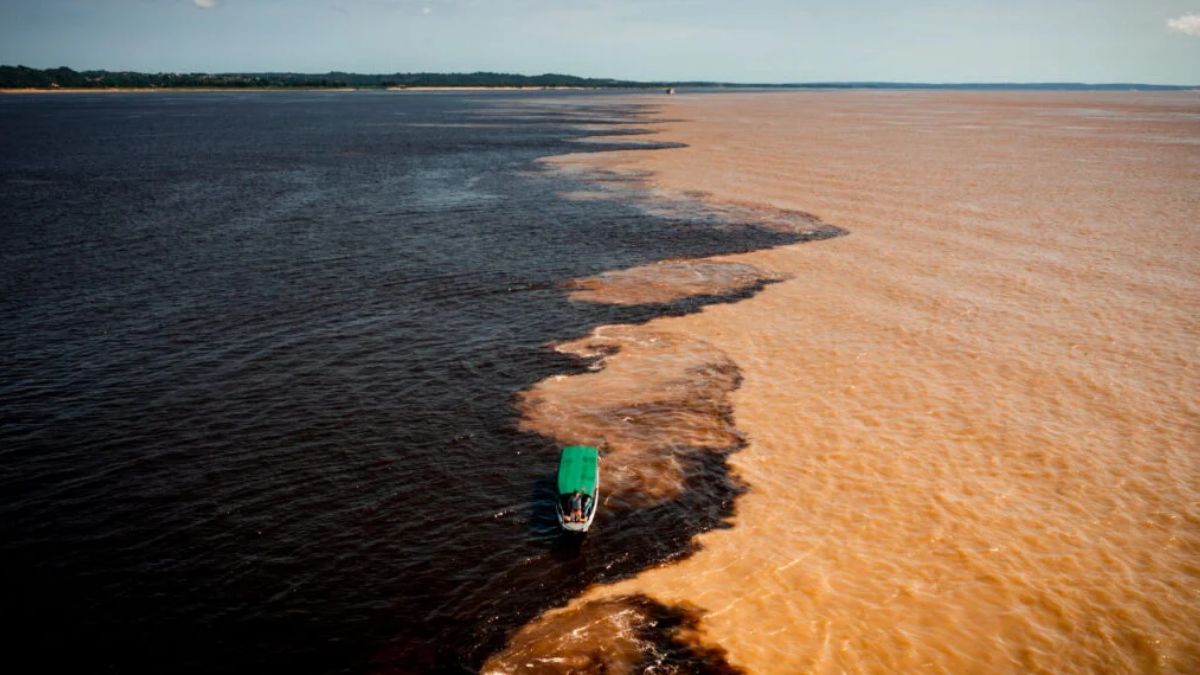
At the edge of the world — near the southernmost tip of South America — two ancient oceans meet. The mighty Pacific and the commanding Atlantic don’t crash into one another like armies in battle. Instead, they dance. Slow. Reluctant. Beautiful.
Viral images often show a sharp line where these oceans seem to refuse to mix — one side deep blue, the other a cloudy teal. “They don’t blend,” the captions suggest. But like many things in nature, what appears at the surface often hides a far more fascinating truth beneath.
Where the Pacific and Atlantic Truly Meet
The great meeting point lies in the Drake Passage, between Cape Horn and Antarctica. Before the Panama Canal existed, this perilous stretch was the main path for ships traveling between oceans. Dotted with islands like the Beagle Channel and the Strait of Magellan, it’s a place where currents twist, waves roar, and the Pacific and Atlantic engage in a slow-motion union.
But this isn’t a place of instant mixing. It’s a region where difference defines beauty.
The Science of Their Slow Embrace
While the Pacific and Atlantic do mix, it doesn’t happen instantly or evenly. The Pacific is less salty because it receives more rainfall and glacial runoff. The Atlantic is saltier, due to higher evaporation rates. This salinity difference slows down the mixing process — like oil hesitating in water.
Closer to Antarctica, fierce waves and the Antarctic Circumpolar Current stir the oceans more quickly. Meanwhile, in narrow island channels near South America, waters move sluggishly, delaying the union.
But beneath the waves, tides do their quiet work. Every hour, every minute, the oceans inch toward each other — slowly, silently.
How Climate Change Alters the Current
As with everything else on this planet, climate change plays a role in this story. Melting Antarctic ice adds fresh water, reducing salinity and disrupting natural mixing. Pollution, like the infamous Great Pacific Garbage Patch, changes ocean behavior and water density. Even as scientists explore solutions — like plastic-eating fungi — human impact is still outpacing nature’s ability to heal. The oceans are trying to embrace, but we’ve made their path more difficult.
The Truth Behind the Photos
That viral photo — the one showing a sharp, almost artificial line in the sea — was real. But it wasn’t what many assumed.
Taken in 2007 by scientist Ken Bruland, the image shows sediment-rich glacial runoff entering the Gulf of Alaska. The murky water didn’t blend right away with the clearer ocean, creating a temporary line. Over time, though, it did mix — just like the Pacific and Atlantic eventually do.
So, no, the oceans don’t remain divided. What we see is a moment, not a permanent wall. A moment where difference creates contrast — before blending into something new.
Lessons from the Edge of the Earth
Where the oceans meet, we’re reminded that borders in nature are rarely fixed. They shift, soften, blur. The Atlantic and Pacific aren’t enemies. They’re forces that shape each other — gradually, deeply. And maybe, in a world filled with division, that’s a lesson we need: Even the most different waters find a way to become one.
So next time you see that viral photo, remember — it’s not about separation. It’s about patience. About movement. About the hidden beauty in the places where boundaries fade and worlds come together.




