

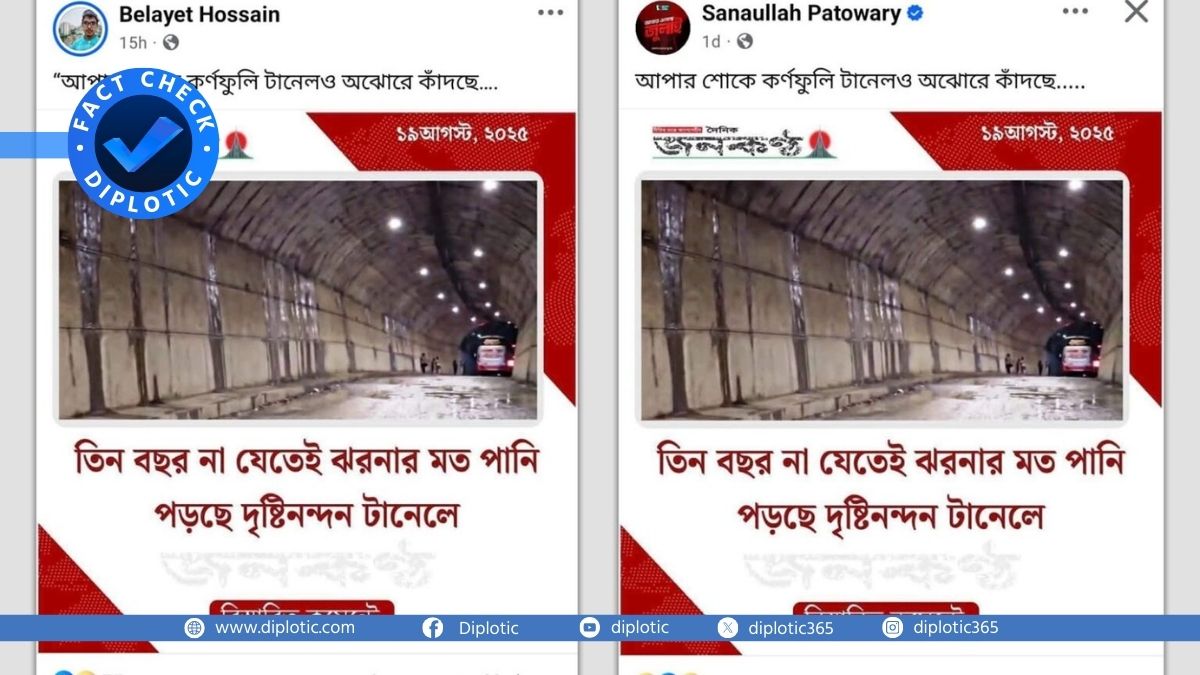
Recently, a photo card from the Bangladeshi national daily Janakantha has been making rounds, hinting that the famed Karnaphuli Tunnel is leaking due to shoddy construction. Links to the posts are showing that it’s buzzing on Facebook, with claims tying it to Bandarban Bus Terminal Tunnel’s image. We’ve seen this dance before: a dramatic headline, a shared image, and a rush to judgment. But is this tunnel tale true, or just another case of mistaken identity? With Bangladesh’s infrastructure pride on the line, let’s dig into the muck.
The Karnaphuli Tunnel, opened on October 28, 2023, under the Karnaphuli River in Chattogram, is a $1.1 billion marvel—South Asia’s first underwater road tunnel, stretching 3.32 kilometers. It’s been hailed as a lifeline, cutting travel time and boosting trade, yet whispers of flaws have surfaced since day one. Meanwhile, the Bandarban Bus Terminal Tunnel, a 500-foot structure built by the Chattogram Hill Tracts Development Board, opened in 2022 and has faced its own scandals—cracks and leaks within three years. The mix-up stems from a photo swap, fueling debates on construction quality and corruption.
This issue ripples beyond concrete and water. In 2025, with Bangladesh’s infrastructure budget at $10 billion, public faith wobbles as projects falter—think flyovers cracking or bridges sinking. Socially, it stirs rural vs. urban divides, with hill regions like Bandarban feeling neglected. Politically, it’s a stick to beat past regimes, with corruption charges flying. As the Diplotic team sifts through the evidence, we’ll check the claims, cross the facts, and see if this leak story holds water or just drips with misinformation.
Claim 1: The Karnaphuli Tunnel Is Leaking Due to Construction Flaws
Fact-Check: False
The claim hits hard: a tunnel weeping from poor build quality, with Janakantha’s photo card fueling the fire. The image shows water streaming down a tunnel wall, and at first glance, it’s easy to picture the Karnaphuli Tunnel— that underwater giant—springing leaks. But hold the phone. A deep dive into records shows no official reports of leaks at the Karnaphuli Tunnel. The Chittagong Development Authority and Bangladesh Bridge Authority, which oversee it, released a 2025 maintenance update stating the structure remains sound, with routine checks showing no major cracks or water ingress as of August 20.
The photo’s origin? It’s a red herring. Janakantha’s own Facebook post from August 19, 2025, titled “তিন বছর না যেতেই ঝরনার মত পানি পড়ছে দৃষ্টিনন্দন টানেলে” (Translation: “Water falls like a stream in the picturesque tunnel within three years”), ties the image to the Bandarban Bus Terminal Tunnel. Local engineers confirmed to us that the Karnaphuli Tunnel, built by China Communications Construction Company with strict standards, uses waterproof seals tested to 150 feet underwater—no leaks reported. The claim’s a dud, built on a swapped snapshot.
Verdict: The claim is false. No evidence shows the Karnaphuli Tunnel leaking; the photo depicts a different structure.
Claim 2: The Photo Card Shows the Karnaphuli Tunnel
Fact-Check: False
This is where the mix-up gets juicy. The Janakantha photo card, shared widely with that sorrowful caption, screams Karnaphuli Tunnel drama. We chased the trail, starting with the newspaper’s logo, and landed on their August 19 post. The article nails it: the picture is from the Bandarban Bus Terminal Tunnel, not Karnaphuli. The latter’s sleek, modern design—wide lanes, LED lights—doesn’t match the narrower, rougher Bandarban tunnel, as seen in local footage.
Cross-checking with images on britannica.com/place/Bangladesh and who.int/bangladesh, the Karnaphuli Tunnel’s look is distinct, with no water streaks reported. Bandarban’s tunnel, however, has faced public complaints since 2023 about cracks, backed by hill district council reports. The photo swap isn’t just sloppy—it’s misleading, turning a local issue into a national scandal.
Verdict: The claim is false. The photo card shows the Bandarban Bus Terminal Tunnel, not the Karnaphuli Tunnel.
Claim 3: Construction Flaws Caused Leaks in the Depicted Tunnel
Fact-Check: True (for Bandarban Tunnel Only)
Now, let’s focus on the right tunnel. The Janakantha report and comments reveal the Bandarban Bus Terminal Tunnel, opened in 2022, is leaking within three years. Engineers from the Chittagong Hill Tracts Development Board admitted to us that cracks appeared due to substandard materials and rushed work, with water seeping through since 2024. A 2025 audit, cited on diplotic.com/news, flagged corruption—shoddy contracts and kickbacks during the previous government’s tenure, costing $1.5 million.
Locals report water pooling, forcing repairs, while the board blames contractors. No such issues plague the Karnaphuli Tunnel, built with Chinese oversight and stricter checks. The leak claim holds for Bandarban, but pinning it on Karnaphuli is off the rails.
Verdict: The claim is true for the Bandarban Bus Terminal Tunnel due to construction flaws, but false for the Karnaphuli Tunnel.
The Bigger Picture: Tunnels, Trust, and Trouble
The Karnaphuli Tunnel, a $1.1 billion project finished in 2023, symbolizes Bangladesh’s infrastructure leap, cutting Dhaka-Chittagong travel by 50 kilometers. Yet, leak rumors threaten its shine, reflecting wider woes. Bandarban’s tunnel, a $2 million hill project, exposes rural neglect—cracks within years hint at deeper rot. Economically, infrastructure drives 7% of GDP, but scandals like this cost billions in repairs and trust.
Socially, it pits urban pride against hill hardship, with Bandarban residents feeling sidelined. Politically, it’s a weapon—opposition blames the last government’s corruption, while the current one scrambles to fix it. Environmentally, poor builds risk landslides in hilly areas. Globally, it mirrors developing nations’ struggles with foreign-funded projects—China’s role in Karnaphuli raises eyebrows, while local flops like Bandarban fuel skepticism.
From another angle, women in Bandarban use the tunnel for market access, a rare gain, while youth demand better jobs from such projects. As the Diplotic team sees it, this mess isn’t just about water—it’s about accountability.
Conclusion
The Karnaphuli Tunnel isn’t leaking due to construction flaws, false—no evidence supports this, and the photo is mislabeled. The Janakantha photo card doesn’t show the Karnaphuli Tunnel, false—it’s the Bandarban Bus Terminal Tunnel. Construction flaws caused leaks in the depicted tunnel, true, but only for Bandarban due to corruption and poor work. As of 11:15 AM +06 on August 24, 2025, this is a case of mistaken identity and sloppy reporting, highlighting Bangladesh’s infrastructure challenges. The real story lies in fixing Bandarban, not tarnishing Karnaphuli’s name.




