
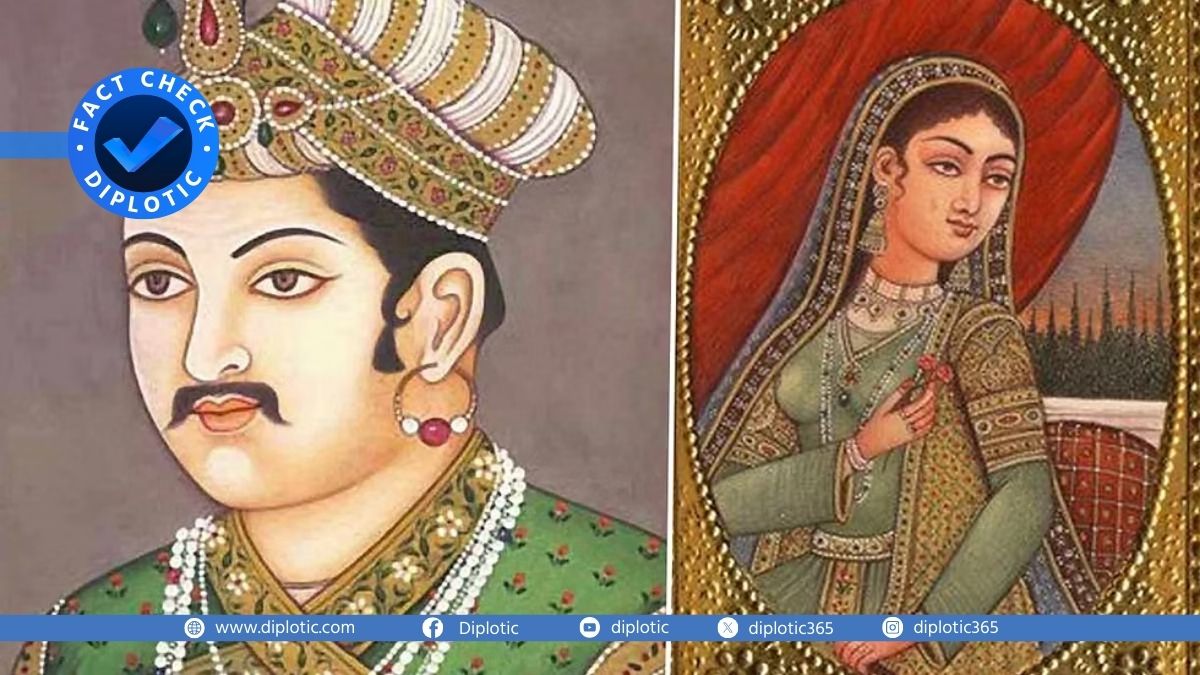
A Legendary Romance
The love story of Jodha and Akbar has become one of the most fascinating tales in South Asian history and culture. Countless novels, television dramas, and films have celebrated the romance between a Rajput princess and the great Mughal emperor. But if we look past the legends and check the historical records, a richer, more detailed story comes to light. The story of Jodha Bai, as she is popularly known, is both real and mythical at the same time.
The Historical Marriage
Emperor Akbar, who ruled the Mughal Empire from 1556 to 1605, was one of the most powerful and visionary rulers of the subcontinent. In 1562, he entered into a marriage alliance with the Rajput kingdom of Amer. The princess he married was the daughter of Raja Bharmal. History remembers her by the honorific title Mariam-uz-Zamani, meaning “Renowned Woman of the Age.” According to Abul Fazl’s Akbarnama, the official chronicle of Akbar’s reign, this marriage was more than just a personal union; it symbolized political reconciliation between the Mughals and the Rajputs.
The alliance played a vital role in strengthening Akbar’s empire. By marrying into the Rajput royal family, Akbar gained not only the loyalty of Amer but also created a broader sense of harmony between Muslims and Hindus under his rule. It is widely believed that Mariam-uz-Zamani became Akbar’s most influential wife and, most importantly, she was the mother of Jahangir, Akbar’s heir and future emperor.
The Question of “Jodha Bai”
But where does the name “Jodha Bai” come from? Interestingly, if one consults the official Mughal records such as the Akbarnama or Jahangir’s memoirs (Tuzuk-i-Jahangiri), the name does not appear. Instead, they mention Mariam-uz-Zamani. The title “Jodha Bai” seems to have entered popular imagination much later, during the 18th and 19th centuries. Colonial writers like James Tod, in his Annals and Antiquities of Rajasthan (1829), romanticized Mughal–Rajput relations and popularized the term “Jodha.” The name itself suggests a link to Jodhpur, while Mariam-uz-Zamani was actually from Amer (modern Jaipur).
Over time, popular culture embraced the name. In plays, novels, and eventually cinema, “Jodha Bai” became the affectionate identity of Akbar’s Hindu queen. For audiences, the story of Jodha and Akbar symbolized unity, tolerance, and love that transcended religion and politics. Films like Mughal-e-Azam and Jodhaa Akbar further immortalized this name, even though it was historically inaccurate.
Influence and Legacy
Regardless of the debate over her name, Mariam-uz-Zamani’s role in the Mughal court cannot be dismissed. She was one of the most respected women of her time. As Akbar’s chief consort, she enjoyed privileges and wielded influence. Historian Ruby Lal, in her book Domesticity and Power in the Early Mughal World, highlights that Mariam-uz-Zamani had her own ships for overseas trade and even issued royal orders, something rare for women of her era.
Her son, Jahangir, cherished her deeply and built a beautiful tomb for her in Sikandra, near Agra, close to Akbar’s own resting place. The palace in Fatehpur Sikri that is today called “Jodha Bai Mahal” reflects a later tradition. Historians such as Satish Chandra note that while the building exists, the name was attached in later times and does not appear in Mughal records. Still, the architecture itself beautifully combines Hindu and Mughal styles, symbolizing the cultural fusion she embodied.
Recent Controversies
In recent years, debates have re-emerged around this marriage. Some modern political voices in India have questioned whether Akbar truly married a Rajput princess, arguing that the story of Jodha is nothing more than a later invention. However, most historians, including Satish Chandra, maintain that while the name “Jodha Bai” is a myth, the marriage between Akbar and the Rajput princess—Mariam-uz-Zamani—is an undeniable historical fact. The confusion arises not from the marriage itself but from the mislabeling of her name.
Myth and Memory
The enduring popularity of the Jodha–Akbar tale shows how history and legend often merge. For the people of the subcontinent, the story represents something larger than fact—it symbolizes religious harmony, cultural blending, and the romantic ideal of love conquering all barriers. In a region often marked by division, the tale of Jodha and Akbar offers an inspiring counter-narrative of unity.
Conclusion
So, did Jodha Bai really exist? The answer depends on how one defines her. The woman popularly known as Jodha was in fact Mariam-uz-Zamani, a Rajput princess who married Akbar and became the mother of his heir. The name “Jodha Bai” is a later invention, popularized by storytellers and filmmakers. But the essence of the story—the marriage between Akbar and a Hindu princess, and the harmony it symbolized—is very real.
For us in South Asia, this story is not only about history but also about imagination. It reminds us how legends shape our understanding of the past, and how sometimes the myth becomes just as powerful as the reality.