

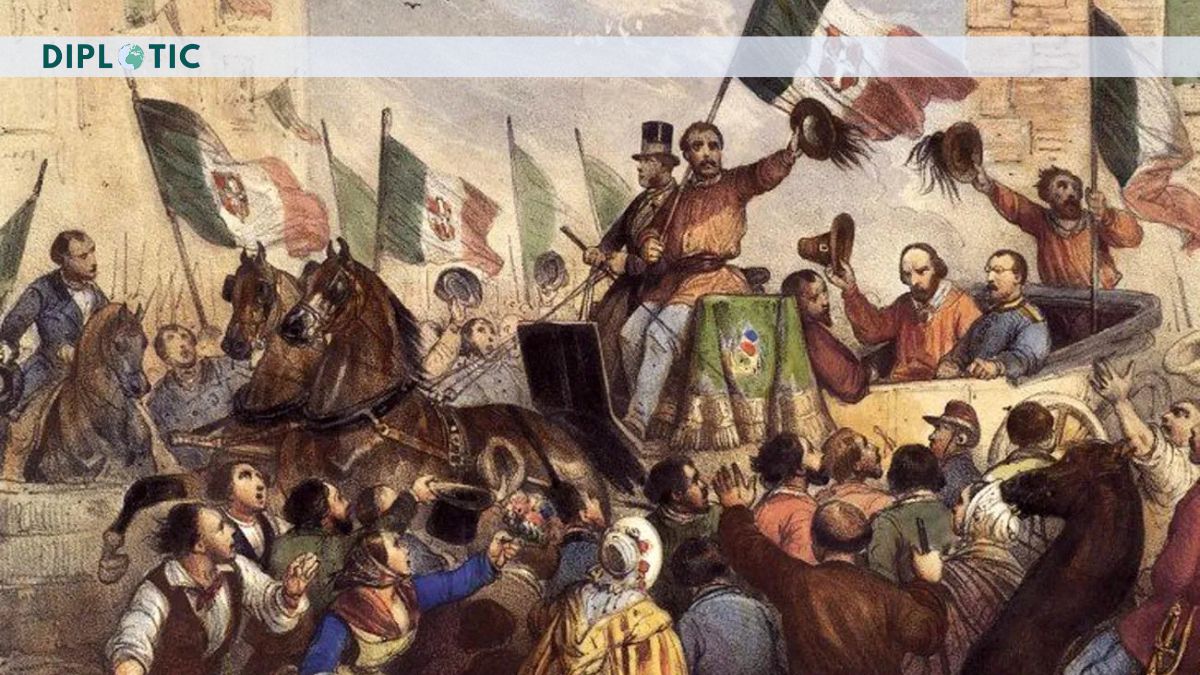
The Italian Risorgimento stands as one of the most decisive and transformative political movements in modern European history. While commonly remembered as the process that led to the unification of Italy in 1861, the reality is far more complex. It was not simply a nationalist uprising, but a highly strategic geopolitical transformation shaped by diplomacy, military campaigns, and the competing interests of Europe’s great powers.
At its core, the Risorgimento was about more than unity. It was about power, influence, and the reordering of a continent still adjusting to the aftermath of the Napoleonic Wars. By examining this process through a geopolitical lens, it becomes clear that Italy’s unification was neither inevitable nor straightforward, but rather the result of calculated decisions and shifting international dynamics.
A Fragmented Italy Under Foreign Control
The origins of the Risorgimento can be traced back to the settlement established after the Congress of Vienna. Following the defeat of Napoleon Bonaparte, European powers sought to restore stability by reinforcing monarchies and preventing further revolutionary upheaval.
As part of this settlement, the Italian peninsula remained divided into multiple states. These included the Kingdom of Sardinia in the northwest, Austrian-controlled Lombardy and Venetia in the north, the Papal States in central Italy, and the Kingdom of the Two Sicilies in the south.
This fragmentation served the strategic interests of dominant powers, particularly Austria. By maintaining control over key regions, Austria ensured that Italy could not emerge as a unified rival. In effect, the peninsula became a geopolitical buffer zone, shaped by external influence rather than internal unity.
However, this imposed structure also generated growing dissatisfaction. Over time, a sense of shared identity began to emerge among Italians, fueling demands for independence and national unity.
Revolutionary Movements and the Rise of Nationalism
The early phase of the Risorgimento was marked by revolutionary activism. Secret societies such as the Carbonari played a central role in promoting political reform and resistance against conservative rule.
One of the most influential figures of this period was Giuseppe Mazzini. Through his movement “Young Italy,” Mazzini articulated a powerful vision of a unified republic based on popular sovereignty and democratic principles.
His ideas resonated widely, inspiring a generation of activists and intellectuals. However, repeated uprisings in the 1820s and 1830s were suppressed by the dominant European powers, which were determined to maintain stability.
Despite these setbacks, Mazzini’s influence endured. He helped transform Italian nationalism into a powerful ideological force, even if his revolutionary methods proved insufficient in the face of strong geopolitical opposition.
Diplomacy and Strategy: Cavour’s Decisive Approach
While revolutionary movements ignited the desire for unity, it was diplomacy that ultimately made it possible. This shift was led by Camillo Benso di Cavour, a statesman who understood the importance of working within the European power system.
Cavour pursued a pragmatic strategy focused on strengthening the Kingdom of Sardinia economically, politically, and militarily. Under his leadership, the state became the driving force behind unification.
Recognizing the importance of alliances, Cavour aligned Sardinia with major powers such as France and the United Kingdom. This approach culminated in the 1859 war against Austria, which resulted in the annexation of Lombardy and encouraged other Italian states to join the unification movement.
Cavour’s strategy demonstrated that geopolitical awareness and diplomatic skill were essential to achieving national goals. His approach marked a turning point in the Risorgimento, shifting it from revolutionary idealism to strategic execution.
Garibaldi and the Power of Military Action
While diplomacy reshaped northern Italy, the south was transformed by the actions of Giuseppe Garibaldi. In 1860, Garibaldi launched the famous Expedition of the Thousand, leading a small volunteer force into Sicily.
What began as a daring mission quickly evolved into a decisive campaign. Garibaldi’s forces gained widespread support, ultimately defeating the Kingdom of the Two Sicilies and bringing southern Italy into the unification process.
His success highlighted the importance of popular mobilization and bold leadership. At the same time, it reflected the broader geopolitical environment. With major European powers focused elsewhere, there was limited interference, allowing the campaign to succeed.
Garibaldi’s role added a crucial military dimension to the Risorgimento, accelerating the path toward unity.
The Influence of European Great Powers
The Italian Risorgimento unfolded within a complex international context. The major powers of Europe closely monitored developments in Italy and adjusted their policies according to their strategic interests.
France supported efforts to weaken Austria but remained cautious about the emergence of a strong unified Italy. The United Kingdom generally favored unification, seeing it as beneficial for trade and regional stability.
Austria, however, was the primary opponent. Its control over northern Italy made unification a direct threat to its influence. As a result, it resisted Italian nationalism at every stage.
This interplay of interests turned the Risorgimento into a high-stakes geopolitical contest, where success depended not only on internal efforts but also on external conditions.
The Birth of Italy and the Completion of Unification
In 1861, the Kingdom of Italy was officially proclaimed under Victor Emmanuel II. This marked a major milestone, but the unification process was not yet complete.
Venetia remained under Austrian control until 1866, and Rome remained under Papal authority until 1870. The capture of Rome in 1870 marked the final stage of unification, establishing it as the capital of the new nation.
This achievement represented the culmination of decades of political struggle, military campaigns, and diplomatic efforts.
Challenges of a Newly Unified State
Despite its success, the new Italian state faced significant internal challenges. Economic disparities between regions, administrative differences, and social divisions complicated the process of national integration.
Italy also had to establish its position within the European system of states. Building a stable political structure and asserting itself internationally proved to be ongoing challenges.
These difficulties highlighted the reality that unification was not an endpoint, but the beginning of a new phase in Italy’s development.
A Transformative Moment in Global Politics
The Italian Risorgimento was far more than a nationalist movement. It was a profound geopolitical transformation that reshaped Europe and marked the rise of modern nation-states.
By combining revolutionary ideas, strategic diplomacy, and military action, Italy emerged as a unified country from a fragmented past. Its unification altered the balance of power in Europe and contributed to the decline of traditional empires.
Today, the Risorgimento remains a powerful example of how nations are formed not only through shared identity but through careful strategy and global context.
In the end, Italy’s unification was not just a national achievement; it was a defining moment that changed the course of European history.




