

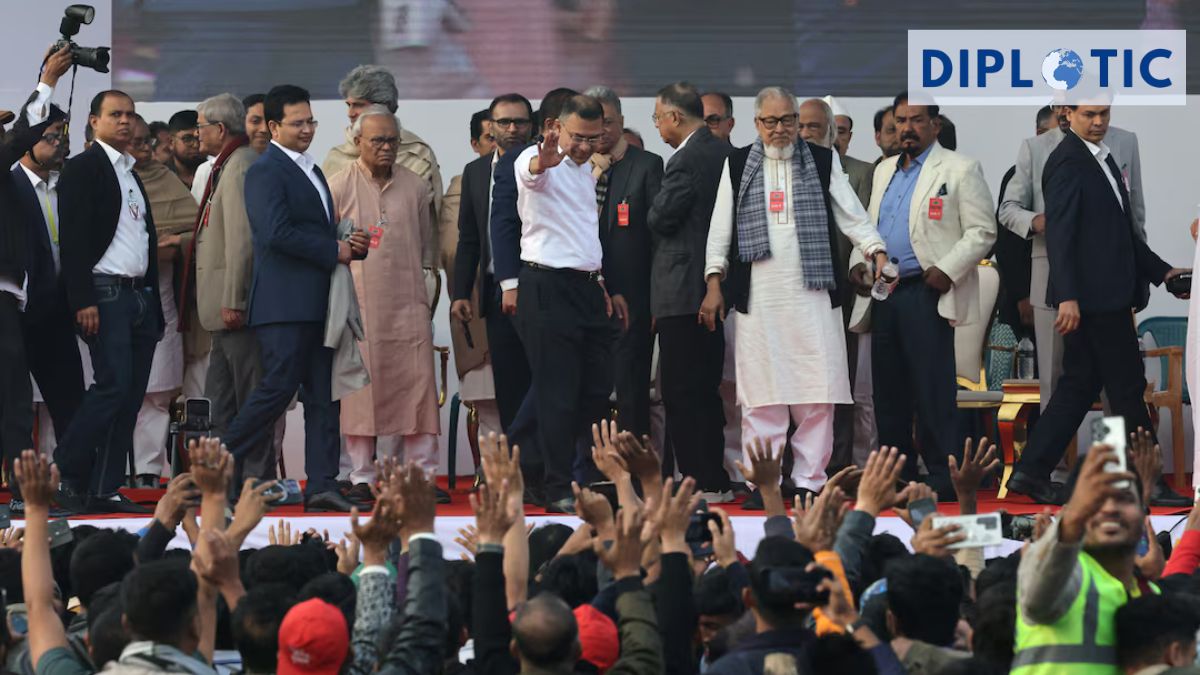
After 17 years in exile, Bangladesh Nationalist Party (BNP) acting chairman Tarique Rahman’s dramatic return to Dhaka has triggered one of the most significant political realignments in Bangladesh’s recent history. His arrival, marked by a massive show of strength at Purbachal, has instantly reshaped the national political narrative, not only strengthened BNP’s electoral prospects but also raised serious geopolitical and diplomatic questions.
Rahman’s homecoming comes at a time when Bangladesh remains under the stewardship of an interim government, and the country’s political roadmap remains uncertain. His re-emergence is widely seen as the beginning of a new chapter that could determine both the nature of governance and the country’s diplomatic direction in the years ahead.
A New Tone, A New Tarique Rahman
Observers and rival political leaders alike have taken note of a significant shift in Rahman’s public rhetoric. In his speech in Dhaka, he pledged to build a Bangladesh that is “safe for all communities Muslims, Hindus, Buddhists, and Christians,” a statement that marks a departure from his earlier hardline political posture.
Equally notable was his conspicuous omission of the BNP’s traditional slogan “Bangladesh Zindabad,” which has long been associated with echoes of Pakistan-era political symbolism. Awami League leaders argue that this change reflects Rahman’s attempt to rebrand his political image for a modern, internationally conscious electorate.
“He is carefully recalibrating his language,” noted an Awami League leader in exile. “This is not accidental. It is an effort to remove ideological stigmas that have limited BNP’s global acceptability.”
Awami League’s Strategic Anxiety
Leaders of the Awami League many currently outside the country have reacted cautiously to Rahman’s return. While they acknowledge his growing popularity and the “vibe and hype” surrounding his political revival, they have also voiced concern that his return may lend political legitimacy to what they describe as “foreign-backed interference” in Bangladesh’s governance structure.
From their perspective, Rahman’s growing prominence risks empowering external forces seeking influence over Bangladesh’s internal political process. These leaders argue that the interim government’s political arrangements could be inadvertently strengthened by Rahman’s participation, creating a complex legitimacy dilemma.
BNP Poised as Election Front-Runner
Political analysts widely agree that BNP has emerged as the leading contender ahead of the next national election, which is tentatively projected for February. Rahman is expected to assume the country’s top political role should elections proceed as scheduled.
However, uncertainty looms large. Opposition leaders and international observers remain unconvinced about whether conditions are being adequately prepared for a genuinely free and fair election. Questions persist about voter security, media independence, and the neutrality of the interim administration.
India-Bangladesh Relations at a Diplomatic Crossroads
One of the most significant implications of Rahman’s return lies in Bangladesh’s regional diplomacy, particularly its strained relationship with India. Awami League leaders have expressed hope that Rahman may attempt to normalize bilateral ties, which have cooled under the interim arrangement.
Given India’s strategic importance in trade, security cooperation, and regional connectivity, any recalibration in Dhaka’s diplomatic posture could have far-reaching consequences for South Asia’s geopolitical balance.
Rahman’s current emphasis on moderation and inclusivity may signal an awareness of international expectations, particularly from New Delhi and Western partners seeking political stability and democratic legitimacy in Bangladesh.
Foreign Influence and the Question of Sovereignty
Behind the political optimism, a deeper debate is unfolding, one that concerns national sovereignty. Awami League figures warn that Rahman’s rising influence could inadvertently strengthen foreign political interests inside Bangladesh’s decision-making processes.
This debate has sharpened anxieties over whether Bangladesh’s next government will truly reflect domestic democratic will or become shaped by external geopolitical considerations.
Minority Security in the Spotlight
Rahman’s strong emphasis on minority protection in his inaugural address is being closely scrutinized by human rights organizations and religious leaders. Minority safety has emerged as a defining issue following recent reports of communal tensions.
His commitment to a pluralistic Bangladesh could prove pivotal in restoring public confidence, particularly among communities who feel politically marginalized amid the ongoing transition.
Election Uncertainty Clouds the Road Ahead
Despite growing political momentum, skepticism remains about whether the upcoming polls will materialize as promised. Analysts caution that Bangladesh’s political environment remains fragile, and delays or contested outcomes could reignite unrest.
“There is still no absolute clarity on the election timeline,” a senior political observer noted. “Whether February will truly deliver a democratic reset or merely a managed transition remains an open question.”
A Defining Moment for Bangladesh
Tarique Rahman’s return has done more than energize BNP supporters it has reintroduced unpredictability into Bangladesh’s political equation. His evolving rhetoric, diplomatic undertones, and electoral ambitions collectively point to a possible reconfiguration of the nation’s political and international identity.
As Bangladesh approaches a potentially transformative election, Rahman now stands at the center of a national crossroads where democracy, diplomacy, minority rights, and sovereignty intersect.
The months ahead will determine whether his political revival becomes a catalyst for national renewal or the beginning of another complex chapter in Bangladesh’s turbulent political story.




