

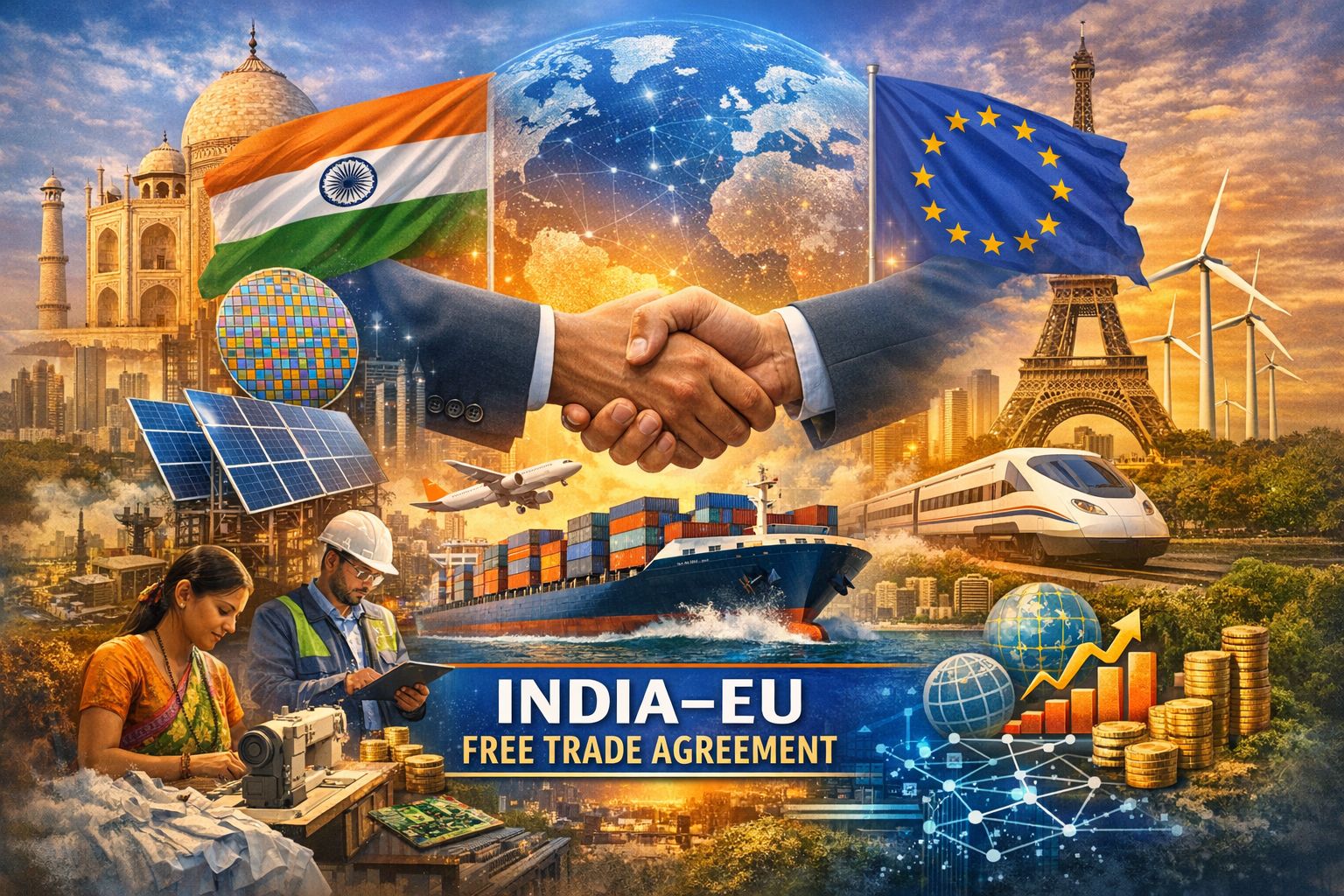
At a time when the global economy feels shaky, trade wars are everywhere, supply chains breaking, and countries turning inward, India and the European Union have done something rare. They chose cooperation over confrontation. After nearly 20 years of on-and-off negotiations, they finally signed one of the biggest trade deals in modern history: the India–EU Free Trade Agreement (FTA).
This is not just another agreement between two regions. It is a signal that in an uncertain world, strong partnerships still matter.
Twenty Years in the Making
The story of the India–EU FTA is long and messy. Talks began in 2007 with big hopes, but by 2013 everything collapsed. Both sides wanted too much and were willing to give too little.
Europe wanted deeper access to India’s markets especially cars, dairy products, wine, and stricter intellectual property rules. India, on the other hand, wanted something equally important: easier visas for its professionals and better treatment for its services sector. Neither side was ready to compromise.
Back then, global trade was booming. Supply chains were smooth. There was no real pressure to move fast.
So the talks died quietly.
Why the World Forced Them Back Together
Fast forward to today, and the world looks very different.
The US–China trade war shook global markets. The COVID-19 pandemic exposed how fragile supply chains really are. The Russia–Ukraine war disrupted energy and food systems. Even shipping routes like the Red Sea became risky.
Suddenly, countries realized something important: depending on just a few partners is dangerous.
Critical sectors like semiconductors, clean energy, digital technology, and data are no longer just about business. They are about national security and survival. That reality pushed India and the EU back to the table in 2022, and this time, both sides were ready to be practical.
A Deal Built on Realistic Compromise
Unlike before, this agreement is not about one side winning and the other losing. It is about meeting halfway.
India agreed to open up many of its manufacturing sectors.
Europe agreed to be flexible on regulations and timelines.
India protected what matters most politically its farmers and agriculture.
Europe secured access to key industrial and consumer markets.
Cars will face gradual tariff cuts.
Dairy will enter through limited quotas.
Sensitive sectors are phased in slowly.
In simple words: no shock therapy, only steady opening.
That is why this deal finally worked.
What This Means for India
For India, this agreement could be a game-changer for exports and jobs.
Nearly 90% of Indian goods, textiles, medicines, leather, gems, chemicals, and machinery will now enter Europe with very low or zero tariffs. Earlier, many of these products faced heavy taxes, making them less competitive.
Economists estimate: India’s exports could rise by $35–40 billion every year. The majority of these positions will be in labour-intensive sectors like apparel and footwear. For a country with a young population and huge employment needs, this matters a lot.
Services: Where India Really Wins Big
India’s biggest strength is not factories it is services.
IT, software, consulting, education, and digital platforms, India already leads the world in many of these. The FTA opens access to 144 service sectors across Europe.
This means Indian companies can now work more easily in: Banking and financeEngineering and healthcare Research and education Data services and digital commerce. Experts believe this could unlock over $100 billion in new opportunities.
India’s services exports are already around $375 billion. With this deal, they could touch $1 trillion by 2030.
That is not just growth. That is global leadership.
Mobility: People Finally Move, Not Just Goods
People are one of the deal’s most poignant aspects. India has long desired easier mobility for its professionals. This time, Europe said yes at least partially. Included in the agreement are: Easier visas for Indian IT, healthcare, and engineering workers. Opportunities for Indian students to find employment after studying. Over the next ten years, about 200,000 skilled visas. Europe needs workers. Its population is ageing.
India has skilled youth looking for global exposure.
It’s a natural match.
And with India already receiving $129 billion in remittances, this human connection also strengthens the economy back home.
Manufacturing, Technology, and the China Factor
Another silent winner of this deal is India’s manufacturing sector. European businesses have already made significant investments in: Semiconductors, Electric vehicles, Green energy, Production of electronics, Businesses like Micron and Foxconn are establishing plants. These are strategic moves away from China, not merely investments.Europe and India both wish to become less reliant on Chinese supply chains. This FTA gives them a safer alternative. It contributes to India’s development into a reliable global center for manufacturing.
What Europe Gets in Return
For Europe, the biggest attraction is simple: India’s massive market. India is one of the few countries where European businesses can still expand quickly, thanks to its 1.4 billion inhabitants and rapidly expanding middle class. There will now be much fewer obstacles to European exports of automobiles, machinery, chemicals, luxury goods, and wine. The EU could gain: An additional €40 billion in exports annually. Improved access for logistics companies, banks, and insurers a significant presence in the financial and digital sectors of India. India provides new energy and demand at a time when the European economy is contracting.
Beyond Trade: A Strategic Friendship
There is much more to this deal than just money. It improves collaboration in: Safety and security at sea Technology and defenceQuantum research and artificial intelligenceClimate solutions and clean energy.
Most importantly, it creates a stable bridge between two democratic regions in a world full of unstable alliances.
Neither India nor the EU wants to blindly follow the US or confront China directly. Both prefer strategic independence with strong partnerships.
This FTA fits that vision perfectly.
The Real Challenge Starts Now
It’s simple to sign. Implementation is challenging. This deal’s success hinges on:How quickly it is approved How significant the reforms are Whether visa promises are kept How companies really utilise it Many trade agreements fail because they are poorly executed rather than because they are bad.
A Quiet but Powerful Moment
The India–EU Free Trade Agreement will not make headlines like wars or elections. But in the long run, it may matter just as much.
In a world driven by fear, protectionism, and rivalry, India and Europe chose something different: trust, cooperation, and shared growth.
This is not just a trade deal.
It is a statement about the kind of world they want to build.
And in uncertain times, that may be the most powerful message of all.




