

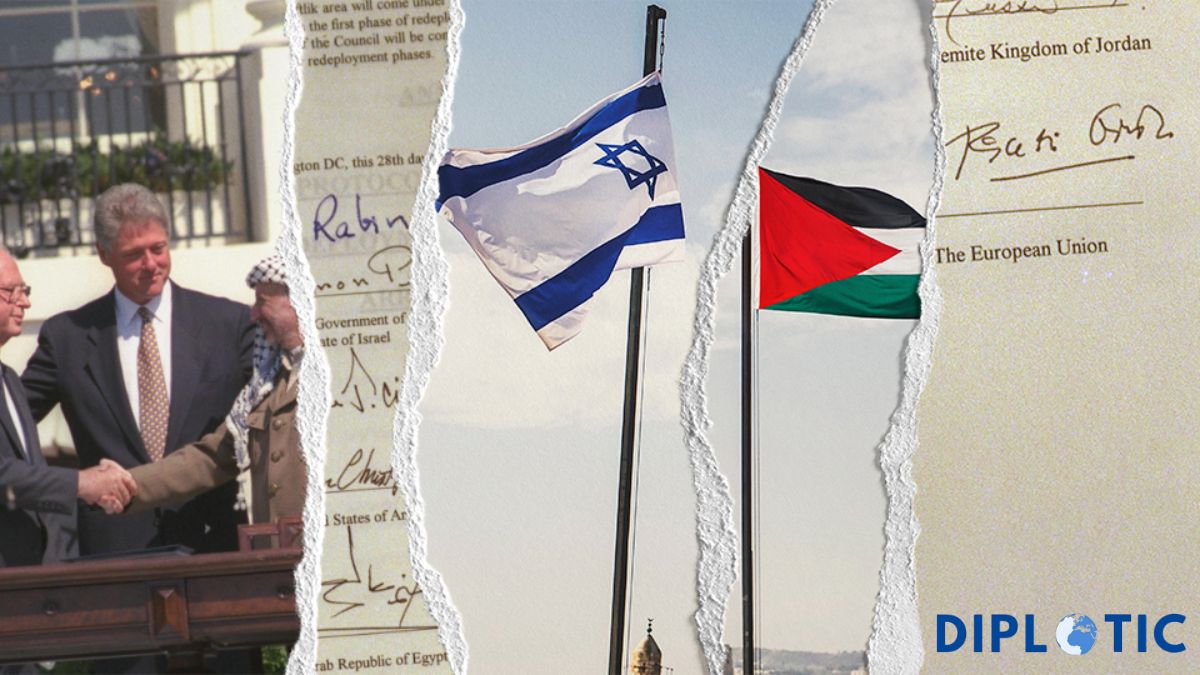
In a bold and consequential declaration, Israeli President Isaac Herzog has stated that the long-discussed two-state solution between Israel and Palestine is no longer viable under current geopolitical realities. Speaking in an exclusive interview with The Yomiuri Shimbun, Herzog pointed to the devastating Hamas-led attack of October 7, 2023, as a historic turning point that has irreversibly reshaped Israel’s security mindset and diplomatic direction. His remarks have reignited global debate about the future of peace in the Middle East, highlighting a dramatic shift in Israel’s diplomatic posture amid rising regional tension, international isolation, and deep internal trauma.
The Hamas assault of October 7 is being described by Herzog as a national earthquake that shattered long-held assumptions about coexistence and security. The unprecedented violence, which claimed hundreds of lives and triggered prolonged warfare, forced Israel to re-evaluate its national priorities. According to Herzog, expecting Israelis to return to pre-attack peace formulas is no longer realistic. He emphasized that the two-state framework, once backed by much of the international community, no longer aligns with the urgent need to guarantee security and prevent terrorism, reinforcing that Israelis must first be shown how their safety can be protected before any political concessions are considered.
For decades, the two-state solution symbolized hope and compromise, but Herzog argues that new realities on the ground have rendered this vision increasingly unworkable. The persistence of Hamas control in Gaza, the escalation of regional conflicts, and the constant threat of cross-border violence have convinced many Israelis that territorial concessions could expose them to existential risks. His message signals a shift in priorities, where security now outweighs symbolism and where peace proposals must reflect real-world threats rather than idealistic assumptions.
While distancing himself from the traditional peace framework, Herzog highlighted a more pragmatic and regionally driven diplomatic strategy. Building on the success of the Abraham Accords, which normalized relations between Israel and several Arab nations including the United Arab Emirates, he advocated for a broader Middle Eastern dialogue. This approach emphasizes cooperation with neighboring states and the Palestinians through economic integration, security coordination, and technological partnerships, reflecting Israel’s growing reliance on regional alliances over distant international mediation.
Despite these diplomatic breakthroughs, Israel continues to face increasing international criticism and growing isolation due to the prolonged Gaza conflict and tensions with neighboring countries. Herzog acknowledged that global opinion has become harsher but warned against what he described as unfair judgment. He stated that Israel hatred is increasingly being used as an antisemitic tool and urged the international community to recognize the psychological and emotional toll on Israeli society. According to him, entire nations can suffer post-traumatic stress, just like individuals, after years of continuous violence and insecurity.
Internally, Herzog is focusing on healing Israel’s fractured society. Years of conflict, political instability, and social polarization have strained national unity, and the president has made reconciliation one of his top priorities. He has committed himself to fostering honest dialogue, supporting democratic processes, and encouraging fair and open elections in an effort to restore public trust and strengthen social cohesion.
Herzog also addressed the controversial issue of Prime Minister Benjamin Netanyahu’s request for a presidential pardon. Netanyahu faces multiple charges including bribery, fraud, and breach of trust, making the issue deeply sensitive within Israel’s political and legal system. Herzog emphasized that any decision regarding the pardon would strictly follow legal procedures and be guided by both the rule of law and his personal conscience, underscoring the seriousness with which he views the matter.
Turning to global partnerships, Herzog expressed strong interest in expanding Israel’s strategic cooperation with Japan. He highlighted Japan’s potential role in supporting economic development, humanitarian assistance, technological innovation, and food and health security projects across the Middle East. He also proposed a broader Asia–Middle East alignment involving Israel, Japan, India, and the United Arab Emirates, envisioning a powerful partnership that could drive regional stability and technological advancement. Herzog confirmed his intention to visit Japan, signaling a deepening of diplomatic and economic ties.
Herzog’s remarks reflect a broader transformation in Middle Eastern diplomacy. Traditional peace formulas based on symbolic compromises are increasingly being replaced by security-centered and regionally anchored frameworks. His declaration marks a turning point, emphasizing that any future peace process must be grounded in realistic security guarantees and trusted regional partnerships rather than purely theoretical agreements.
In conclusion, Isaac Herzog’s assertion that the two-state solution is no longer viable underscores a historic shift in Israel’s diplomatic strategy. It reflects how trauma, persistent security threats, and evolving alliances are reshaping peace efforts in one of the world’s most volatile regions. As Israel strengthens regional and Asian partnerships while reassessing conventional peace frameworks, a new diplomatic era is emerging one defined by resilience, strategic realism, and security-first cooperation that will shape the future of global stability for decades to come.




