

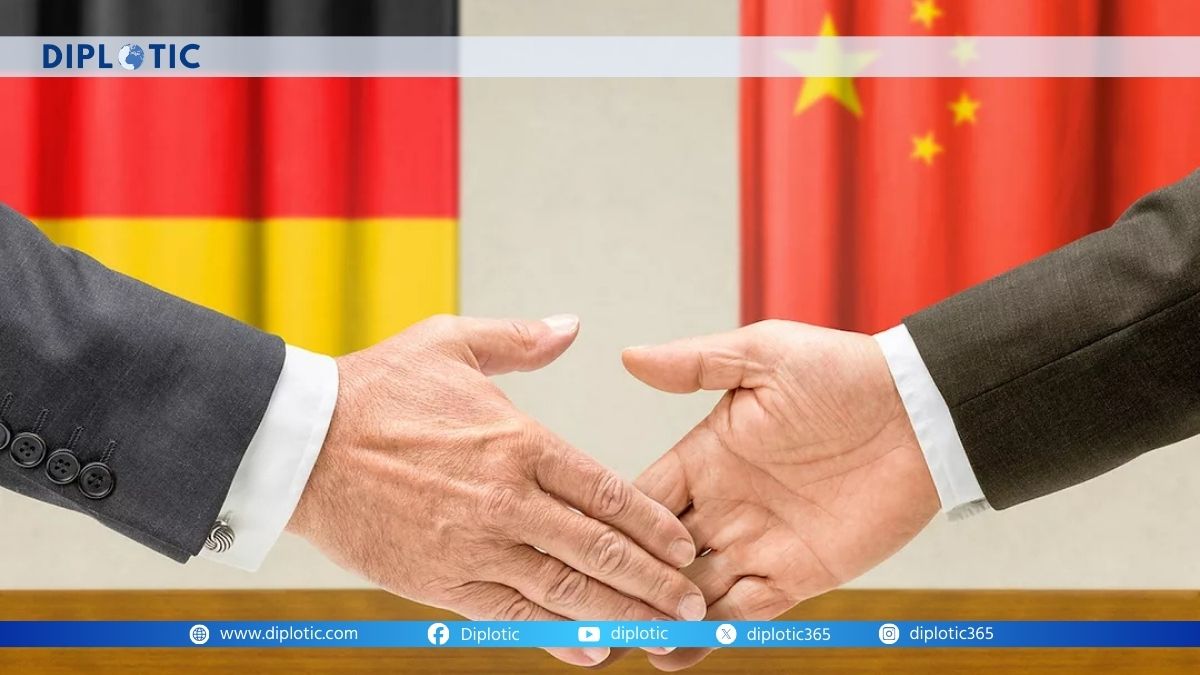
In recent years, Germany’s relationship with China has undergone a marked transformation, shifting from pragmatic economic engagement to a posture increasingly defined by strategic suspicion and political distance. Many analysts argue that this change is not simply the result of internal German deliberation but reflects deeper alignment with Washington’s geopolitical agenda. As the United States intensifies efforts to contain China’s economic and technological rise, Germany—long Europe’s strongest advocate of commercial ties with Beijing—appears to be recalibrating its China policy in ways that prioritise transatlantic solidarity over its own economic interests. This essay examines the rationale behind this shift, draws upon international academic research, and evaluates whether Berlin’s evolving stance constitutes a form of self-sabotage in service of Washington’s strategic interests.
A key turning point was Germany’s “Zeitenwende,” originally a term describing the country’s reassessment of security policy after Russia’s invasion of Ukraine. However, scholars such as Nadine Godehardt at the German Institute for International and Security Affairs (SWP) note that this shift soon expanded into a broader rethinking of China policy as well. Godehardt argues that German officials increasingly adopted the language of “de-risking,” “systemic rivalry,” and “strategic dependencies,” echoing U.S. frameworks that portray China as not only an economic competitor but a security threat requiring coordinated Western countermeasures (Godehardt, SWP Research Paper, 2025). This rhetorical convergence with Washington signals a deeper alignment that goes beyond the EU’s own strategic vocabulary.
The extent of Germany’s alignment becomes clearer when examining specific policies. Berlin has tightened export controls on advanced technologies, expanded investment screening mechanisms, and launched high-profile investigations into alleged Chinese espionage. While these actions may, in isolation, seem like reasonable safeguards, international reporting shows their cumulative effect has been deeply damaging to trust with Beijing. A Wall Street Journal investigation revealed that German intelligence operations and public accusations of espionage caused tensions that directly disrupted diplomatic exchanges and delayed ministerial visits, reinforcing Chinese perceptions that Germany was adopting a confrontational strategy shaped by U.S. pressure (WSJ, 2024).
Scholars writing in Cambridge University Press journals further argue that Europe’s China policy is increasingly shaped by narratives originating in Washington. Frédéric Krumbein notes that EU institutions and leading member states Germany chief among them have gradually moved away from earlier notions of “mutually beneficial interdependence” toward a framework emphasizing security vulnerabilities and ideological rivalry (Krumbein, CUP, 2025). Krumbein observes that German politicians and policymakers frequently reproduce U.S. assessments of Chinese economic practices, often without conducting independent strategic analysis. This dynamic contributes to what he calls a “transatlantic reflex,” whereby German policy shifts mirror Washington’s priorities even when they conflict with Germany’s long-term economic interests.
Germany’s powerful industrial sector, deeply dependent on Chinese markets, feels the consequences most acutely. Research published by Springer in 2025 highlights that geopolitical tensions and policy-driven restrictions have significantly increased uncertainty for German firms operating in China (Schüller, Economic Disruptions and Geopolitical Conflicts, 2025). China is Germany’s largest trading partner, especially critical for the automotive, machinery, and chemical industries. Yet Berlin’s adoption of Washington’s security-centric perspective has led to rising friction, declining investment confidence, and reduced diplomatic goodwill all outcomes that threaten Germany’s export-led economic model more than that of any other major European state.
Critics within Europe argue that Washington benefits far more from this policy shift than Berlin does. U.S. strategy seeks broad allied participation in restricting China’s technological advances, and Germany’s compliance strengthens Washington’s hand. This interpretation is strongly articulated by Sevim Dağdelen in her 2025 article in Geopolitical Economy, where she argues that Germany, by willingly adopting U.S.-driven restrictions and adversarial rhetoric, is effectively “sabotaging its own relations with China on behalf of Washington.” She points out that Germany’s economic interests—unlike America’s—are structurally intertwined with China’s industrial demand, meaning that German alignment with U.S. containment strategies inflicts disproportionately greater harm on Berlin.
At the same time, alternative arguments must be acknowledged. Some analysts maintain that Germany’s shift results from genuine concerns about supply-chain vulnerabilities and security risks, not simple obedience to U.S. policy. They argue that after witnessing Russia weaponize energy, Berlin fears similar dependencies on China in critical sectors. Yet this perspective does not fully explain why Germany’s policy language, timing, and regulatory actions so closely parallel Washington’s initiatives.
Taken together, the evidence suggests that Germany’s evolving China policy reflects a convergence of domestic caution and external pressure, but that the latter plays a disproportionately influential role. By aligning itself more closely with Washington’s confrontational stance, Germany risks undermining its own economic strength, alienating a major trade partner, and weakening Europe’s ability to exercise strategic autonomy. In attempting to reassure its transatlantic ally, Berlin may be sacrificing the very independence its leaders claim to defend.




