

A Forum Facing Fresh Tests
In the grand halls of Johannesburg’s Sandton Convention Centre, where leaders from the world’s largest economies gathered in November 2025, the Group of Twenty (G20) marked a historic milestone: its first summit on African soil, hosted by South Africa. Presidents, prime ministers, and finance chiefs discussed debt relief, climate finance, and trade amid a backdrop of global strains. Yet several key chairs sat empty. U.S. President Donald Trump, Chinese President Xi Jinping, Russian President Vladimir Putin, Argentina’s Javier Milei, and Mexico’s Claudia Sheinbaum all skipped the event, citing various reasons from domestic priorities to disagreements over the agenda. This absence highlighted a deeper question: In an era of rising nationalism, trade wars, and geopolitical rifts, does the G20 remain the premier platform for global economic coordination, or has it become more symbol than substance?
Formed in 1999 as a response to financial crises, the G20 represents 85 percent of global GDP, 75 percent of exports, and two-thirds of the world’s population. It has delivered landmark agreements, from stabilizing markets during the 2008 crash to a 2021 global minimum tax. But recent years have seen consensus fray. Russia’s war in Ukraine, U.S.-China rivalry, and Trump’s sweeping tariffs have turned summits into stages for division rather than unity. As the United States prepares to assume the presidency in 2026 with plans for a streamlined, less multilateral approach, the forum’s future hangs in balance. South Africa’s 2025 theme—”solidarity, equality, and sustainability”—aimed to refocus on Global South priorities, but limited outcomes underscore the challenge: coordinating policy when members increasingly pursue “America First,” “China Dream,” or national resilience agendas.
————————————————————
Origins and Evolution: From Crisis Response to Broad Agenda
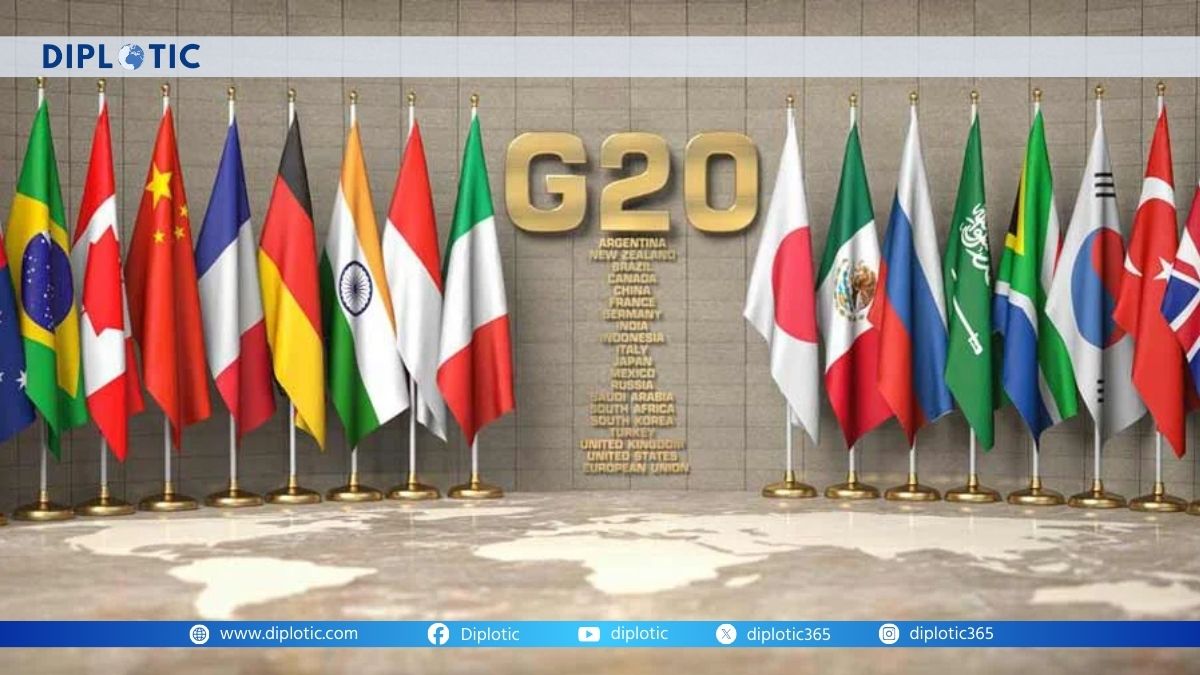
The G20 traces its roots to the late 1990s Asian financial crisis, when major economies realized existing forums like the G7—comprising only advanced democracies—lacked representation from emerging powers. Launched in 1999 as a meeting of finance ministers and central bankers, it included nineteen countries plus the European Union: Argentina, Australia, Brazil, Canada, China, France, Germany, India, Indonesia, Italy, Japan, Mexico, Russia, Saudi Arabia, South Africa, South Korea, Turkey, the UK, and the US. Spain is a permanent guest, and hosts invite others.
Elevated to leaders’ level in 2008 amid the global meltdown, the G20 shone brightest then. Coordinated stimulus worth trillions, banking reforms, and the Financial Stability Board creation averted deeper recession. Analysts hailed it as rescuing a “system in free fall.” Over time, the agenda widened: health (COVID vaccines), climate (methane curbs), and security (Iran’s nuclear program, Syria ceasefire).
Key expansions include the African Union’s 2023 admission, adding 55 nations and $3.1 trillion in GDP. Unlike the UN or WTO, the G20 has no headquarters or binding treaties—decisions rely on consensus and voluntary implementation. It operates via two tracks: finance (ministers, bankers) and sherpa (advisors shaping summits). Dozens of working groups feed into the annual leaders’ meeting, with IMF, World Bank, and WTO input.
This structure allows flexibility but breeds fragility. Early cohesion—shared crisis response—gave way to divergence as emerging economies gained weight. G20’s inclusivity edges out G7’s shrinking share (now under 40% of GDP), making it the “best-suited” for global challenges, per experts. Yet without enforcement, outcomes often stay declarative.
————————————————————
Membership and Mechanics: Who Sets the Table Each Year
The core nineteen plus EU and AU form a diverse bloc: democracies alongside autocracies, North and South, exporters and importers. This mix reflects shifting power—China and India now economic giants, Saudi Arabia energy pivot. Annual rotation of presidency shapes priorities: India’s 2023 focused debt and food security; Brazil’s 2024 bridged to COP30 climate talks; South Africa’s 2025 emphasized multilateral reform and low-income debt.
Hosts invite guests—South Africa added regional voices—and chair yearlong preparations. Summits culminate negotiations, but sidelines often steal spotlight: Biden-Xi Bali talks, India-Middle East corridor launch. 2025’s absences dimmed this, with Rubio skipping foreign ministers over “anti-American” tones.
U.S. 2026 presidency signals change: Trump plans smaller guest lists, no broad ministerials, narrower agenda—potentially sidelining Global South issues. This informal setup—consensus-driven, no legal bite—enables candid talk but hampers follow-through. As geopolitical analysts note, a “G-Zero” world of ad hoc coalitions increasingly overshadows coordinated leadership.
————————————————————
Persistent Fault Lines: From Trade Wars to Climate Stalemates
Geopolitics tops tensions. Russia’s Ukraine war split members: G7 sanctions versus BRICS neutrality. Putin skips summits amid ICC warrant; Xi absences signal disengagement. Israel-Hamas conflict further divides.
Economic strains hit hardest in the Global South. Post-pandemic inflation, Ukraine-driven food/energy spikes, and strong dollar worsened debt—half of 150 developing nations at risk. G20’s 2020 Common Framework aided few; 2025 calls for reforms yielded little.
Trade frays WTO commitments. Trump’s 2025 reciprocal tariffs—10% baseline, up to 50% on some—sparked retaliation fears, echoing his first-term wars. Climate lags: phasedowns without phaseouts, reneged fossil pledges post-Ukraine. Trump’s fossil fuel push widens gaps.
These divides—advanced vs. emerging, West vs. rest—slow progress on AI governance, health equity, corruption. Yet the forum endures as the most representative, bridging voices absent elsewhere.
————————————————————
Conclusion: Relevance in an Era of Rivalry
The G20’s 2025 Johannesburg summit, historic yet hollowed by absences, mirrors a forum at crossroads. Once a crisis savior, it now navigates a multipolar mess where consensus is scarce. South Africa’s solidarity push spotlighted debt and equality, but limited deliverables underscore limits. As Trump readies a pared-down 2026 U.S. hosting, sidelining expansive talks, the group’s broad appeal risks narrowing.
Still, its strength lies in inclusivity: no other table seats China beside the U.S., India with Russia, Africa collectively. In a fragmented world, the G20 offers rare space for dialogue—even if outcomes underwhelm. Its future hinges on adapting: perhaps refocusing core finance while sidelining intractable geopolitics. For now, it remains the closest to a steering committee for global economy—imperfect, indispensable, ever-tested by the tides of power.




