A Viral Myth Unraveled
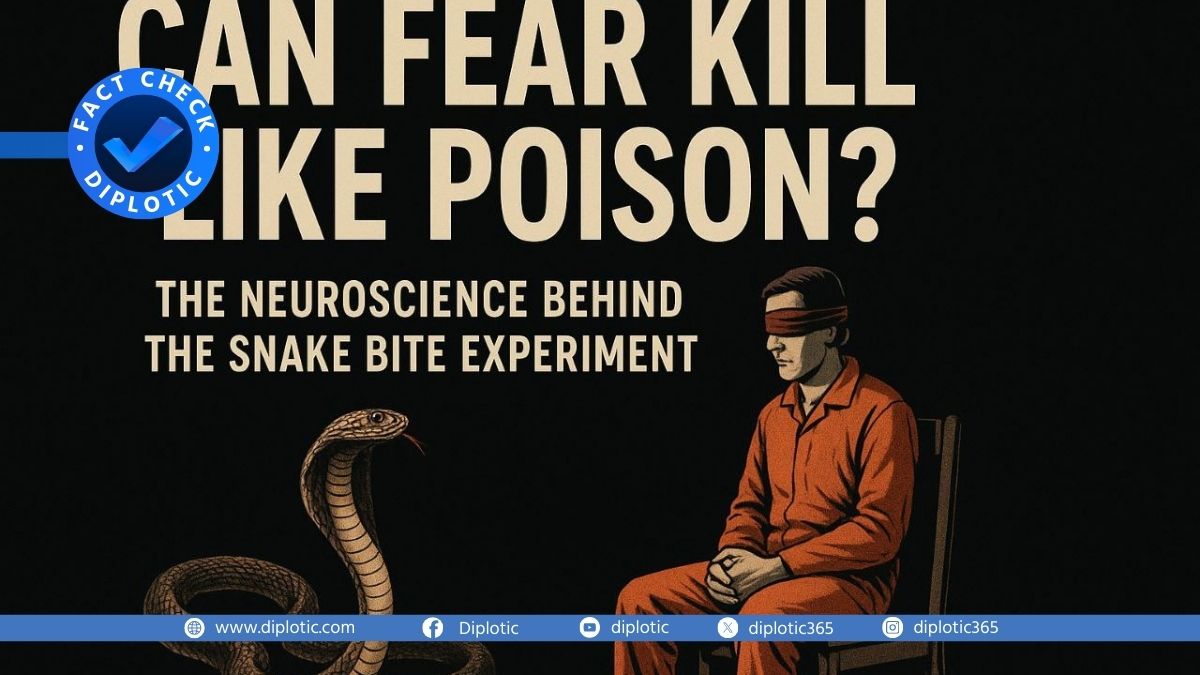
Over the last few years, there has been a strange story going viral on social media again, particularly in South Asia. The so-called “Boston Snake Experiment” of 1986. According to the viral myth, an American death row prisoner was told that he would be killed by snakebite. What actually happened was that they pricked him with a needle and led him to believe that he had been bitten. He died later after a few hours, and scientists purportedly found snake venom in his blood.
The story is offered as evidence that the human brain can “create poison” under extreme fear. But how much is fact and how much is legend? To determine this, we must look at both the history behind this claim as well as what neuroscience really says about fear, stress, and so-called “nocebo effect.”
Claim 1: The 1986 Boston Snake Experiment
Investigation
Massachusetts abolished the death penalty in 1984. The state’s Supreme Judicial Court ruled capital punishment unconstitutional in Commonwealth v. Colon-Cruz (1984), and a vetoed attempt to reinstate it in 1986 failed.
Even before abolition, the last execution in Massachusetts occurred in 1947, when Philip Bellino and Edward Gertson were electrocuted.
Since then, no legal execution has taken place. Federal death sentences can occur for federal crimes, but this still doesn’t support any bizarre “cobra venom experiment.”
Verdict: The claim is entirely false. In a state where capital punishment had long been abolished, this sensational experiment never took place.
Claim 2: Can Belief Alone Cause Death?
While the experiment itself is fictional, this part of the claim is true. Fear and belief can kill.
Here enters the nocebo effect- the shadow twin of the placebo effect. Placebo shows how optimistic expectation can cure. Nocebo shows how pessimistic expectation can hurt, sometimes to death.
Medical literature describes cases in which fear or belief produced fatal physiological reactions.
- “Voodoo death” reports (Walter Cannon, 1942): In some cultures, individuals who believed they had been cursed or poisoned would faint and perish, and no poisons were detected. Autonomic nervous system overload and stress hormones were suspected perpetrators.
- Cardiac arrest from acute fear: In accidents or natural disasters, sudden adrenaline and cortisol surges can cause arrhythmias or cardiac failure.
- Clinical misdiagnosis instances: The misinformed patients would sometimes collapse quickly even where there was no deadly disease present.
Thus, belief and fear can actually kill, though through cardiovascular collapse and not poison production.
Verdict: Partially True. Fear does kill, but certainly not through snake venom production.
Claim 3: Snake Venom in the Blood?
This is where the story breaks down completely. Snake venom is a complex mix of proteins and enzymes that vary according to snake species. These compounds cannot be synthesized by human cells.
Neuroscience shows that fear triggers:
- Stress hormones (cortisol, adrenaline, norepinephrine)
- Neurotransmitters (glutamate, dopamine, serotonin imbalances)
- Physiological responses (rapid heart rate, blood pressure spikes, oxidative stress)
None of these remotely resemble snake venom. There is no known biochemical pathway for the human brain, or any mammalian system, to synthesize phospholipase A2, metalloproteinases, or neurotoxic peptides found in actual venom.
Even stressed, the body produces toxic byproducts like reactive oxygen species (ROS) or misfolded proteins, but these are not venoms.
Verdict: False. Human biology cannot produce snake venom.
Explaining the Myth
The best explanation is that the story is a modern myth, blending elements of real psychological science with fabricated drama. It’s a warning tale about the power of fear, but it distorts the science to make it more sensational.
The real phenomenon at work is the nocebo effect, when pessimistic expectations are the source of real physiological harm. Neuroscience can confirm this through the following mechanisms:
- Hyperactivation of the amygdala (fear center of the brain).
- Overactivation of the sympathetic nervous system (‘fight-or-flight’ response).
- Excessive release of stress hormones, causing cardiac stress.
- Suppression of the immune system in chronic fear or trauma.
These together can lead to collapse or even immediate death. But none need snake venom production.
Verdict: The Boston snake experiment never took place.
Belief and terror can be fatal, but through stress-induced physiological breakdown—quite aside from the production of venom.
Snake venom in the blood of humans without the snake bite is a biological impossibility.
The viral rumor merges a grain of truth (nocebo effect) with fabrication (production of venom) to provide a plausible but false account.
Conclusion
The story of the “Boston snake experiment” is a myth and not a scientific truth. Yet it testifies to something profoundly true: the human ability to control the body with the mind. Fear can alter heart rates, dampen immunity, and even kill. But it cannot generate venom in snakes.