

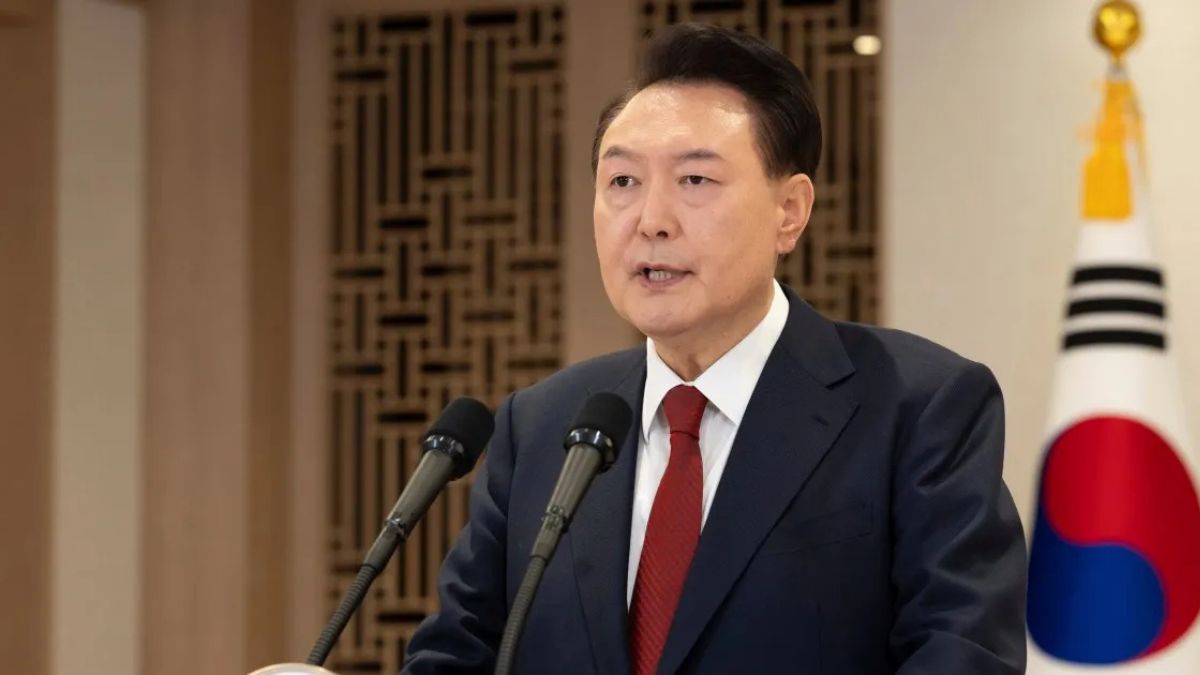
South Korea’s democracy faces a critical test as President Yoon Suk Yeol is arrested for insurrection. Explore how political extremism, populist tribalism, and Cold War ideologies threaten the country’s democratic future.
On the cold morning of January 15, 2025, the tranquil skyline above Seoul’s presidential compound was pierced by a surreal scene: police in riot gear scaling barricades of buses and razor wire, finally arresting South Korean President Yoon Suk Yeol after a weeks-long standoff. The former prosecutor-turned-politician, once hailed as a guardian of justice, had barricaded himself in his hilltop residence following a failed attempt to impose martial law. His arrest, unprecedented in the country’s modern history, marks a political earthquake—but the deeper tremors lie in what it reveals about the country’s deteriorating democratic fabric.
This crisis was not created overnight. Rather, it is the culmination of years of ideological polarization, authoritarian nostalgia, and institutional decay, all unfolding against the backdrop of regional instability and global political flux. Yoon’s downfall is dramatic, but the real story is how close South Korea came to democratic collapse—and why it may not be out of the woods yet.
The Martial Law and Its Aftermath
The immediate trigger of the crisis was Yoon’s abrupt and shocking declaration of martial law in December 2024. Justifying the move by accusing the opposition-dominated National Assembly of paralyzing governance, Yoon claimed it was necessary to restore order. His critics saw a naked power grab.
The opposition swiftly moved to impeach him, and the courts suspended his authority. Still protected by the Presidential Security Service, Yoon remained holed up in the Blue House-like residence, vowing to “fight to the end.” His eventual arrest on January 15, following a failed earlier attempt by investigators, brought a temporary sense of legal closure—but no political consensus.
Yoon was indicted on January 26 for leading an insurrection, a charge that could carry a life sentence or even the death penalty. His trial will be a first in South Korean history: a sitting president, tried for attempting to usurp the democratic process through military force.
Echoes of Trumpism: Evangelicals, Misinformation, and a New Korean Right
Yoon’s base—composed largely of evangelicals, anti-communists, and young men disenchanted with feminism and liberal elites—didn’t vanish with his arrest. Outside his detention center, crowds gathered daily to pray for his release, wave Korean and American flags, and chant “Stop the Steal” in Korean, referencing a viral conspiracy theory that the 2024 parliamentary elections were rigged in favor of the Democratic Party (DP).
The resemblance to Donald Trump’s political style and movement is not coincidental. As political scientist Shin Gi-wook noted, “You can call it Trumpism in Korea.” From the use of religious nationalism to the weaponization of online misinformation, Yoon built a reactionary populist coalition that sees liberal democracy as an existential threat rather than a political system.
The so-called “men’s rights” movement also played a key role in Yoon’s 2022 victory. Nearly 60% of men aged 18–29 voted for him, in part due to his pledge to abolish the Ministry of Gender Equality. Although blocked by the opposition, the symbolic message was clear: Yoon cast himself as a defender of “traditional” values against liberal overreach.
Cold War Shadows and the Left-Right Culture War
South Korea’s political divide is rooted in history—specifically, the unresolved legacy of the Cold War and authoritarianism. The right, including Yoon’s People Power Party (PPP), continues to frame itself as a bulwark against communism, often equating the progressive DP with pro-North Korean sympathies. The left, meanwhile, maintains deep grievances against historical Japanese colonialism, conservative repression, and U.S.-backed dictatorships.
Darcie Draudt-Véjares of the Carnegie Endowment observed that South Korea’s current polarization “relies on a contest left over from the Cold War.” This framework allows each side to claim moral authority: the right defends the state from communism; the left defends the people from tyranny.
But what makes this cycle especially dangerous today is the amplifying effect of digital platforms. South Korea is among the most online countries globally, and misinformation spreads rapidly through YouTube, TikTok, and KakaoTalk. Conspiracy-driven echo chambers have become the new battleground for ideological control, often bypassing traditional journalism altogether.
Democracy in a Revenge Loop: A Crisis of Leadership and Law
If South Korean democracy is cracking, part of the reason lies in the institutional pattern of prosecutorial revenge. Since 2000, every president except Moon Jae-in has faced indictment, imprisonment, or suicide post-tenure:
- Roh Moo-hyun (2003–2008): Died by suicide after corruption allegations.
- Lee Myung-bak (2008–2013): Sentenced to 17 years in prison, pardoned by Yoon.
- Park Geun-hye (2013–2017): Impeached and jailed; Yoon was a lead prosecutor.
- Moon Jae-in (2017–2022): Named as a suspect in a bribery probe in 2024.
This has bred a toxic cycle: leaders fight to stay in power not for policy, but for survival. Yoon’s decision to attempt martial law now appears in this light—not as an isolated power grab, but as a desperate move to avoid post-office persecution.
Even his nemesis, DP leader Lee Jae-myung, faces his own legal drama. Already convicted of making false claims during the 2022 campaign and facing multiple corruption investigations, Lee could be disqualified from office if the Supreme Court upholds his conviction. The timing is crucial—if Yoon is removed first, Lee can likely run and win a new election. If Lee is disqualified first, the right maintains its hold.
Economic Precarity and Strategic Volatility
While politics burns, South Korea’s economy is on the brink. With the won at its weakest since 2008, a housing market in crisis, and youth unemployment surging, the economic fallout from the political chaos is already being felt. The country also holds the world’s lowest fertility rate, fueling demographic collapse and generational resentment.
Externally, tensions are worsening. North Korea has declared the South a “hostile state” and claims to have tested hypersonic missiles in January 2025. Yoon’s alignment with the U.S.—including indirect arms support for Ukraine and reconciliation with Japan—could be undone by a DP government that favors more balanced relations with Beijing and Pyongyang.
A return of Donald Trump in the U.S. would only add volatility. Under Trump’s first term, Seoul faced pressure to quadruple its payments for hosting U.S. troops. That debate is likely to return—especially if South Korea’s next leader is seen as less loyal to Washington.
What’s Next: Courts, Chaos, or Correction?
The coming months will be critical. Yoon awaits criminal trial, as well as a Constitutional Court ruling on whether to uphold his impeachment and officially remove him from office. Meanwhile, the Supreme Court’s decision on Lee could dramatically alter the electoral landscape.
The question isn’t just who will win—it’s whether either side will accept defeat. As Shin Gi-wook warned, “I don’t think either side will accept a decision they don’t like… they will challenge it, and they will fight.”
For now, South Korean democracy is holding—barely. The arrest of Yoon, the resistance to martial law, and the institutional procedures for impeachment show signs of resilience. But democracy requires more than process—it requires public trust.
And with each scandal, each conspiracy theory, and each betrayal of democratic norms, that trust is eroding.




