

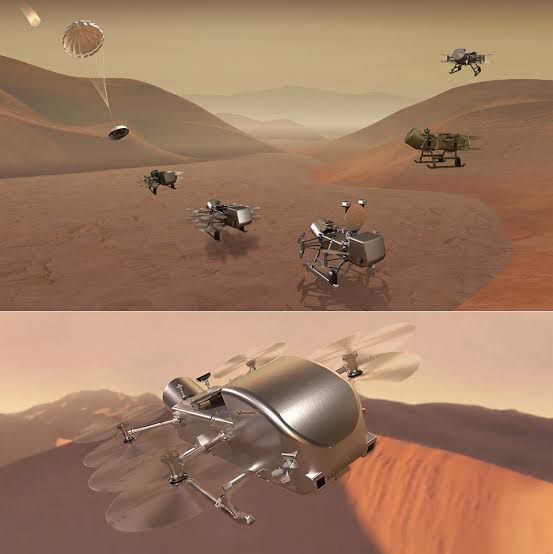
Imagine a helicopter the size of a car, powered by a nuclear heart, soaring through the thick, hazy skies of a distant moon. That’s NASA’s Dragonfly, a bold dream one step closer to reality. On April 24, 2025, NASA shared thrilling news: Dragonfly passed its Critical Design Review (CDR), a make-or-break moment that proves its plans are rock-solid. This milestone means the team can roll up their sleeves and start building the spacecraft that will journey to Saturn’s massive moon Titan, hunting for clues about life beyond Earth. It’s a $3.35 billion gamble, but the chance to explore a world as wild and mysterious as Titan? Worth it.

From Blueprint to Reality: Building a Cosmic Explorer
At the Johns Hopkins Applied Physics Laboratory (APL) in Maryland, a team led by the passionate Elizabeth “Zibi” Turtle is pouring their hearts into Dragonfly. This isn’t just any spacecraft—it’s an eight-rotor, nuclear-powered beast designed to fly through Titan’s soupy atmosphere, something we’ve never done before. Passing the CDR is like getting an A+ on the toughest exam ever. It means every detail, from the rotors to the science gear, is ready to go from paper to metal. “We’re thrilled,” NASA said in a statement. “Now we can focus on building the real thing.”
The Dragonfly idea was born in 2019 when NASA picked it for its New Frontiers program, a lineup of missions tackling the solar system’s weirdest, most wonderful places. Titan, Saturn’s biggest moon, is a total rockstar. It’s bigger than Mercury, with a foggy atmosphere thicker than Earth’s, hiding methane lakes, organic dunes, and maybe even a hidden ocean of liquid water. Scientists are obsessed because Titan might be a time capsule of the chemistry that kickstarted life on Earth—or could spark it somewhere else. Dragonfly’s job? Fly around, sniff out those clues, and tell us if Titan’s got the stuff for alien life.
Bumps in the Road: The Human Side of a Big Dream
Getting here wasn’t easy. Dragonfly’s budget has ballooned to $3.35 billion, and delays have pushed the launch to 2028. Building a machine to survive Titan’s bone-chilling -290°F (-179°C) weather is no joke. The team had late nights, endless coffee, and moments of doubt, but their grit kept them going. Titan’s just too special to give up on. It’s got rivers and lakes (of methane, not water), dunes made of organic goo, and that possible underground ocean. It’s like Earth’s weird cousin, and studying it could crack open secrets about how life begins.
The CDR win feels like a group hug for the team. It’s proof their crazy ideas—like a nuclear-powered chopper that can hop across the moon—can work. Next up, they’ll build Dragonfly’s power source, a gadget called a Multi-Mission Radioisotope Thermoelectric Generator (MMRTG), which will keep it humming in Titan’s faint sunlight. Unlike a Mars rover stuck crawling, Dragonfly will fly, landing in new spots to poke around Titan’s surface over a three-year adventure.
The Big Trip: A Seven-Year Trek to Titan
Picture this: July 2028, NASA’s Kennedy Space Center in Florida. A SpaceX Falcon Heavy rocket launches a Dragonfly into space as it commences its interstellar voyage. Reaching Titan requires Dragonfly to travel through space for almost seven years before finally arriving. Following the multiday flight Dragonfly will enter Titan’s atmosphere before conducting its descent through the atmosphere and delivery to the planet’s surface for investigation of this strange yet both unfamiliar and foreign world. Dragonfly will leap to different locations including dunes and icy plains to acquire photos and debris samples along with examining organic molecules that could indicate existence.
Dragonfly’s got a toolbox packed with cameras, sensors, and samplers to study Titan’s air, dirt, and maybe even that hidden ocean. The team wants to know: Could microbes survive here? What kind of chemistry is cooking on this moon? Every data point Dragonfly sends back will be like a postcard from the edge of the solar system, helping us piece together the puzzle of life’s origins.
Why Titan Steals Our Hearts


Titan’s not just another moon—it’s a vibe. It’s the only known moon with a real atmosphere, thicker than ours, and it’s got lakes, rivers, and rain (methane, not water). Under its icy crust, scientists think there’s a salty ocean, maybe like the ones hiding life in Earth’s deep seas. Back in 2005, NASA’s Cassini mission dropped the Huygens probe onto Titan, and the photos blew our minds. Dragonfly’s ready to take it to the next level, flying around to see what Huygens couldn’t.
A Dream Worth Chasing
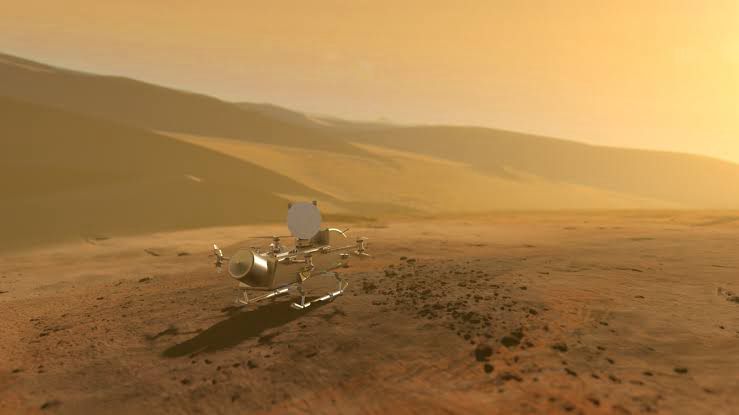
Dragonfly’s more than a machine—it’s a bunch of humans daring to ask big questions. Could life exist out there? What makes a planet or moon a home for it? As the team starts building, they’re not just assembling parts—they’re crafting a legacy. When Dragonfly touches down on Titan, it could change how we see our place in the universe. For now, the countdown to 2028 is on, and we’re all rooting for this little chopper to make history.




